























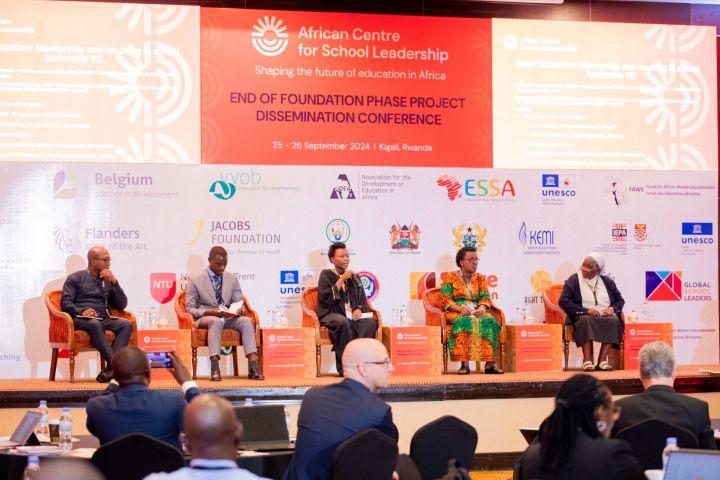


Education professionals from eight African countries have developed proposals for strengthening school leadership through approaches rooted in African values, community participation and local experiences.
The initiative followed a five-day workshop held in Kigali, Rwanda, from October 26 to 30, which brought together 17 participants from Ghana, Kenya, Liberia, Malawi, Rwanda, Sierra Leone, Tanzania and Uganda.

The workshop was organised under the Blended Exchange and Learning Trajectory (BELT) programme of the African Centre for School Leadership (ACSL), as part of efforts to improve leadership development and professional support for school administrators across the continent.
Discussions focused on how African values and cultural practices, including Ubuntu, collective responsibility, ethical leadership, community participation and mentorship, could be incorporated into school management and leadership development.


Participants also examined Rwanda’s community-based development practices, including Itorero, a civic education initiative; Umuganda, a community service programme; and Imihigo, a performance accountability framework.

As part of the programme, participants visited GS Rosa Mystica and GS Mpushi, two inclusive schools in Kamonyi District, where they observed approaches to school management, teacher support, learner development and community engagement.
The visits provided practical examples of how school leadership could extend beyond administrative responsibilities to include parental involvement, teacher collaboration and partnerships with surrounding communities.
Participants also presented proposals addressing leadership challenges in their respective countries. Uganda introduced an Ubuntu School-Community Baraza Model designed to bring school leaders, teachers, parents and community members together to address challenges affecting schools.
Rwanda presented a mentoring and coaching approach, while Malawi focused on strengthening instructional leadership. Proposals from Ghana, Kenya, Liberia and Sierra Leone explored leadership induction, continuous professional development, peer learning, mentorship and community-led school improvement.
The final two days of the workshop were dedicated to peer reviews, during which participants assessed one another’s proposals and considered their feasibility, available resources and institutional support requirements.
Strategic Education Adviser at the African Centre for School Leadership, Jocelyne Kirezi, said she was encouraged by the participants’ engagement and commitment to developing leadership approaches that reflect African realities.
She expressed optimism that the proposals would translate into practical interventions in participating countries and generate lessons that could strengthen school leadership development across the continent.
The participants will continue the 16-week learning programme through a community of practice, where they are expected to share implementation experiences, assess progress and identify approaches that could be adopted by other African education systems.
The initiative highlights growing efforts across Africa to strengthen school leadership as a key component of improving teaching quality, school management and learning outcomes.
Source: African Centre for School Leadership.













 EduTimes Africa, a product of Education Times Africa, is a magazine publication that aims to lend its support to close the yawning gap in Africa's educational development.