



















































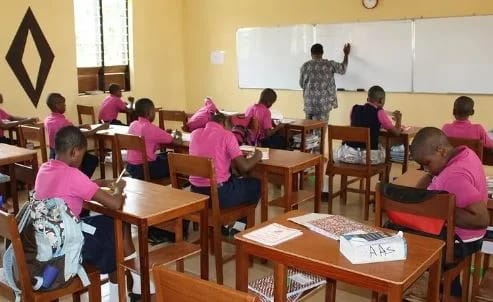


For many students in public schools, unstable internet is not just an inconvenience — it is a daily barrier to learning.
That could begin to change.
The Federal Government plans to connect 38,803 public schools to broadband internet under a $500 million World Bank–backed programme designed to expand digital access in underserved parts of Nigeria.
Another 16,872 health facilities are also included in the rollout, bringing the total number of targeted public institutions to 55,675 by September 2030.

The initiative, known as the Building Resilient Digital Infrastructure for Growth (BRIDGE) project, was approved by the World Bank Board in October 2025.
It aims to expand the inclusive use of broadband internet in selected unserved and underserved areas across the country.
For students, the impact goes beyond faster browsing.
Reliable broadband could mean smoother access to online classes, research materials, digital libraries, CBT exams, scholarship applications and virtual internships — opportunities that increasingly define academic success.
According to the World Bank’s Implementation Status and Results Report, total broadband-connected public facilities are expected to rise from 33,628 in September 2025 to 59,103 by the end of the project.
This figure includes 3,428 local government administration offices, up from a baseline of 510.
The infrastructure target is ambitious: 90,000 kilometres of fibre-optic network to be deployed nationwide, with 90 per cent designed to be climate-resilient.
If achieved, wholesale broadband prices are projected to drop by 20 per cent, while median fixed broadband speeds are expected to increase from 22.15 Mbps to 50 Mbps.
For students who struggle with buffering during virtual lectures or spend heavily on mobile data, those numbers matter.
The report also projects that the number of Nigerians using broadband internet will increase from 92.01 million in April 2025 to 150 million by 2030.
Youth broadband users are expected to grow from 57.96 million to 100 million within the same period.
Female broadband users are projected to rise from 30.36 million to 45 million.
Beyond infrastructure, the programme includes digital literacy training for 37,000 Nigerians, with 60 per cent expected to be women.
The fibre deployment will be handled through a Special Purpose Vehicle (SPV) — an independent, majority privately owned company created specifically for the nationwide rollout.
The Federal Government will participate through the Ministry of Finance Incorporated, but its shareholding will be capped at 49 per cent, ensuring the company remains majority privately managed.
While no private capital had been mobilised as of December 2025, the structure is expected to attract up to $1.1 billion in private investment by September 2030.
Financial records show that the $500 million International Development Association (IDA) loan tied to the project had not yet been disbursed as of January 2026, as the facility was still awaiting effectiveness.
However, the Project Implementation Unit has been staffed, and preparatory activities have commenced, with key procurements underway and implementation expected to begin in early 2026.
The World Bank rated overall progress towards achieving the project’s development objective as satisfactory, though it noted substantial risks linked to political, fiduciary, environmental and institutional capacity challenges.
Earlier reports also indicated that $460 million — about 92 per cent of the loan — will be used to capitalise the new fibre infrastructure company, while the remaining $40 million will fund goods, consulting services, training, operational costs and project preparation expenses.
For students, this is not just a policy document.
It is about whether a public secondary school in a rural community can run digital lessons without interruption..
It is about whether a university undergraduate can complete online research without depending on expensive private data plans.
And in a country where digital access often determines opportunity, broadband connectivity may quietly become one of the most powerful tools in shaping who gets ahead by 2030.











 EduTimes Africa, a product of Education Times Africa, is a magazine publication that aims to lend its support to close the yawning gap in Africa's educational development.