




















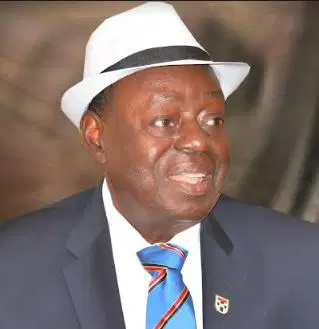


Legal luminary and founder of Afe Babalola University, Ado-Ekiti (ABUAD), Aare Afe Babalola, has raised alarm over the growing number of illegal and substandard private universities operating in Nigeria. He urged the National Universities Commission (NUC) to overhaul its accreditation processes and shut down institutions that fall short of acceptable standards.



Speaking in Ado-Ekiti while receiving the Medical and Dental Council of Nigeria (MDCN) accreditation team, Babalola said Nigeria must not tolerate inferior education systems if it hopes to develop sustainably.

Babalola, who established ABUAD as a non-profit institution, lamented that despite massive private investment in quality infrastructure — including the university’s multi-system teaching hospital, industrial research park, and world-class academic facilities — the institution has never received any significant endowment from individuals or government.
“ABUAD is a non-profit private university where nobody has shares. Whatever extra money made is ploughed back into the university,” he said. “The valuation of the university today is over ₦300 billion. When you go around, you will see the hospital, the farm, the industrial park, the colleges and the serene campus.”


Citing World Bank standards, he emphasised that a true university must deliver quality teaching, impactful research and community service — areas in which he said ABUAD continues to excel.
Babalola accused the NUC of relaxing its earlier rigorous approval process, which once required thorough inspection of permanent sites, staff strength and infrastructure before granting licences. He stressed that the proliferation of illegal universities poses a threat to national development and should be met with strict enforcement, including arrests of operators.
“This country deserves the best and should therefore not tolerate substandard education,” he said. “What makes a man, and indeed a country, is quality and functional education.”
He called for stronger support for credible private universities, noting that no government can single-handedly fund education for all citizens. He urged wealthy Nigerians and philanthropists to invest in quality institutions that prioritise community development, youth empowerment and ethical training.

Earlier, the Vice-Chancellor of ABUAD, Professor Smaranda Olarinde, described the MDCN visit as a crucial stage in the ongoing accreditation of the university’s Bachelor of Medicine, Bachelor of Surgery (MBBS) programme.
Highlighting the institution’s rapid progress since launching its medical programme in 2011, she noted that ABUAD secured full accreditation within three years — an uncommon feat in Nigeria. She said the university has since produced seven cohorts of doctors trained under a competency-based curriculum supported by cutting-edge facilities at the ABUAD Multi-System Teaching Hospital and the Federal Teaching Hospital, Ido-Ekiti.
Olarinde assured the MDCN team of complete transparency during the accreditation exercise, describing it as an opportunity to further strengthen the university’s systems and raise standards.









 EduTimes Africa, a product of Education Times Africa, is a magazine publication that aims to lend its support to close the yawning gap in Africa's educational development.