





















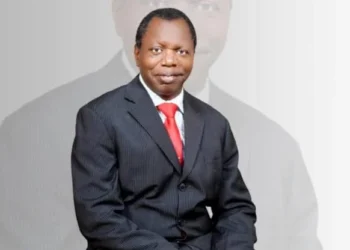
Dr Jubril Adewale Tinubu (CON), Group Chief Executive Officer, Oando Plc., a sub-Saharan African foremost indigenous energy group, says the essence of nation-building is to allow failure to be an acceptable concept, noting that citizens must learn from their failures and hitherto, get it right.

According to him, there is the need for citizens to imbibe the culture of patriotism by refraining from condemning the country at every slightest opportunity.

Tinubu who began his professional career in 1990 as a legal practitioner, and subsequently distinguished himself as a serial entrepreneur with a proven reputation for building resilient energy companies and institutions, said this in an interview with in Lagos.
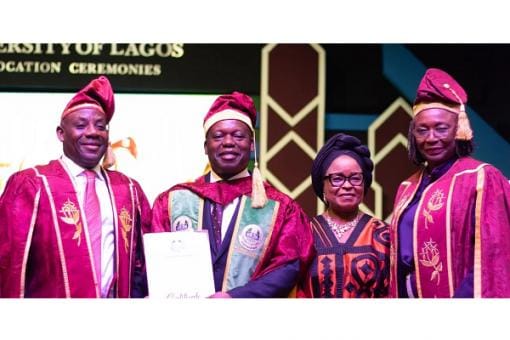
Recall that Dr Tinubu was at the 56th Convocation of the University of Lagos (UNILAG) conferred with an honorary doctorate degree in Business.
The award is in recognition of his contributions to enterprise-building, energy sector transformation and national development.

“We learn from our failures, and we get it right. We stop condemning the country and believing the country cannot go right. The country can go right and it goes right by, us as a people, collectively moving in one direction.
“It is very important, that is the theme of my message today,” he said.
Speaking further, the business mogul whose energy group has a primary listing on the Nigerian Stock Exchange and a cross-border listing on the Johannesburg Stock Exchange and fondly known as J.A.T., noted that the only way one could be successful was to dare to take risks, adding that a lot of people were scared of failing.
He added: “They simply don’t try and accordingly, they never succeed.
“Think about the nations that have gone to the moon. You can imagine how many times they tried, before they made it to the moon. People have climbed Mount Everest; it doesn’t matter how many times they tried.
Dr Tinubu, who in 2021, founded Oando Clean Energy Limited to design and deliver sustainable energy projects toward the realisation of the nation’s energy requirements and the United Nations race to net zero, further identified the need for stronger collaboration between ‘the town and the gown’.
“I think there should be more public/private sector collaboration all the time in everything we do. particularly in the social services, health, as well as in education.
“There is so much that is being done privately in Nigeria, even in education. There are private universities and other tertiary institutions, but we also need to use the alumni.

“Ex-students who have done well, need to be tapped back into society; they need to be re-engaged to contribute to the development of these institutions as this is a continuous process of re-investing in what you have towards building a beneficial future,” he stated.
Meanwhile Dr Tinubu had, while speaking on behalf of other honorees at the just-concluded convocation of UNILAG, said that the gesture was a renewed call to more service.
According to him, as one of Nigeria’s first-generation universities established in 1962, UNILAG, occupies a unique place in the country’s history.
It was founded when the young Nigerian state understood that political independence alone was not enough for nationhood, and this country required world-class institutions of learning.
“We receive it not merely as a celebration of past achievements, but as a renewed call to service, a call that reflects the very purpose for which this university exists.
According to him, over the decades, the university of Lagos has been guided by the succession of visionary scholars and administrators.
He listed the scholars to include Prof. Eni Njoku, the first Vice Chancellor; Prof. Saburi Biobaku, a distinguished Historian and nation builder; Prof. Adebisi Omotola, an eminent legal scholar; immediate past vice-chancellor, Prof. Oluwatoyin Ogundipe; and the incumbent and first female vice-chancellor of Unilag, Prof. Folasade Ogunsola.
According to him, from UNILAG, have emerged men and women who have shaped Nigeria across public service, law, science, enterprise, medicine, the arts, and diplomacy.
He added that UNILAG had also become a hub of innovation and creativity, a growing centre for STEM, digital research, entrepreneurship, and the creative economy.
He said across the co-creation hubs, innovation laboratories, start-ups, through partnership, industry, technology and the private sector, UNILAG had become a launchpad for a new generation of problem solvers, advancing medical research, creating green technology and shaping Nigeria’s digital future.
The Oando boss noted that this evolution was not accidental but an outcome of a culture that insisted scholarship must serve society.
“UNILAG has never been content to produce credentials but has produced nation builders.
” It is therefore feasible that this institution once again places leadership at the centre of this convocation. At a time when Nigeria itself is being called to renew; that renewal itself is not abstract, as Nigeria stands at a defining turning point. Our nation is undergoing a necessary difficult transition.
“The reforms underway seek to stabilise the economy, restore confidence, unlock productivity, broaden opportunities, improve security, health and social welfare of this country. Reforms do not succeed by policy alone; they succeed when ideas shape action, and knowledge guides leadership; this is where the university becomes indispensable.
“Citadels of learning are not spectators to national challenge; they are drivers of it. They generate the ideas, train the innovators, test the evidence and nurture the ethical leadership that progress demands.
Tinubu said that countries doing well prioritised education, invested in it, and gave support to learning, particularly at the higher levels.
“It reminds us that the true measure of success is not how far we rise, but how much we lift others when we rise.
” Knowledge, like leadership, only fulfils its purpose when it is placed in the service of the common good, and I think it brings me to the point that was made by Chief Agabi, who repeatedly stated the merits that the society has.
“As we can see, what we hve done here today is witness a ceremony that has rewarded merit. It is extremely important, therefore, that merit be placed at the forefront of institution building, because there is no way we will get things wrong by doing so,” he said.
Born on June 25, 1967, Dr Tinubu completed his primary and secondary school education in Nigeria before proceeding to the University of Liverpool, England, where he earned a Bachelor of Laws (LLB) in 1988.
The oil and gas magnet subsequently obtained a Master of Laws, in international business law from the London School of Economics and was called to the Nigerian bar in 1990.
He began his professional career in 1990 as a legal practitioner and subsequently distinguished himself as a serial entrepreneur with a proven reputation for building resilient energy companies and institutions
“As a young man growing up in Lagos, I did not imagine I would one day build the global enterprises I built, or stand on a stage. What I grew up with was the belief that one could dream beyond our circumstances, build from scarcity and compete at the highest levels. Early in my career, as a young lawyer with no office, no corporate name and very little capital, I encountered the distress of all tankers stranded offshore faced, which most people saw as a problem.
“I saw it as a possibility with little more than conviction and negotiation. The single opportunity became the spark that ignited a much larger vision for me; that moment taught me a lesson that has guided every step of my life. ‘Do not wait for perfect conditions’.
“And I speak to our young graduates; the world is never placed where you want it, you have to move, you have to dare, you have to build as you proceed. Though Chief Agabi maintained the legal path with extraordinary success, while I ventured into business, our stories intersect into one common truth, that success is never handed to one; it is earned through conviction, courage and persistence. We have faced uncertainty, we have navigated, we have endured and we have learned not to merely survive these challenges, but to transform them into stepping stones,” he said
As a philanthropist and humanitarian, Dr Tinubu had led the drive to raise private sector awareness and funding for the humanitarian crisis in the northeast part of Nigeria, having hosted the 2018 launch of the Nigerian humanitarian fund private sector initiative, styled NHF PSI, and led a private sector delegation to a first-ever collective tour of two internationally displaced camps in Maiduguri, in Borno State.
Similarly, his passion to drive a sustainable basic educational system for the Nigerian child led to the creation of the Oando Foundation, which, through its signature programme; the ‘Adopt a School’ Initiative, had adopted 88 public primary schools nationwide, supported over 500,000 students, enrolled over 60,000 out of school children and trained over 5,000 teachers.
He also constructed 154 classrooms and sanitation facilities as well as established 39 digital learning centres.
As an astute business leader, he had raised over 4 billion dollars from international finance to fund various growth acquisitions and large-scale development projects across Africa and in 1993, co-founded Ocean and Oil Group, leading its evolution from an oil trading and shipping company into a fully diversified oil and gas company.
In 2000, Ocean and Oil acquired a controlling interest in UniPetrol PLC and two years later, he led the largest ever acquisition at the time, of a quoted Nigerian company with UniPetrol PLC’s purchase of Agip Nigeria PLC and later rebranded Oando PLC.
Mr. Tinubu is globally recognized for transforming Oando PLC from a petroleum marketing company into sub-Saharan Africa’s foremost integrated energy group. Under his leadership, Oando PLC marketing emerged as the nation’s leading distributor of petroleum products, with over 130,000 metric tons of storage capacity and more than 400 retail outlets nationwide.
In May 2023, OCEL, in conjunction with the Lagos state government, rolled out two electric mass transit buses in fulfilment of the proof-of-concept phase, with 552 buses to be secured by the end of 2027.
A respected global thought leader, the oil and gas business mogul played a prominent role in shaping Nigeria’s development agenda and advancing Africa’s presence on the global stage.
A member of the World Economic Forum’s oil and gas governors and a regular member of Nigeria’s delegation to the United Nations General Assembly, Dr Tinubu serves on the Presidential Committee on long-term funding and investments and is frequently consulted on matters of public policy, infrastructure and economic transformation.
He also co-chairs the US-Nigeria commercial investment dialogue and participates in high-level global climate and sustainable discussions.
Dr Tinubu was conferred with the national honour of Commander of the Order of the Niger, in October 2022.







 EduTimes Africa, a product of Education Times Africa, is a magazine publication that aims to lend its support to close the yawning gap in Africa's educational development.