




























































President Bola Ahmed Tinubu has signed the Electoral Act (Amendment) Bill 2026 into law, introducing key changes that will shape how future elections are conducted — especially ahead of 2027.
Here’s a breakdown of the seven major changes and what they mean:

1. Voter Registration Requirements Reduced
The law narrows acceptable documents for voter registration to just three:

Birth certificate
Nigerian passport
National Identification Number (NIN)
This move is aimed at streamlining registration and tightening identity verification.
2. Downloadable Voter Cards
Voters will now be able to download their voter cards directly from the website of the Independent National Electoral Commission (INEC).
This could reduce reliance on physical card collection and improve access for voters.
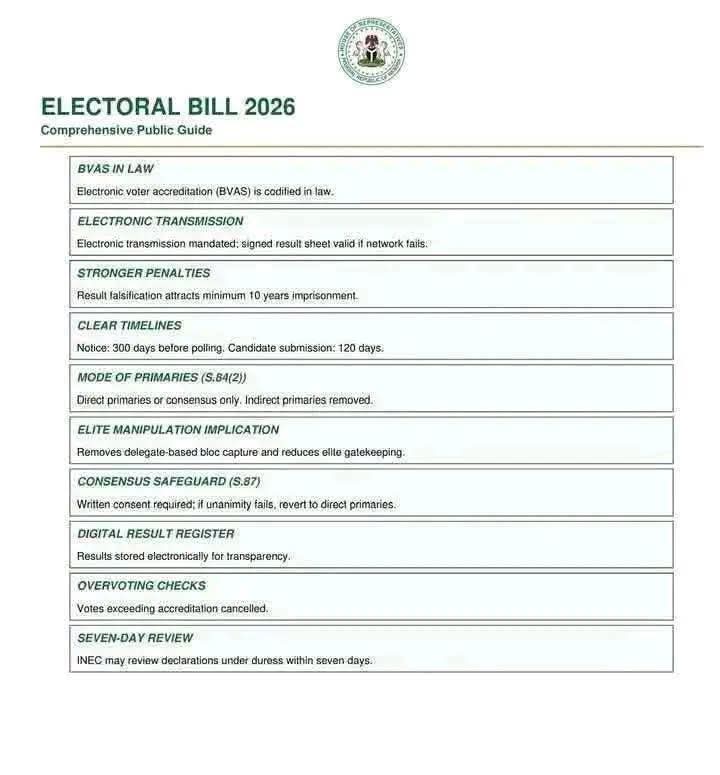
3. Electronic Transmission of Results is Now Compulsory
Electronic transmission of results to the INEC Result Viewing Portal (IReV) is mandatory.
However, there is a proviso in Section 60(3):
If network failure prevents electronic transmission, the physical result sheet (Form EC8A) becomes the primary source for collation and declaration.
This clause has drawn attention, as concerns remain about potential abuse in cases of “network failure.”
4. Party Primaries Limited to Two Options
Political parties can now nominate candidates only through:
Direct primaries
Consensus
Indirect primaries have been removed as an option.
5. Election Funds Timeline Adjusted
Funds for elections must now be released to INEC at least six months before a general election.
Previously, funds were to be released 12 months before.
6. Deadline for Submission of Candidates
Political parties must submit their list of candidates 120 days before election day.
Previously, this deadline was 180 days.
7. Publication of Final Candidate List
INEC must publish the final list of candidates 60 days before the election.
Previously, the timeline was 150 days.
What Happens Next?
With the law signed, attention now shifts to INEC and implementation.
Citizens and stakeholders are expected to monitor whether INEC:
Strictly complies with the new law and treats all parties fairly
Deploys technology effectively for accreditation and result transmission
Ensures timely logistics and distribution of materials
Protects the integrity of the voters’ register
Works with security agencies to guarantee peaceful elections
Uploads and publishes results promptly to boost transparency
Public Accountability and Oversight
The amendment also raises broader questions about:
Oversight of the proposed ₦873 billion election budget for 2027
Quality and functionality of BVAS machines
Software upgrades for BVAS and IReV systems
Possible partnerships with network providers to guarantee nationwide coverage across Nigeria’s 177,000 polling units
Citizens who are dissatisfied with any aspect of the law retain the right to challenge it in court, as legislation can be reviewed through judicial processes.
The Electoral Act Amendment 2026 marks a significant shift in Nigeria’s electoral framework. Whether it strengthens electoral integrity will depend largely on implementation, oversight, and civic engagement.
















 EduTimes Africa, a product of Education Times Africa, is a magazine publication that aims to lend its support to close the yawning gap in Africa's educational development.