

























































If you’ve ever done a “practical” without real equipment, you already understand why this matters.
Better laboratories could soon become a reality in tertiary institutions across Nigeria’s six geopolitical zones — and that could change how research and practical learning happen on campus.

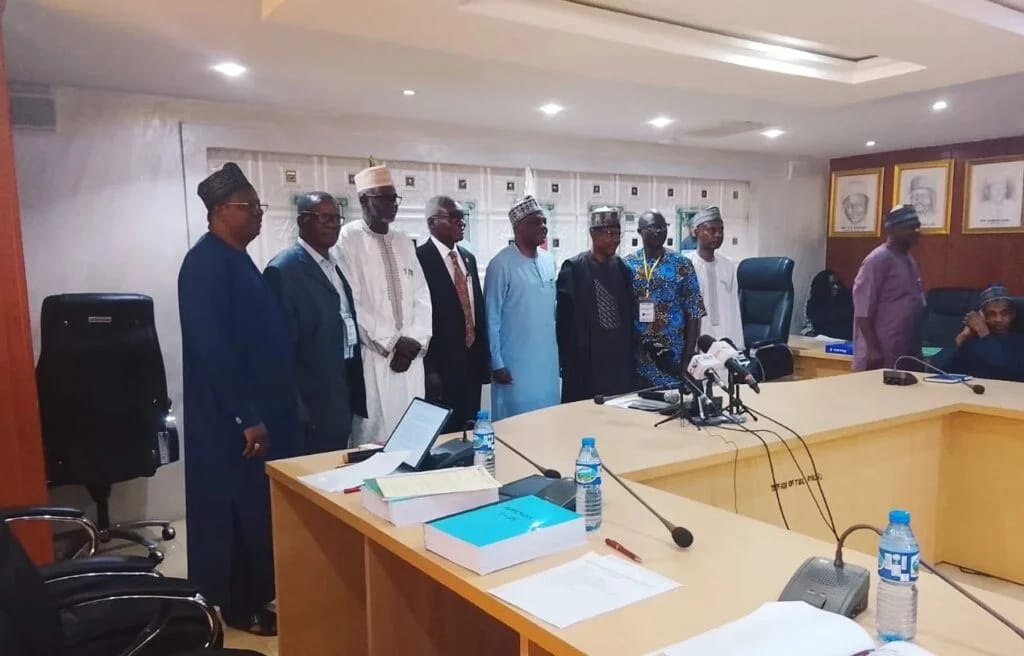
The Tertiary Education Trust Fund (TETFund) has inaugurated a seven-member advisory committee to drive the establishment and effective use of multipurpose laboratories nationwide.
The Executive Secretary of TETFund, Sonny Echono, inaugurated the committee in Abuja on Tuesday.

He gave the members one month to provide strategic guidance on the design, equipment specification, deployment, and sustainable management of the proposed laboratories.
According to Echono, the goal is simple but ambitious: maximum impact.
“Today’s event is part of the legacy of the present administration to build in this nation a research culture.
“It is also to support infrastructure that will help to transform our country from one of consumption to one that not only produces, but is able to compete with its peers across the globe,” he said.
In practical terms, this means reviewing and updating equipment lists to match current technology, especially in a world where tools become outdated quickly.
The committee’s assignment includes recommending cost-effective procurement options, reviewing equipment proposals, and advising on how the labs should be managed.
They are also expected to suggest ways to ensure long-term sustainability, encourage industry collaboration, and even explore revenue generation opportunities for the laboratories.
Echono stressed that rapid technological disruption makes constant updates necessary.
He noted that sustainable economic growth depends on innovative, solution-driven research — and that kind of research needs solid infrastructure.
Importantly, he assured that the laboratories would have alternative power supply systems to guarantee uninterrupted, round-the-clock research activities.
For students, that detail alone could be a game-changer.No more cancelled lab sessions because of power outages.
Responding on behalf of the committee, Chris Maiyaki, chairman of the advisory committee and former Acting Executive Secretary of the National Universities Commission (NUC), thanked TETFund for the trust placed in them.
“We do not take for granted the confidence and the trust that you have bestowed on us to contribute our own quota in the successful execution of this very important national assignment of historic significance,” he said.
Maiyaki added that members had studied the terms of reference and were ready to meet expectations.
He emphasised that modern, centralised laboratories would help bridge the gap between theoretical knowledge and practical application in higher education and research.
For many Nigerian students, that gap is real.
Lectures are plenty.
Hands-on exposure? Not always.
If properly implemented, these multipurpose labs could improve final-year projects, postgraduate research, innovation, and even startup ideas emerging from campuses.
The bigger question now is execution.
Will the labs be accessible?
Will they be properly maintained?
And will students actually feel the impact?
Because beyond policy announcements, what students really want is simple— facilities that work, opportunities to innovate, and an education that prepares them to compete globally.
















 EduTimes Africa, a product of Education Times Africa, is a magazine publication that aims to lend its support to close the yawning gap in Africa's educational development.