













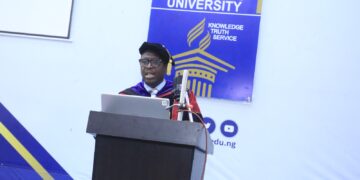











































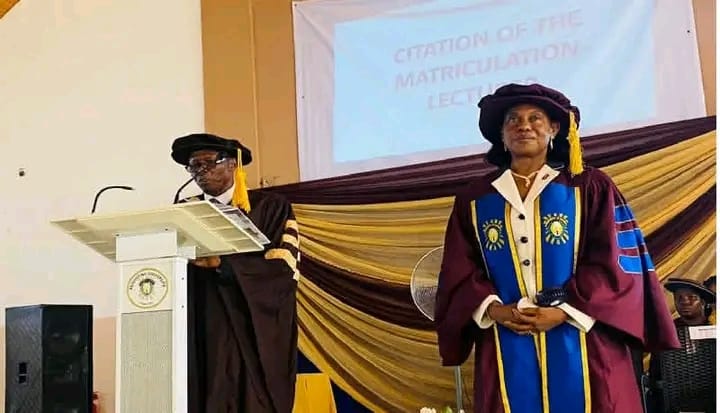


A Professor of Cellular and Molecular Parasitology, Roseangela Nwuba, has raised concern over the growing “school is a scam” narrative among young Nigerians, describing the trend as disturbing and misleading.
Nwuba made this observation while delivering the matriculation lecture at Augustine University, Ilara-Epe, Lagos State, where she noted that the slogan has gained traction on social media and even within university spaces, often fuelled by stories of individuals who attained success without completing tertiary education.
According to her, the narrative reflects deep-seated frustrations linked to unemployment, inequality and economic hardship in the country, but warned that it dangerously oversimplifies complex societal realities.
While acknowledging the challenges facing graduates, the professor said the claim that formal education is irrelevant promotes shortcuts to success at the expense of hard work, discipline, intellectual growth and character formation.

“Slogans are poor substitutes for truth,” she said, urging students to subject such claims to critical scrutiny, just as they would scientific assertions.
In her lecture titled “Beyond ‘School Is a Scam’: The True Value of Tertiary Education,” Nwuba rejected the idea that education is fraudulent or obsolete, stressing that learning goes beyond access to information.
Drawing from her background in parasitology, she explained that tertiary education provides structured understanding, intellectual discipline and moral formation.
Using scientific metaphors, she likened the university process to biological differentiation, noting that just as cells require regulation, time and structure to mature into functional units, the human intellect also needs mentorship, evaluation and progressive challenge to reach its full potential.
“Education is not a scam; it is differentiation,” she said, adding that lectures, assignments and assessments help build what she described as “intellectual immunity” against shallow thinking and poor judgment.
She also warned against the dangers of shortcuts, comparing them to parasitic systems that extract value without contributing, ultimately weakening the host.
According to her, societies thrive when citizens are trained to think critically, innovate responsibly and act ethically.
“Universities produce thinkers, not shortcuts; builders, not opportunists,” she said, urging students to see their years in school as a period of formation that would be tested by real-life challenges rather than ridiculed by popular slogans.
Earlier, the Vice-Chancellor of Augustine University, Prof. Anthony Akinwale, announced that 400 students were matriculated for the 2025/2026 academic session, describing the figure as the highest in the institution’s history.
He congratulated the students and their parents, while commending those who excelled academically and morally and were placed on the Vice-Chancellor’s and Dean’s Lists.
Akinwale reminded the students of the university’s motto, pro scientia et moribus (for knowledge and good character), stressing that education without ethics is incomplete.
“The purpose of education, rightly conceived, is to cultivate the intellect, form character and sharpen the technical skills needed to improve personal and societal life,” he said.
He emphasised critical thinking as central to the university’s mission and urged the students to remain focused, disciplined and committed to academic integrity.
The event was attended by members of the Governing Council and Senate, principal officers, academic and non-academic staff, parents, guardians and other stakeholders.













 EduTimes Africa, a product of Education Times Africa, is a magazine publication that aims to lend its support to close the yawning gap in Africa's educational development.