





















































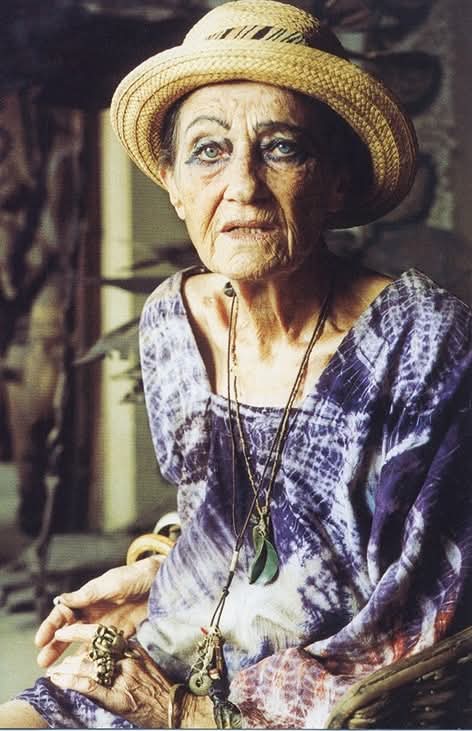


Suzanne Wenger, also known by her Yoruba name Adunni Olorisha (1915–2009), was an Austrian-born artist, sculptor and Yoruba high priestess whose life and work became inseparably linked with the spiritual and cultural revival of Osogbo, southwestern Nigeria. By the 1960s, she had emerged as one of the most influential figures in modern Nigerian art and traditional religious preservation.
Early Life and Artistic Formation

Wenger was born in Graz, Austria, in 1915. She studied art in Graz and Vienna, where she became associated with the Vienna Art Club, a progressive circle of artists experimenting with modernist and expressionist ideas. Her early exposure to avant-garde art shaped her lifelong interest in symbolism, spirituality and ritual.
Move to Nigeria and Cultural Immersion

In 1949, Suzanne Wenger married Ulli Beier, a German scholar, writer and cultural activist. In 1950, the couple moved to Nigeria after Beier accepted a teaching position at University College Ibadan. Their move coincided with a formative period in Nigeria’s cultural history, marked by artistic experimentation and a renewed interest in indigenous traditions.
After living in Ibadan, Wenger relocated to Ede, where her encounter with Yoruba culture became transformative. It was there she met Ajagemo, a powerful Obatala priest, who became her spiritual mentor. Through this relationship, Wenger was initiated into the Yoruba traditional religion and introduced to the world of the Orisha.
Spiritual Transformation and Personal Life
Following her initiation, Wenger fully embraced Yoruba spirituality, adopting the name Adunni Olorisha. She later separated from Ulli Beier and married a Yoruba drummer, Chief Ayansola Oniru Alarape, further deepening her integration into local life and religious practice.
Her spiritual commitment went beyond personal belief. Wenger viewed art as a sacred duty, inseparable from ritual and communal responsibility.
Artistic Legacy and the Osun–Osogbo Sacred Grove
Suzanne Wenger became a central figure in the revival of the Osun–Osogbo Sacred Grove, a forest shrine dedicated to the goddess Osun. At a time when the grove faced destruction from urban expansion and neglect, Wenger worked with local artists and devotees to restore and protect it.
Her work included:
Monumental cement and clay sculptures
Carvings and shrine reconstructions
Collaborative artworks rooted in Yoruba cosmology
These efforts formed part of what became known as the New Sacred Art Movement, which fused traditional religious symbolism with modern artistic expression.
In recognition of her work, the Osun Grove was declared a national monument in 1965, and in 2005, it was inscribed as a UNESCO World Heritage Site, due in part to Wenger’s decades-long advocacy and custodianship.
Later Years and Death
Suzanne Wenger lived the remainder of her life in Osogbo, serving as the chief custodian and high priestess of the Osun Sacred Grove. She died in 2009, leaving behind a legacy that bridged continents, cultures and belief systems.
Her life remains a powerful example of cultural exchange rooted in respect, devotion and long-term commitment rather than appropriation.
Historical Significance
Suzanne Wenger’s contributions are significant for:
Preserving one of Africa’s most important sacred landscapes
Advancing modern Nigerian art rooted in indigenous spirituality
Demonstrating the role of art as a tool for cultural survival
She remains one of the most remarkable foreign-born figures to have shaped Nigeria’s cultural and religious history.
Source
Biographical records of Suzanne Wenger (1915–2009)
Osun–Osogbo Sacred Grove documentation
Gallery One, Soho exhibition records (c. 1960)
UNESCO World Heritage inscription reports
Nigerian art and cultural history archives











 EduTimes Africa, a product of Education Times Africa, is a magazine publication that aims to lend its support to close the yawning gap in Africa's educational development.