





















































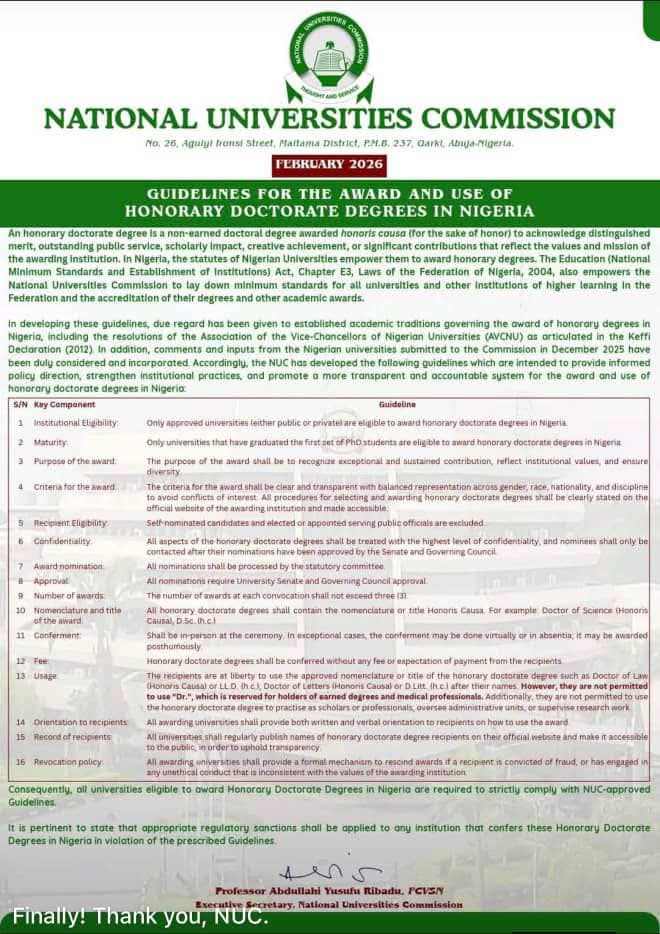
The National Universities Commission (NUC) has released comprehensive new guidelines regulating the award and use of honorary doctorate degrees in Nigeria.



In a directive dated February 2026, the Commission stated that the framework is designed to strengthen institutional standards, promote transparency, and ensure accountability in the conferment of honorary degrees across Nigerian universities.

According to the NUC, only approved public and private universities are eligible to award honorary doctorates. Furthermore, such institutions must have graduated at least one cohort of PhD students before they can confer honorary doctorate degrees.
The Commission clarified that honorary doctorates are non-earned awards conferred honoris causa (for the sake of honour) to recognise distinguished merit, outstanding public service, scholarly impact, creative achievement, or other significant contributions that reflect the values and mission of the awarding institution.

Key Provisions
Under the new guidelines:
Universities must establish clear and transparent criteria for the selection of recipients.
Self-nominated candidates and serving public officials are not eligible.
All nominations must be processed by statutory committees and approved by both the University Senate and Governing Council.
Institutions are limited to a maximum of three honorary doctorate awards per convocation ceremony.
The award must bear the designation “Honoris Causa”, such as Doctor of Science (DSc h.c.).


The NUC further emphasised that recipients of honorary doctorates are not permitted to use the title “Dr”, which is reserved for holders of earned academic degrees and medical practitioners. Additionally, recipients may not use the honorary degree for professional practice, administrative advancement, or research supervision.
Honorary doctorates must be conferred without any fee or expectation of payment from recipients.
Transparency and Sanctions
Universities are required to publish the names of recipients on their official websites to enhance public transparency. Institutions must also establish a formal mechanism for revoking awards where a recipient is convicted of fraud or engages in conduct inconsistent with the institution’s values.
The Commission warned that regulatory sanctions will be imposed on any institution that violates the prescribed guidelines.
The directive was signed by the Executive Secretary of the NUC, Professor Abdullahi Yusuf Ribadu, reaffirming the Commission’s commitment to restoring credibility and integrity to the honorary doctorate system in Nigeria.













 EduTimes Africa, a product of Education Times Africa, is a magazine publication that aims to lend its support to close the yawning gap in Africa's educational development.