
























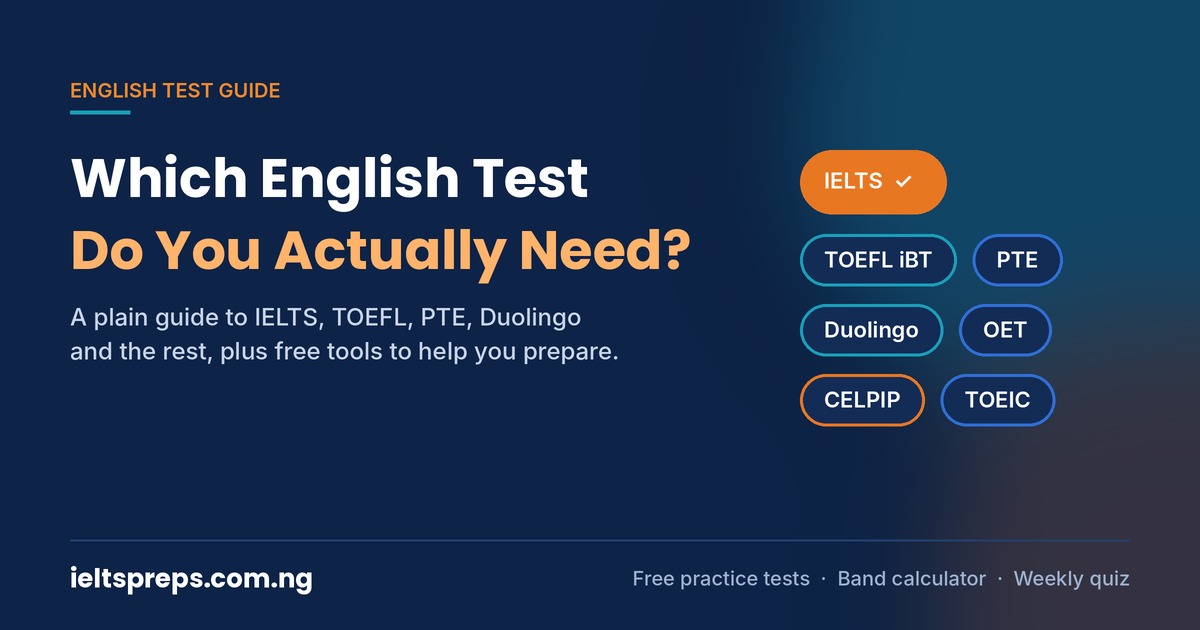


So, which test are you supposed to take?
Someone tells you to “just write IELTS.” A cousin abroad swears PTE is easier. A friend did Duolingo from his bedroom and got admitted. Then the school portal mentions TOEFL, and suddenly you’re three tabs deep wondering if you’ve been preparing for the wrong exam all along.

I’ve watched this confusion play out with candidates for years. And to be honest, it’s not your fault. There are now at least seven major English tests, each with its own score scale, its own format and its own list of people who will (or won’t) accept it.
Here’s the thing, though. The “best” test doesn’t really exist. The right test is simply the one your university, employer or immigration office asks for. Everything else is noise.

So let’s clear the noise. Below is a plain guide to the main tests, followed by four free tools that will help you check your requirement, understand your score and actually get ready.
The main English tests, in plain words
| Test | Mostly used for | How it’s scored | Roughly how long |
|---|---|---|---|
| IELTS (Academic, General Training, UKVI) | Study, work and migration in the UK, Canada, Australia, New Zealand and beyond | Bands 0 to 9 for each skill and overall | 2 hours 45 minutes |
| TOEFL iBT | Universities in the USA, Canada and elsewhere, scholarship bodies, some visa routes | Each section on a 1 to 6 scale (half levels allowed), with the familiar 0 to 120 also shown during the transition | 1.5 hours on a computer |
| PTE Academic | Study and migration to Australia, New Zealand and the UK | 10 to 90 overall and per skill, all marked by computer | 2 hours |
| Duolingo English Test | Admission at thousands of universities worldwide | 10 to 160 in steps of 5 | 1 hour, online, at home |
| CELPIP-General | Canadian permanent residence and citizenship | A level from M and 1 to 12 per skill | 3 hours in one sitting |
| OET | Nurses, doctors, pharmacists and other health workers registering abroad | A grade from A to E on a 0 to 500 scale | About 3 hours |
| TOEIC Listening & Reading | Jobs and promotions with airlines, hotels and multinationals | 10 to 990 in total | 2 hours, 200 multiple-choice questions |
A few things jump out when you see them side by side. TOEFL and Duolingo are adaptive, so questions get harder or easier depending on how you answer. PTE uses integrated tasks, which means one answer can count towards two skills at once. And OET is really only for healthcare professionals, so if you’re a nurse heading to the UK, it might genuinely suit you better than IELTS.
But IELTS is still the one that opens the most doors at the same time. Study, work, migration, professional registration. That’s why most people end up there, even after flirting with the others.
Step 1: Check what your destination actually asks for
This sounds obvious. It isn’t.
I’ve met candidates who spent months chasing a band 8 when their programme only needed a 6.5. I’ve also met the opposite, someone who sat the General Training test when their university wanted Academic. Painful. And expensive, because you pay for the test again.
Before you buy a single prep book, find out three things:
- Which test your university, employer or visa route accepts
- Which version (IELTS Academic, General Training or UKVI are not interchangeable)
- What score, both overall and per skill, because many institutions set a minimum for each section too
The IELTS Requirements Guide
The IELTS requirements guide on IELTS Preps lays all seven tests out side by side, with who uses each one, how it’s scored and how long it takes. It also breaks down which IELTS version fits which purpose.
How it helps you: instead of guessing, you start with clarity. You’ll know whether IELTS is even the right exam for your goal, and if it is, which version to register for. Ten minutes on that page can save you a wasted exam fee. Maybe more than one.
Step 2: Understand how your score is really worked out
IELTS scoring confuses almost everyone at first. You answer 40 questions in Listening and 40 in Reading, but you never see “32 out of 40” on your result. You see a band. Then your four bands get averaged and rounded to the nearest half band for your overall score.
That rounding matters more than people think. An average of 6.25 becomes 6.5. An average of 6.75 becomes 7. So sometimes one extra point in Speaking is the difference between “not quite” and “you’re in.”
Have you ever finished a practice test and had no idea what it meant? Yeah. Most of us.
The IELTS Band Calculator
The free IELTS band calculator turns your raw practice scores into estimated bands and shows you the overall score you’d likely get.
How it helps you: you stop practising blind. Plug in your numbers after each mock and you’ll see exactly how far you are from your target, and which skill is dragging your average down. It’s also a nice reality check. Sometimes you’re closer than you feel. Sometimes, well, not.
Step 3: Practise under real exam conditions
Knowing English and performing in an English exam are two different skills. I’ll say that again because it’s the hardest lesson for strong speakers to accept. Two different skills.
The exam rewards timing, stamina and familiarity with the format. Most IELTS centres now deliver the test on a computer, so if your only practice has been on paper, the real thing can feel strange. Scrolling through a reading passage. Typing your essay with a word counter ticking away. Listening while the next question is already on screen.
You don’t want exam day to be the first time you experience any of that.
Free IELTS Practice Tests
The free IELTS practice tests are built to look and work like the computer-delivered exam. You can take them as a full mock or one skill at a time:
- Full mock test: all four skills back-to-back, about 2 hours 45 minutes, timed like exam day
- Listening: four recordings, 40 questions, 30 minutes, with maps and plans included
- Reading: three passages, 40 questions, 60 minutes, with passage and questions side by side
- Writing: Task 1 and Task 2 in 60 minutes, with a word count and band feedback
- Speaking: practice for the face-to-face section too
How it helps you: you build the stamina and the screen habits before they count. All you need is a free account. And because your results stay on your dashboard, you can actually watch your scores move week by week, which is oddly motivating.
Step 4: Keep the habit going, a little every week
Here’s a confession. Full mock tests are great, but nobody does them every day. Life happens. Work, family, electricity, traffic.
What tends to work better is something small and regular that keeps your brain in “English exam mode” between the big practice sessions. Grammar and vocabulary are perfect for this, because they quietly support every single skill. Better linking words lift your Writing. A wider vocabulary helps your Reading and Speaking. It all connects.

The Weekly IELTS Quiz
The weekly IELTS quiz drops a fresh set of 15 quick questions every Monday, free. Each week has a theme (one recent edition focused on linking words and cohesion), there’s a timer to beat, and a leaderboard showing the week’s top scorers.
How it helps you: it’s twelve minutes, not two hours, so you’ll actually do it. Your results arrive by email with explanations, so you learn why an answer was right, not just that it was. And honestly? Seeing your name climb the leaderboard is a surprisingly good reason to show up next Monday.
Putting it together
If I had to squeeze this whole post into one plan, it would look something like this:
- Confirm your test, version and target score on the requirements page.
- Take one free practice test to see where you’re starting from.
- Run your results through the band calculator and spot your weakest skill.
- Do the weekly quiz every Monday while you work on that skill.
- Repeat the mock every few weeks and watch the gap close.
It’s not glamorous. But it works, and it costs you nothing to start.
Choosing an English test shouldn’t feel like guesswork. Once you know what’s required and where you stand, the path gets a lot less foggy. The rest is just showing up.

About the author: David Olufeagba is the founder of De-Brill Consults Ltd and has spent more than a decade examining and coaching IELTS candidates. His team runs IELTS Preps, offering free practice tests, structured coaching and trainer feedback for students in Nigeria and online.
Credit: De-Brill Consults Ltd











 EduTimes Africa, a product of Education Times Africa, is a magazine publication that aims to lend its support to close the yawning gap in Africa's educational development.