

























Across Africa, governments are investing in digital classrooms, online learning platforms and technology-driven teaching methods to improve access to quality education. However, the challenge is no longer simply getting computers into schools. It is ensuring that teachers can use the technology, learners can access digital resources and schools have the infrastructure to sustain these investments.
Initiatives in Nigeria and Kenya offer practical examples of how governments and education partners are attempting to address these challenges. From teacher training and digital learning platforms to virtual science laboratories and interactive classroom equipment, both countries are exploring ways to make technology more useful in everyday teaching.

Their experiences also highlight a critical question for African education policymakers: how can digital investment translate into better learning outcomes, particularly for children in underserved communities?
## Nigeria: Training teachers to make technology work

In Nigeria, limited access to learning resources, inadequate digital infrastructure and gaps in teachers’ digital skills remain significant barriers to technology-driven education.
Providing schools with devices alone does not guarantee improved learning. Teachers need to understand how to incorporate digital resources into lessons, while schools require reliable electricity, appropriate learning materials and technical support.
Enugu State is addressing part of this challenge through its SMART School Initiative, which combines investment in school infrastructure with teacher development.
According to UNICEF Nigeria’s report, *From Smart Schools to Smarter Learning: Enugu Teachers Gain Digital Skills to Transform Classrooms*, published on 3 September 2026, 600 teachers across 30 SMART Schools were receiving practical training in digital and pedagogical skills.
The training focuses on using smart boards and the Nigeria Learning Passport, a digital platform that provides learning resources for children and supports teachers’ professional development. Participants also include mentors and experiential learning innovators expected to help colleagues adopt the new approaches.
The programme involves the Enugu State Government, the State Universal Basic Education Board, the Federal Ministry of Education and UNICEF, with support from Microsoft and the Global Partnership for Education.
The approach addresses an important weakness in many technology programmes: the gap between purchasing equipment and using it effectively. By training teachers and creating a network of mentors, the initiative seeks to make digital learning part of regular classroom practice rather than an occasional activity.
UNICEF’s report stresses that teachers need the practical skills and confidence to use technology effectively. The initiative’s success will therefore depend on whether teachers continue receiving support after their initial training.
Read the original report: UNICEF Nigeria: From Smart Schools to Smarter Learning
The Learning Passport: Extending access beyond the classroom
Nigeria is also using digital learning platforms to expand access to educational resources, including for children who face barriers to conventional schooling.
In a joint announcement published on 10 September 2026, UNICEF and TECNO reported that the Nigeria Learning Passport had more than 2.45 million registered users. The programme recorded 471,189 new registered users over the preceding year, while its reported course completion rate increased from 69 per cent in the first year to 81.6 per cent in the second.
The partnership also reported that 2,300 teachers received specialised training during the year. In addition, 10 schools in remote areas of Osun and Kwara states received customised tablets and smart projectors. The implementation team also worked with schools on equipment management and maintenance.
The platform combines online and offline access, enabling learners to use educational resources even where internet connectivity is limited. Its content includes primary education and skills development, alongside professional development resources for teachers.
The initiative also seeks to address language barriers. According to UNICEF and TECNO, a blended learning handbook was distributed in Hausa, Igbo and Yoruba, while outreach activities in Enugu helped 1,888 out-of-school children gain access to the platform.
These developments demonstrate how digital learning can be adapted to local conditions rather than relying entirely on continuous internet access or English-language resources.
However, registration figures do not automatically indicate how many children are learning consistently or improving academically. Governments and partners need to measure active participation, completion across different learner groups and changes in literacy, numeracy and other learning outcomes.
They must also ensure that children without personal devices, electricity or suitable study spaces are not excluded from the benefits of digital education.
Read the original report: UNICEF Nigeria and TECNO: Learning Passport Reaches More Than 2.45 Million Registered Users
Kenya: Taking digital learning into public schools
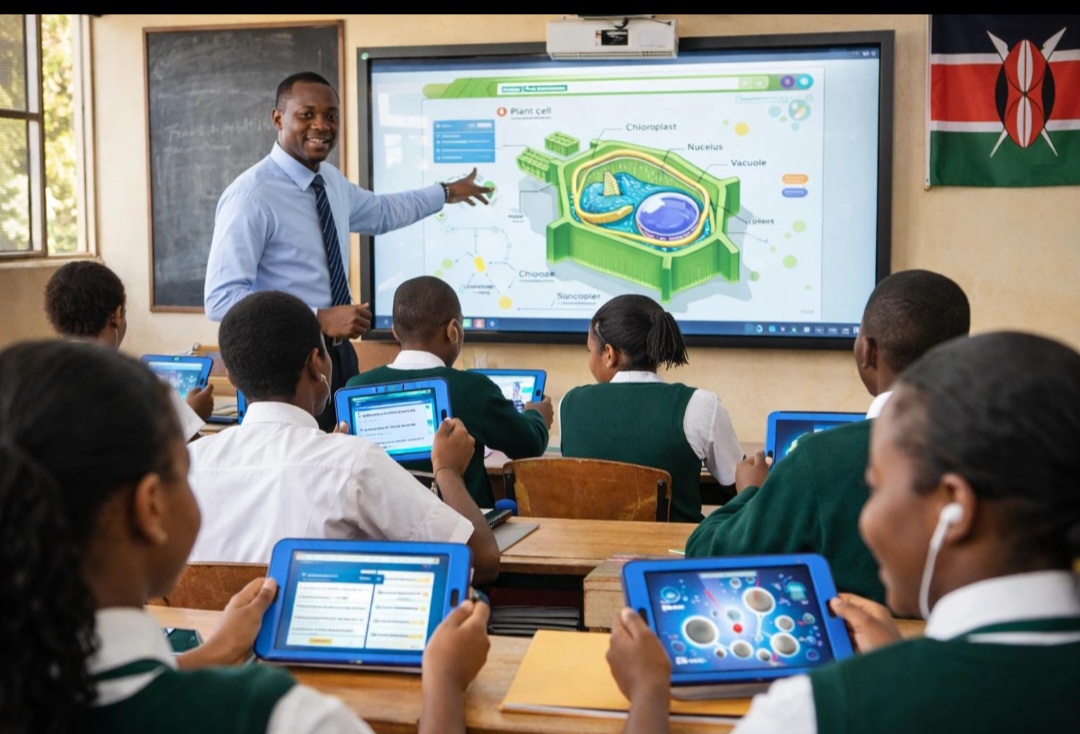
Kenya is pursuing a complementary approach by combining digital classroom infrastructure with teacher training and curriculum-aligned resources.

On 14 October 2026, Kenya’s Ministry of Information, Communications and the Digital Economy reported a national digital classroom demonstration led by President William Ruto at Kiminini Junior Secondary School in Trans Nzoia County.
The initiative, implemented under the Kenya Digital Economy Acceleration Project with World Bank financing through the International Development Association, is designed to connect classrooms and enable teachers and learners in different locations to interact in real time.
The government reported that 10,382 public junior schools had been equipped under the first phase, with each receiving an interactive smart board and a laptop. More than 64,000 teachers had also been trained through a national programme covering all 47 counties.
Digital learning content for Grades 7 and 8 had been developed and made available through the education cloud, while content for Grade 9 was being prepared. The government also reported that Grade 7 materials had been adapted for learners with visual and hearing impairments.
Procurement for the second phase had begun, with a target of approximately 21,000 additional schools by April 2027.
The programme is significant because it combines equipment, teacher development, curriculum resources and national connectivity. It also recognises that learners in remote areas should have access to educational opportunities comparable to those available in better-connected communities.
Nevertheless, the rollout will require continued funding for maintenance, replacement of damaged equipment, electricity, connectivity and technical support. The availability of digital content must also be matched by regular classroom use and effective teaching.
Read the original government report: Kenya’s Ministry of ICT: Connecting Classrooms Nationwide Through Interactive Digital Smartboards
## Virtual laboratories: A solution where physical facilities are limited
Beyond interactive boards, Kenya is exploring how digital simulations can make practical science education more accessible.
The Centre for Mathematics, Science and Technology Education in Africa (CEMASTEA), working with the Ministry of Education, has introduced virtual laboratory training for junior school teachers. The initiative responds to research conducted with the ministry that identified shortages of functional laboratory facilities in schools.
In June 2026, the Kenya News Agency reported that 240 county trainers had completed a three-day programme on using virtual laboratories to teach science, technology, engineering and mathematics (STEM) subjects.

The trainers were expected to support the rollout to approximately 7,000 junior school teachers, with further peer-to-peer training intended to extend the programme’s reach.
The virtual laboratories enable learners to conduct simulated experiments, observe scientific processes and explore concepts that may otherwise be difficult to teach without physical apparatus. The platforms can be accessed online and offline through compatible devices, helping to address connectivity challenges.
This is particularly relevant to schools that cannot immediately afford fully equipped science laboratories.
For example, learners can use simulations to explore scientific processes before carrying out physical experiments where facilities are available. Teachers can also use digital demonstrations to explain concepts that are difficult to visualise through textbooks alone.
However, virtual laboratories should complement rather than permanently replace physical practical work where experiments require direct handling of equipment, observation of real materials or the development of laboratory safety skills.
The programme will be more effective if schools have access to suitable devices, teachers receive continuing support and digital activities are aligned with the curriculum and assessment requirements.
Read the original report: Kenya News Agency: CEMASTEA Trains Teachers on Virtual Labs for STEM Learning Enhancement
What African governments can learn from these initiatives
Nigeria and Kenya demonstrate that digital education requires more than the purchase of equipment. Their programmes point to several practical solutions that other African education systems can adapt.
1. Invest in teachers alongside technology
Every major investment in digital classrooms should include practical teacher training, follow-up support and opportunities for educators to share knowledge. School-based mentors can help colleagues solve everyday problems and make technology use more consistent.
2. Develop offline and locally relevant resources
Internet connectivity remains unreliable in many communities. Downloadable lessons, offline learning platforms and materials in relevant local languages can help learners access content without depending on continuous connectivity.
3. Use technology to address specific shortages
Virtual laboratories can support science teaching where physical facilities are limited. Digital libraries can expand access to reading materials, while interactive boards can support demonstrations and collaborative lessons. Governments should select technology based on identifiable educational needs rather than purchasing devices simply to appear innovative.
4. Plan for maintenance and long-term funding
Governments and partners should budget for electricity, connectivity, repairs, replacement equipment and technical support from the beginning. Schools also need clear procedures for managing devices and reporting faults.
5. Measure learning, not just equipment distribution
The number of devices delivered, teachers trained or learners registered is useful for monitoring implementation, but it does not establish that education quality has improved.
Education authorities should publish data on actual classroom use, learner participation, course completion, teacher confidence and progress in literacy, numeracy and STEM skills. Where possible, they should compare outcomes before and after implementation and examine differences between rural and urban schools.
6. Make digital education inclusive
Programmes should account for learners with disabilities, children from low-income households and pupils in communities with limited electricity or connectivity. Accessible content, offline resources, shared school devices and targeted support can help prevent digital investment from widening existing inequalities.
The next step: Turning access into learning outcomes
Nigeria’s Learning Passport and Enugu SMART School Initiative, alongside Kenya’s national digital classroom rollout and virtual laboratory programme, show how technology can be integrated into broader efforts to improve education.
The initiatives differ in scale and design, but they share an important principle: digital resources become more valuable when teachers are trained, content is relevant and schools receive the support needed to use the technology consistently.
The next stage is to establish whether these investments are improving learning. Governments must move beyond reporting the distribution of devices and the number of people trained to demonstrate measurable benefits for children.
That requires transparent monitoring, sustained funding, independent evaluation and the willingness to adjust programmes when evidence shows that they are not working as intended.
For African education systems, the goal should not simply be to create smart schools. It should be to create schools where children learn more effectively, teachers are better supported and access to quality education does not depend on a learner’s location or family income.
Digital innovation can contribute to that goal, but its success will ultimately be judged by what happens in the classroom.
Sources














 EduTimes Africa, a product of Education Times Africa, is a magazine publication that aims to lend its support to close the yawning gap in Africa's educational development.