

























































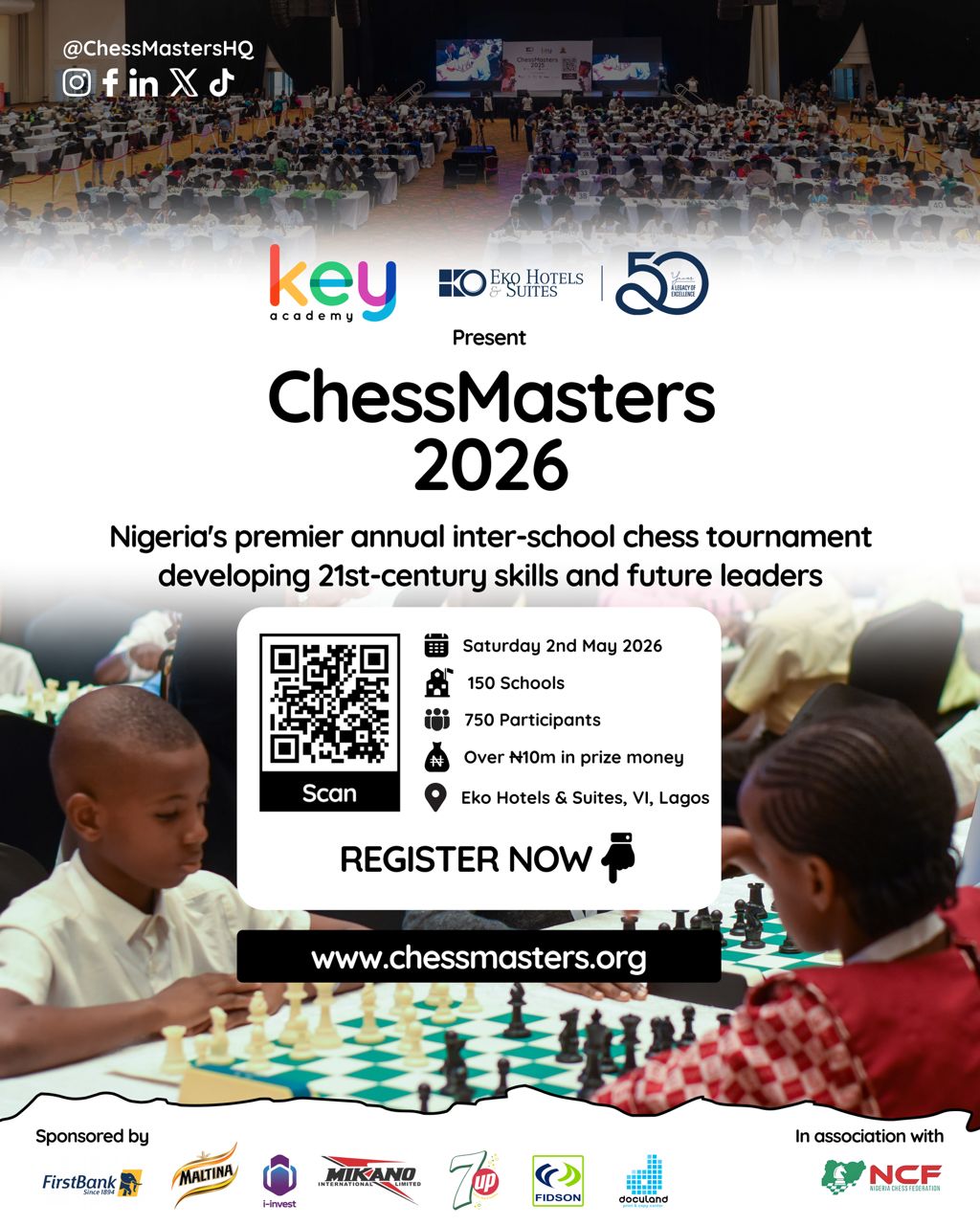


As conversations around the future of education continue to evolve, stakeholders are increasingly shifting focus from content-heavy curricula to skills-based learning. At the centre of this shift is ChessMasters 2026, an initiative positioning chess not merely as a game, but as a structured educational tool for developing critical thinking, decision-making, and resilience among students.
Scheduled to hold on May 2, 2026, in Lagos, the programme is a collaborative initiative between KEY Academy and Eko Hotel & Suites. Building on the success of its inaugural edition, which attracted over 500 students, this year’s tournament is set to expand significantly, with participation expected from 750 students across 150 schools.
Speaking on the vision behind the initiative, Damilola Okonkwo, Founder of KEY Academy, explained that ChessMasters is designed to go beyond competition. According to her, the platform offers students an opportunity to develop life skills that are essential in navigating an increasingly complex world.
“ChessMasters is more than a tournament. It is an opportunity for students to develop the critical thinking and decision-making skills they need for life. The goal is not simply to compete, but to cultivate problem-solvers who understand that their choices matter,” she said.
Also lending her voice, Caline Chagoury Moudaber, Director of Eko Hotel & Suites, framed the initiative within a broader educational context, emphasising the need to rethink how learning happens, especially in environments constrained by resources.
Education experts note that chess has gained global recognition as a practical and cost-effective tool for strengthening cognitive abilities such as attention, working memory, logical reasoning, and executive function. In classroom settings, it provides a structured environment where students can practice decision-making, reflect on consequences, and build resilience in the face of setbacks.
In the Nigerian context, where education systems must balance ambition with practical constraints, initiatives like ChessMasters demonstrate how relatively low-cost interventions can deliver meaningful impact. Rather than adding to existing pressures, chess-based learning can be integrated into current systems to improve engagement and strengthen foundational skills.
Importantly, advocates stress that chess is not a “silver bullet” for educational challenges. However, its adaptability makes it a valuable complement to traditional teaching methods, enhancing rather than replacing them.
The tournament will be held in partnership with the Nigerian Chess Federation, ensuring adherence to global standards of play. Corporate backing from organisations such as FirstBank, Maltina, i-invest, 7Up, Mikano, Fidson, and Doculand further underscores growing recognition of the initiative’s potential in shaping future-ready learners.
With over ₦10 million in prize money, ChessMasters 2026 is set to become one of the most significant scholastic chess competitions in Nigeria. However, organisers insist that its true value lies beyond incentives, focusing instead on the development of skills that prepare students for real-world challenges.
The theme for this year’s edition, “Your Move,” reflects this philosophy, placing responsibility on students to think critically, make informed decisions, and take ownership of outcomes.
As education systems continue to grapple with issues of quality, relevance, and equity, initiatives like ChessMasters offer a compelling case for innovation—demonstrating that meaningful learning can happen through simple, structured, and engaging tools like chess.














 EduTimes Africa, a product of Education Times Africa, is a magazine publication that aims to lend its support to close the yawning gap in Africa's educational development.