
























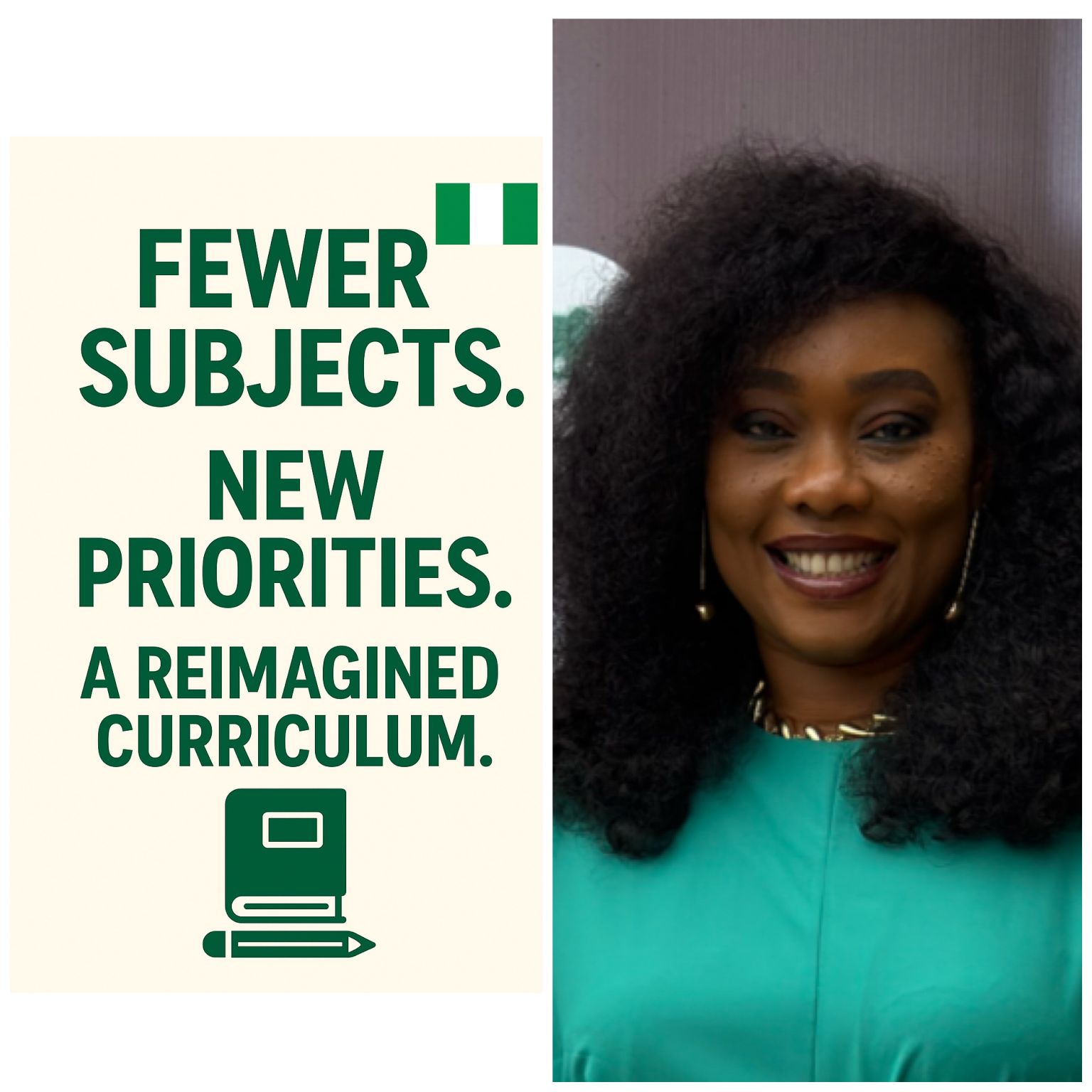





Education policy advocate, Rhoda Odigboh, has described the Federal Government’s newly unveiled national curriculum as “a step forward” but cautioned that reforms must go deeper than a reduction of subjects.

In her reflections shared on LinkedIn, Odigboh welcomed the streamlining of subjects at the primary and secondary levels, noting that children and teachers had long been overburdened.
“I have always frowned at the number of subjects our students were expected to take as our national benchmark. Taking away stand-alones and integrating subjects is progress,” she wrote. “In any case, there was never really any good-enough, evidence-based reason why some of them were.”

She also commended the addition of Digital Literacy and Trade Subjects, describing it as recognition of the world learners are growing into.
However, Odigboh stressed that genuine reform is not simply about adding or subtracting subjects, but ensuring resources, teacher training, and structures are aligned to produce real learning outcomes.
“Teachers need not only the curriculum content but also clear strategies for pedagogy, instructional methods, and assessment,” she said.


Raising concerns about overlooked areas, she questioned where Social Emotional Learning (SEL) and Financial Literacy sit within the new curriculum, calling them essential for preparing students for life in today’s Nigeria.
For Senior Secondary education, Odigboh argued that reforms should include multi-exit pathways supported by strong institutional systems and industry partnerships. She emphasised that government investment and ownership of the process would be key to success.
Highlighting a national learning crisis, she pointed to the large number of Nigerian students who cannot read, write, or perform simple arithmetic even at the secondary level. “This is a national emergency, a loud clarion call,” she warned, adding that streamlining subjects should create more room to address foundational literacy and numeracy.
“The test of this reform will not be the subject list,” she concluded. “It will be whether every Nigerian child leaves school with the knowledge, skills, attitudes and values to thrive in a fast-changing world.”












 EduTimes Africa, a product of Education Times Africa, is a magazine publication that aims to lend its support to close the yawning gap in Africa's educational development.