
























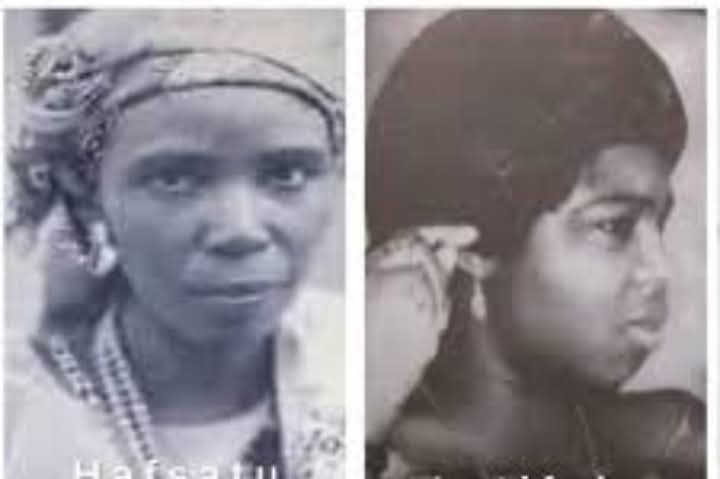


The first woman in the photograph is Hajia Hafsatu Bello, wife of Sir Ahmadu Bello, the Sardauna of Sokoto and Premier of the Northern Region.


As the Premier’s wife, Hafsatu Bello was renowned for her generosity and motherly care. She looked after many who passed through Government House in Kaduna, including Major Chukwuma Kaduna Nzeogwu, then head of the Officers Training College. Nzeogwu was treated as a son by the Sardauna.

On festive occasions such as Sallah, Hafsatu regularly sent food to Nzeogwu and his officers, ensuring they felt welcome and at home in Kaduna.
Yet, in the early hours of 15 January 1966, during Nigeria’s first military coup, Nzeogwu led soldiers to the Sardauna’s residence. There, he killed not only Sir Ahmadu Bello, but also Hajia Hafsatu Bello and Zurumi, the Premier’s loyal traditional bodyguard.

When the soldiers arrived, Hafsatu instinctively threw herself over her husband in a desperate attempt to shield him. Zurumi, armed only with his ceremonial sword, charged at the attackers. Both acts of courage were futile. All three were cut down by Nzeogwu’s bullets.
This came after Nzeogwu had earlier shot Sergeant Daramola Oyegoke, one of his own men, for refusing to fire at the Sardauna.
The second woman in the photograph is Mrs. Lateefat Ademulegun, wife of Brigadier Samuel Ademulegun, Commander of the 1st Division of the Nigerian Army, Kaduna.
In the same early hours of 15 January 1966, a group of young soldiers stormed the Ademulegun home and burst into the bedroom shared by the couple and their two children, Solape and Adegoke.
They were led by Major Timothy Onwuatuegwu, an officer of the Military Training College in Kaduna. Onwuatuegwu served directly under Brigadier Ademulegun and was regarded as a close family friend—almost like a son.
As the soldiers moved to kill him, Lateefat Ademulegun, eight months pregnant, pleaded desperately for her husband’s life and attempted to shield him with her body. Her cries, and those of her children, were ignored.

Onwuatuegwu shot both Brigadier Ademulegun and his wife in front of their children.
These two women—one from the North and one from the South West—chose to die beside their husbands rather than live without them.

Their final moments spoke of love, loyalty, courage, and unwavering commitment.
They remain a lasting testament to the dignity of womanhood and a tragic chapter in Nigeria’s history.
(FFK)












 EduTimes Africa, a product of Education Times Africa, is a magazine publication that aims to lend its support to close the yawning gap in Africa's educational development.