

























As your school grows, its operational footprint expands, enrollment surges, and community expectations multiply.



This reality becomes instructive!

In this context, one critical element must evolve alongside your growth: your leadership approach.
In the early days of a school, a manager or proprietor often wears every hat acting as head administrator, curriculum director, discipline master, and chief operations officer. However, leading a mature, thriving educational institution requires moving away from hands-on micro-management toward strategic, scalable governance.

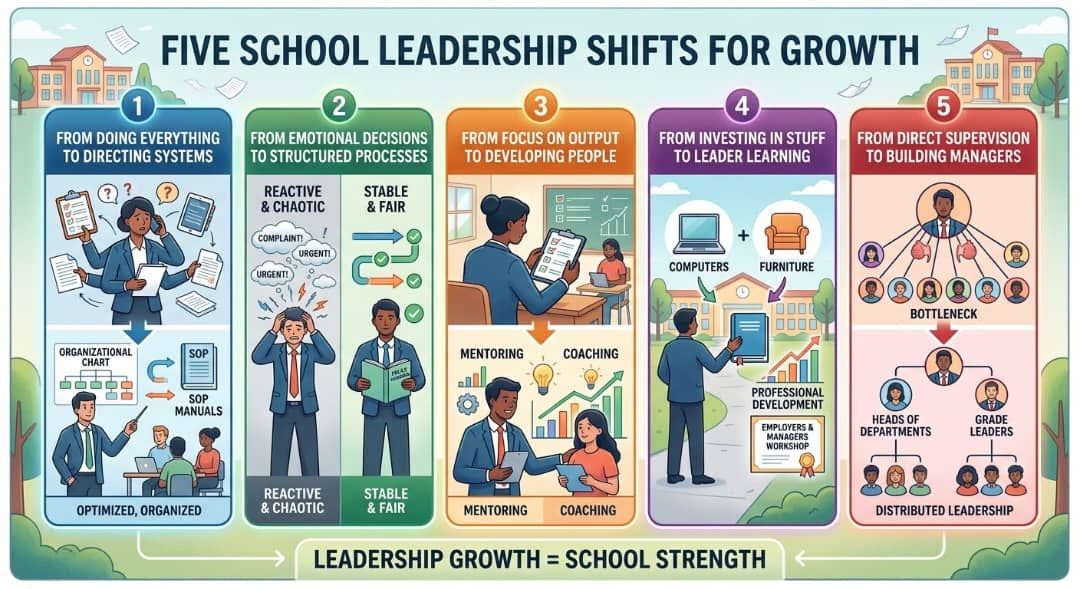
Let me show you 5 vital leadership shifts every school proprietor, administrator, and principal must make to achieve sustainable institutional growth.
1️⃣ Shift From Firefighting to Building Educational Systems:
In a school’s infant stages, leaders personally manage class scheduling, parent grievances, fee collection, and daily facility checks. Continuing this hands-on approach indefinitely turns the school leader into a structural bottleneck.
Mature school leaders shift their energy from executing daily tasks to designing repeatable, robust systems.
* Instead of personally handling every student discipline issue: Establish a clear, standardized behavioral framework and pastoral care protocol that empowers teachers and guidance counselors to resolve issues fairly.
* Instead of manually approving every lesson plan or parent communication: Implement centralized digital portals and standard operating procedures (SOPs) that ensure consistency across all departments.
2️⃣ Replace Reactive Decisions With Clear School Governance:
In many developing schools, administrative decisions are driven by immediate pressure, emotional reactions, or vocal complaints from parents or staff. When policies shift based on who complains loudest, institutional stability erodes.
Strong schools operate on transparent policies and well-defined governance frameworks rather than ad-hoc reactions.
* Establish clear academic handbooks, staff codes of conduct, and administrative guidelines that remain consistent regardless of circumstances.
* Structure protects fairness: when policies guide decisions, parents, faculty, and students understand expectations, building trust throughout the school community.
3️⃣ Prioritize Educator Development Over Immediate Output
A school cannot rise above the competence of its instructional and administrative team. Relying solely on the founder’s vision or a few star teachers creates single points of failure.
Modern educational leadership is less about directing traffic and more about cultivating talent within your system.
* Who among my teaching and administrative staff is expanding their instructional capability and taking on greater operational responsibility?
* Shift from merely evaluating teachers to actively mentoring them through peer observation, instructional coaching, and targeted pedagogical training. Raising high-performing educators strengthens the entire school ecosystem.
4️⃣ Invest Systematically in Educational Leadership Development:
Schools frequently invest in infrastructure, modern laboratories, tech devices, and marketing, yet overlook continuous professional development for their administrative leaders. This is why you need my book: 150 Professional Training Contents for Teachers.
Your personal leadership capacity dictates how effectively every school resource is utilized.

* Engage intentionally with professional school management networks, executive education workshops, and strategic leadership forums designed specifically for school leaders.
* Expanding your strategic, financial, and pedagogical leadership capacity directly correlates with institutional longevity and academic excellence.

5️⃣ Build a Layer of Capable Department Heads and Middle Managers:
As student enrollment increases, direct oversight of every classroom, department, and operational unit becomes impossible and counterproductive.
Identify and empower middle leaders such as Heads of Department (HODs), Vice Principals, and Grade-Level Supervisors to take ownership of specific domains.
* Distributing leadership responsibility does not mean creating bureaucratic friction; it means building a distributed leadership model where trusted professionals manage daily academic quality and student affairs.
* When operational responsibility is shared, institutional growth becomes manageable, sustainable, and resilient.
Key Takeaway for School Leaders
Schools scale only when their leaders evolve.
If student enrollment and school operations grow while administrative leadership remains centralized and reactive, operational friction is inevitable.
By building structured systems, empowering educators, and expanding your own leadership vision, you position your school to deliver lasting educational impact for generations to come.
Which of these five shifts is your school currently navigating, and what system can you implement this term to empower your team?
My name is Stephen Aremu I am an Education Strategist and School Growth Consultant. 08055266237
Credit: Stephen Aremu (School Managers Network)













 EduTimes Africa, a product of Education Times Africa, is a magazine publication that aims to lend its support to close the yawning gap in Africa's educational development.