























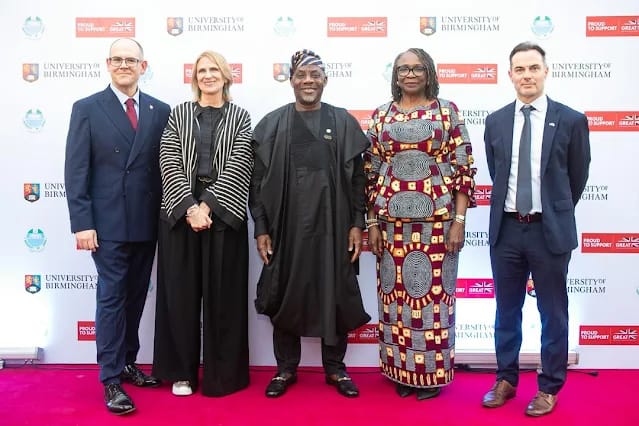


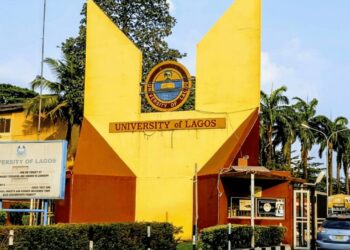
Minister of Education, Dr Maruf Tunji Alausa, has advanced the Federal Government’s drive to expand access to international-standard education with the launch of two joint postgraduate programmes between the University of Lagos (UNILAG) and the University of Birmingham, United Kingdom.

The programmes, an MSc in Artificial Intelligence and Data Technologies and an MA in Digital Media and Communications, are scheduled to commence in September 2027, offering Nigerian students opportunities to obtain internationally developed postgraduate education without travelling abroad.

Speaking at the launch, Alausa described the partnership as a landmark achievement for Nigeria’s education sector, saying it demonstrated the country’s growing ability to attract international academic collaborations and deliver globally competitive education locally.
“Today is a great day for Nigeria. We now have a country where we are daring to do big things. Today, we have transnational education in action, with one of the world’s leading universities partnering with one of Nigeria’s best universities to bring international-standard education to our country. This is a first for Nigeria and the beginning of many more to come,” the minister said.

He said the initiative aligns with the Nigerian Education Sector Renewal Initiative (NESRI), particularly its Education Quality Assurance pillar, and the Federal Government’s Transnational Education (TNE) Policy.
According to Alausa, the programmes were deliberately selected to address emerging skills needs in technology, innovation, entrepreneurship and digital communication.
The MSc in Artificial Intelligence and Data Technologies will cover machine learning, deep learning, computer vision, large language models, data management and AI ethics.
The MA in Digital Media and Communications will focus on digital cultures, research methods, content creation, broadcasting and contemporary media practices, preparing students for careers in journalism and the wider communications industry.
Alausa expressed confidence that the programmes would help produce graduates capable of establishing businesses, creating jobs and contributing to national development.
He also disclosed that plans were underway to expand the partnership to undergraduate degree programmes in other disciplines relevant to the labour market.

The minister linked the development to President Bola Ahmed Tinubu’s Renewed Hope Agenda, noting that the administration’s education reforms were intended to improve institutional quality, strengthen global competitiveness and position Nigeria as a destination for quality education and talent.
Professor Nick Vaughan-Williams, Provost of the University of Birmingham, said the institution was proud to partner with UNILAG, noting that the collaboration would support Nigeria’s higher education and talent-development needs.
He emphasised the role of universities in preparing graduates for changing global economies through skills development, entrepreneurship and employment opportunities.
UNILAG Vice-Chancellor, Professor Folasade T. Ogunsola, described the partnership as a significant step towards internationalising Nigerian higher education through mutual respect, shared responsibility and knowledge co-creation.
She said it would strengthen experiential learning, modernise curricula, improve the university’s global visibility and support research in emerging fields, including artificial intelligence and digital communications.
Jonny Baxter, British Deputy High Commissioner in Lagos, said the programmes reflected the strength of UK-Nigeria educational cooperation and a shared commitment to preparing young people for a rapidly changing economy.

He noted that developing expertise in artificial intelligence, data science and digital communications would promote innovation, expand opportunities and support sustainable economic growth.
Donna McGowan, Country Director of the British Council Nigeria, described transnational education as an important platform for knowledge exchange and skills development.
She said the collaboration would make high-quality UK education more accessible to Nigerian students while helping build the talent needed to drive national growth and prosperity.
The launch follows the signing of a Memorandum of Understanding between the University of Birmingham and UNILAG on January 29, 2026. The programmes were developed in collaboration with the Federal Ministry of Education and the National Universities Commission (NUC) through a Transnational Education Unit based in Lagos.
Alausa reaffirmed the Federal Government’s commitment to expanding strategic international education partnerships, strengthening quality assurance and delivering globally competitive learning opportunities within Nigeria.







 EduTimes Africa, a product of Education Times Africa, is a magazine publication that aims to lend its support to close the yawning gap in Africa's educational development.