

























Africa’s currency landscape continues to reflect different economic conditions, monetary policies and foreign exchange arrangements across the continent, with the Tunisian dinar retaining its position as the highest-valued African currency against the US dollar in October 2026.

While several African economies are grappling with currency depreciation, inflation and foreign exchange pressures, others maintain relatively high nominal exchange rates against the dollar.

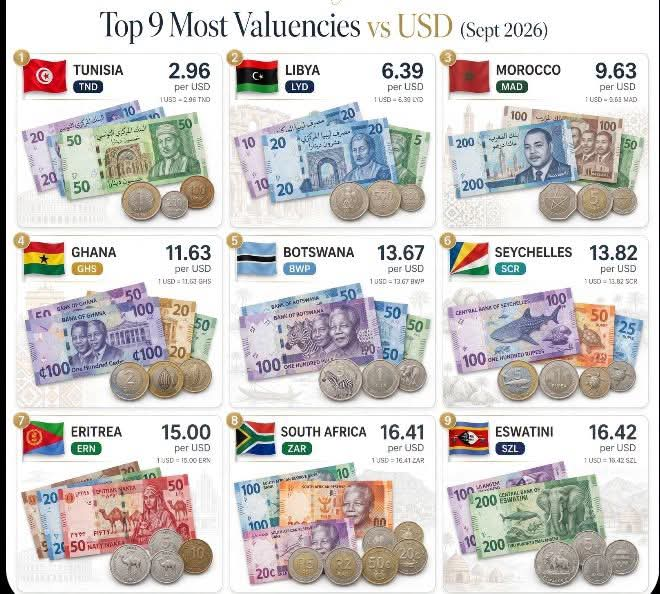
According to the October 2026 ranking, Tunisia leads the continent, followed by Libya and Morocco, while Ghana occupies fourth position as the only West African country among the 10 currencies featured.
The ranking is based on the number of units of each country’s local currency required to purchase one US dollar. In simple terms, the fewer units of a currency needed to exchange for US$1, the higher its nominal value against the dollar.
Here are the 10 most valuable African currencies in October 2026 and how much US$1 is worth in each country.
1. Tunisia – Tunisian Dinar (TND)
<text>Exchange rate: US$1 = 2.98 Tunisian dinars</text>
Tunisia ranks first among African countries with the highest-valued currencies against the US dollar in October 2026.
The Tunisian dinar maintains a relatively high nominal value, requiring approximately 2.98 dinars to purchase one US dollar.
Its position reflects the country’s managed foreign exchange arrangements and monetary policies. However, its high nominal value should not be interpreted as evidence that Tunisia has the continent’s strongest economy.
2. Libya – Libyan Dinar (LYD)

<text>Exchange rate: US$1 = 6.39 Libyan dinars</text>
Libya occupies second position, with approximately 6.39 Libyan dinars exchanging for one US dollar.
The country’s substantial petroleum resources remain central to its economy and foreign exchange earnings.
However, Libya’s currency arrangements are also influenced by domestic economic conditions, political developments and foreign exchange management.
3. Morocco – Moroccan Dirham (MAD)
<text>Exchange rate: US$1 = 9.81 Moroccan dirhams</text>
Morocco ranks third, with approximately 9.81 dirhams equivalent to one US dollar.
The Moroccan dirham operates under a managed exchange rate arrangement, with its value linked to a basket of currencies comprising the euro and US dollar.
The country’s diversified economy, which includes manufacturing, agriculture, tourism and exports, contributes to its position in the ranking.
4. Ghana – Ghanaian Cedi (GHS)
<text>Exchange rate: US$1 = 11.58 Ghanaian cedis</text>
Ghana is the only West African country featured in the October ranking, occupying fourth position.
The cedi’s performance has attracted attention following improvements in its exchange rate during parts of 2026.
Gold exports, foreign exchange inflows, monetary policy and developments in the country’s external reserves are among the factors influencing its currency performance.
Ghana’s position is particularly notable given the currency pressures experienced by several other economies in the West African region.
5. Botswana – Botswana Pula (BWP)
<text>Exchange rate: US$1 = 13.76 Botswana pula</text>
Botswana ranks fifth, with approximately 13.76 pula exchanging for one US dollar.
The pula operates under a managed exchange rate system and is influenced by a basket of currencies.
Botswana’s economy is significantly associated with diamond production and exports, although the country is also working to diversify its economic activities.
Its currency position reflects its monetary arrangements and foreign exchange conditions.
6. Seychelles – Seychellois Rupee (SCR)
<text>Exchange rate: US$1 = 14.00 Seychellois rupees</text>
Seychelles occupies sixth position, with approximately 14 rupees equivalent to one US dollar.
Tourism plays a significant role in the country’s economy and serves as an important source of foreign exchange earnings.
As a small island economy that relies heavily on international trade and imported goods, exchange rate movements have implications for businesses, consumers and the cost of living.
7. Eritrea – Eritrean Nakfa (ERN)
<text>Exchange rate: US$1 = 15.00 Eritrean nakfa</text>
Eritrea ranks seventh, with its official exchange rate standing at approximately 15 nakfa to one US dollar.
However, the country’s position requires an important qualification because Eritrea operates a tightly controlled foreign exchange system.
Its official exchange rate does not necessarily reflect the rate at which individuals and businesses can freely obtain foreign currency.
Consequently, the nakfa’s position should be interpreted with caution when comparing it with currencies operating under more accessible foreign exchange markets.
8. South Africa – South African Rand (ZAR)
<text>Exchange rate: US$1 = 16.41 South African rand</text>
South Africa occupies eighth position, with approximately 16.41 rand exchanging for one US dollar.
Although the rand has a lower nominal value than the currencies ranked above it, South Africa remains one of the continent’s largest and most industrialised economies.
Its currency is influenced by domestic economic conditions, interest rates, international investment flows, commodity prices and global market developments.
The rand is also an important reference currency within the Common Monetary Area in Southern Africa.
9. Eswatini – Swazi Lilangeni (SZL)
<text>Exchange rate: US$1 = 16.42 Swazi emalangeni</text>
Eswatini ranks ninth, with approximately 16.42 emalangeni equivalent to one US dollar.
The country’s currency arrangement is closely linked to South Africa’s monetary system.
The lilangeni is pegged at par with the South African rand, meaning that one lilangeni has the same nominal exchange value as one rand.
This arrangement helps maintain exchange rate stability between the two currencies.
10. Namibia – Namibian Dollar (NAD)
<text>Exchange rate: US$1 = 16.43 Namibian dollars</text>
Namibia completes the top 10, with approximately 16.43 Namibian dollars exchanging for one US dollar.
The Namibian dollar is pegged one-to-one with the South African rand, allowing the two currencies to maintain the same nominal value.
The country’s membership of the Common Monetary Area also connects its monetary arrangements with those of South Africa, Lesotho and Eswatini.
Why does currency value matter?
A country’s exchange rate has important implications for its economy, businesses and citizens.

When a local currency appreciates against the US dollar, imported goods and services may become cheaper, provided other costs remain unchanged. This can benefit businesses that depend on imported machinery, raw materials, medicines and other products.
Conversely, currency depreciation can increase the cost of imports, contribute to inflationary pressures and make foreign debt more expensive to service.
Exchange rate stability also helps businesses plan international transactions, manage costs and make investment decisions.
However, a favourable exchange rate alone does not guarantee economic prosperity.
Does a higher-valued currency mean a stronger economy?
Not necessarily.
One of the most common misconceptions about international currencies is that a country with a higher-valued currency automatically has a stronger economy than a country whose currency exchanges at a much higher numerical rate against the US dollar.
This is not how economic strength is measured.
For instance, the Nigerian naira does not feature among Africa’s 10 highest-valued currencies in this ranking, despite Nigeria being one of the continent’s largest economies.
Similarly, South Africa’s rand has a lower nominal value than the Tunisian dinar, but South Africa has a substantially larger and more diversified economy than Tunisia.
A proper assessment of economic strength considers several indicators, including gross domestic product, inflation, employment, productivity, purchasing power, foreign reserves, industrial capacity and living standards.
The distinction is particularly important when examining currencies such as the Eritrean nakfa, whose official exchange rate operates under strict foreign exchange controls.
Why are the South African rand, Eswatini lilangeni and Namibian dollar closely valued?
The close exchange rates of the South African rand, Eswatini lilangeni and Namibian dollar are not coincidental.
They are connected through the Common Monetary Area, a regional monetary arrangement involving South Africa, Namibia, Lesotho and Eswatini.
Under this arrangement, the currencies of Namibia, Lesotho and Eswatini are pegged at a one-to-one exchange rate with the South African rand.
This means that one Namibian dollar, one Lesotho loti and one Eswatini lilangeni have the same nominal value as one South African rand.
The arrangement supports monetary integration and facilitates financial transactions among member countries.
It is also worth noting that Lesotho’s loti is missing from the supplied top 10 list, despite its one-to-one peg with the rand. A complete ranking should account for this relationship and verify the relevant October exchange-rate snapshot.
Conclusion
The October 2026 currency ranking highlights the different monetary arrangements and economic conditions shaping Africa’s foreign exchange landscape.
Tunisia leads the continent, followed by Libya and Morocco, while Ghana represents West Africa in fourth position.
However, the figures should be understood as a comparison of nominal exchange rates rather than a definitive measurement of economic performance.
For African countries seeking sustainable economic growth, currency stability must be supported by productive industries, stronger exports, effective monetary policies, investment and employment creation.
Ultimately, the value of a currency is important, but the strength of an economy goes far beyond how many units of its money are exchanged for one US dollar.













 EduTimes Africa, a product of Education Times Africa, is a magazine publication that aims to lend its support to close the yawning gap in Africa's educational development.
