






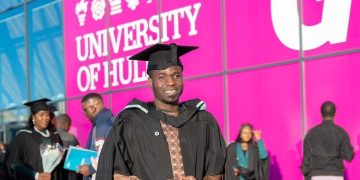







































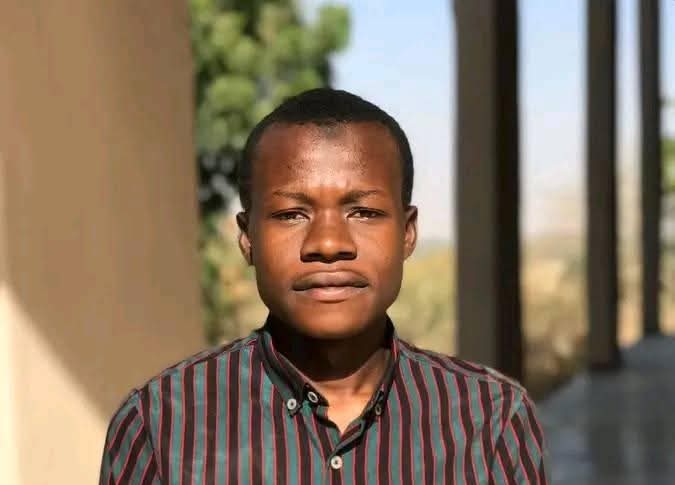
Selim Abdulrasak, a 21-year-old resident of Ijora Badia community, grappled with life struggles early, occulted from enjoyment and accessing quality education. He woke up frightened and beclouded by ensuing uncertainties that made him unwilling to go to school or attend educational activities. As he shouldered responsibility for survival while sketching during leeway, an onlooker saw him, referred him to a foundation revamping children’s education with art, which marked a new-turn.
“I joined the Slum Art when I was 14 years-old in 2018, the time it started under a small cover in the community,” Abdulrasak reminiscence sharply. He filed his name in a note at the entry point to the place like other children who were interested.
“I was in charge of erecting a makeshift for the foundation,” Abdulrasaq affirmed confidently. Explained that when the professional came to map the plan and decide the location, among other things considered were plastic bottles, stick and rope to tighten them together. Then we head to bolar (an informal market place where scrap items and recycle materials are sold at a pocket friendly price) and search for Mr. V plastic around the community. Adding that he was place on the front row during artwork activities like photo collage, painting and animation which helped him refocus his energy to becoming a commissioned artist as a student.
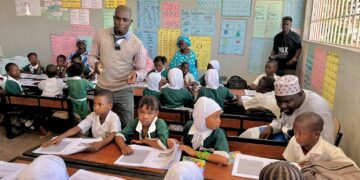
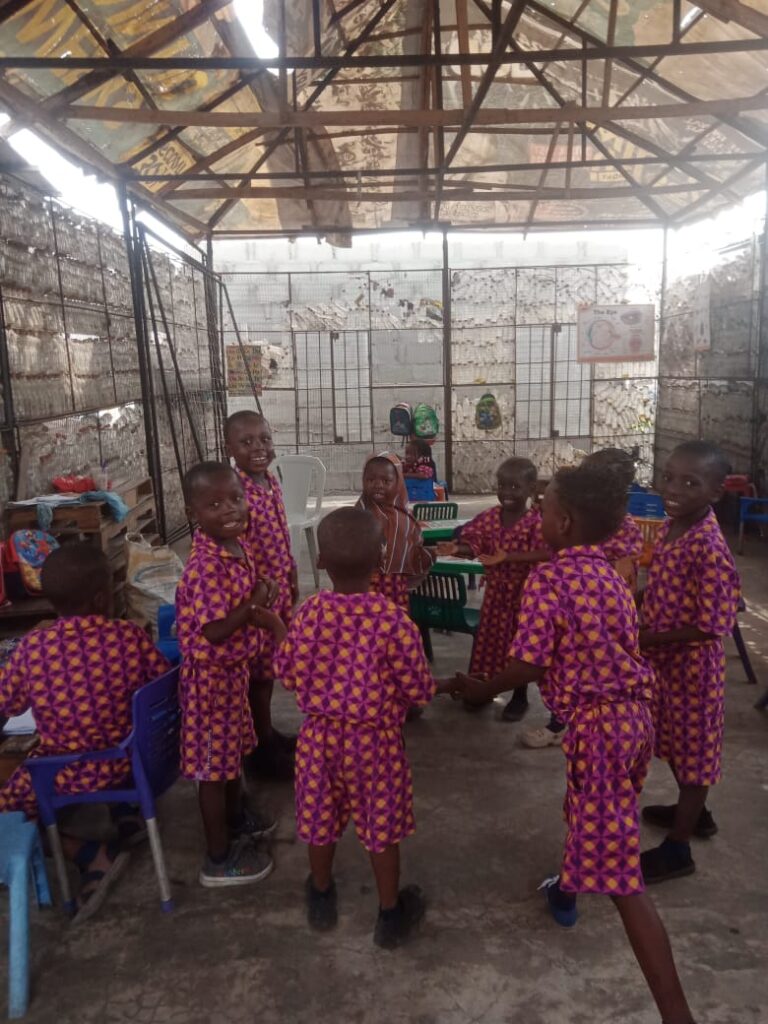
It was evident that The Polythene terephthalate (P.E.T) bottle-built school came to live four years ago about 18, 500 pet bottles were used to finish up, while most of the children participated and over time many of them have received mentorship and career guidance.
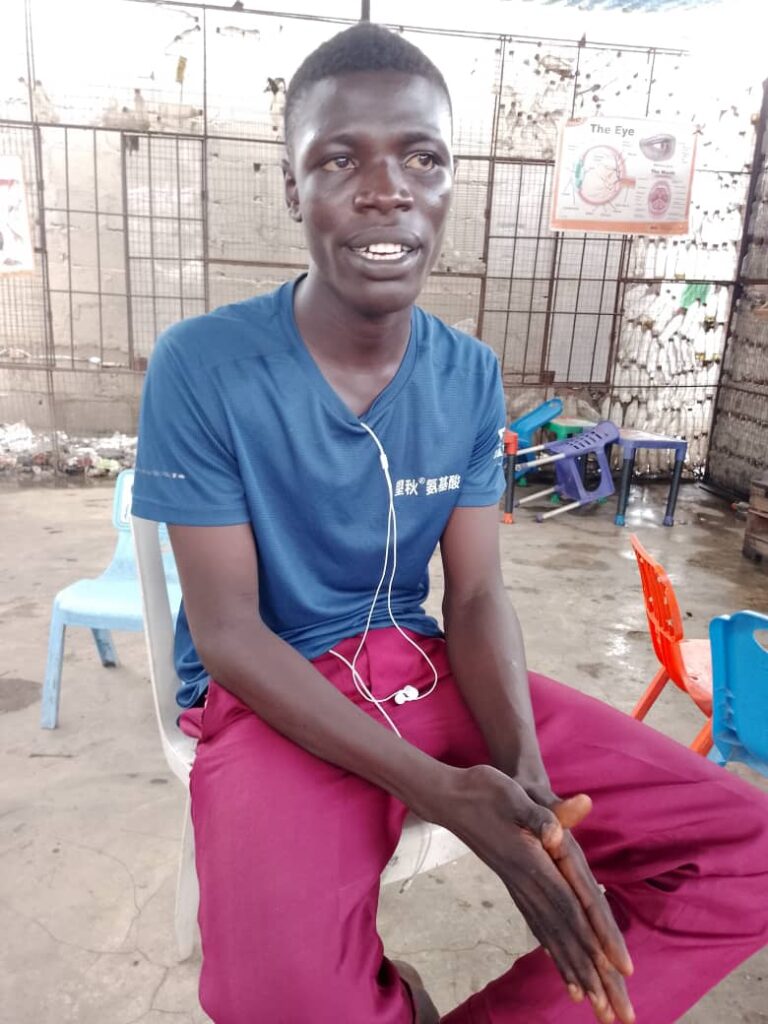
One of the co- founders of the Slum Art foundation, Mr. Adetunwase Adenle, recounted the pedagogy adopted in training each child to live up their potentials, differentiation method formed the key aspects of teaching learners at the foundation. “It is not like a square-fits-all strategy. Every child has his own individual independence. So, we don’t just say this one thing for everybody. No, we have movie night where we have painting and eat usually Jollof rice and Amala (black flour). Stressing that compensation also attracted the learners as each student get commission for every artwork sold at an exhibition. We normally admit 100 children and young people aged 7 – 18 across our programmes and now we took 200 children roughly 1000 children benefit from our project every year.”
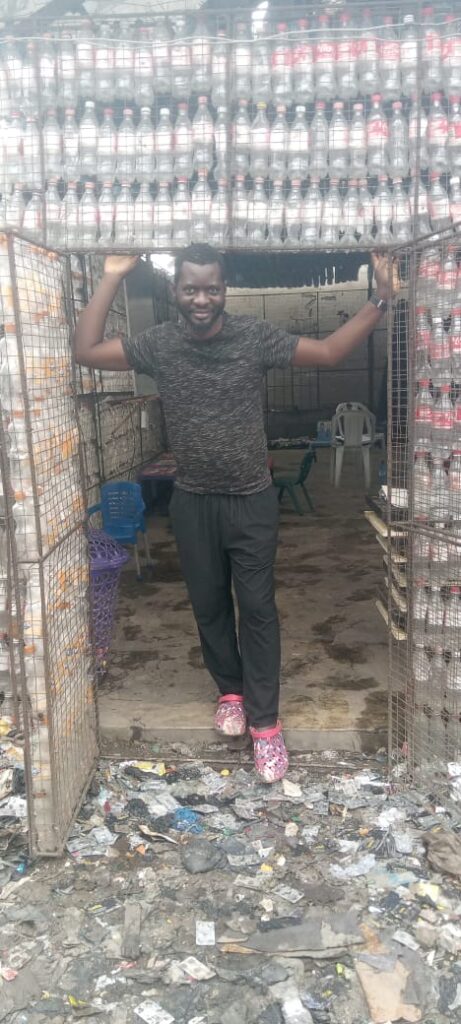
Photo credit: Abdullahi Abdullateef

“So, on Saturday, because we sold some artwork in the United States. Actually, I was in the US in May for an exhibition. We sold nine artworks brought the funds and give them their own commission. Because every artwork we sell, they have their own commission.
Narrating the strategy that transformed Abdulrasaq’s journey, “What we did for him, I reshuffled his learning from JSS to senior secondary and now he will be taking the Joint Admission and Matriculation Board examination. And we are still coaching him towards passing the exam.
“I want to become a naval officer,” he said to me. Mr. Adenle advised him not to learn carpentry as he would spend more time on water, provided insight that he should considered being a chef so that his culinary skills will help his captain to overcome stomach deficiency.
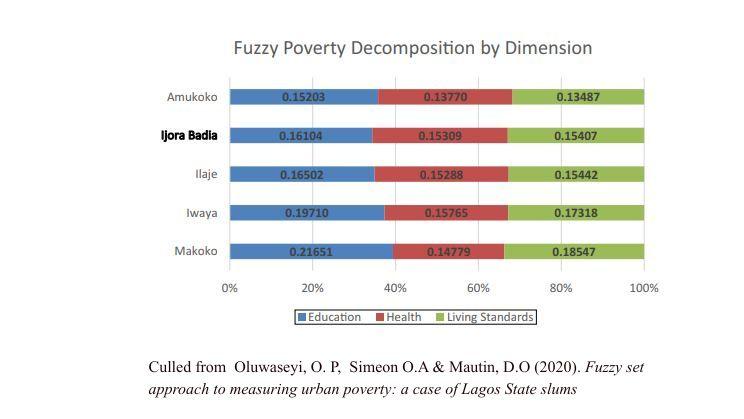
A study focused on poverty within Lagos slums comprising Ijora Badia, Makoko, Iwaya, Ilaje and Amukoko, three development economists, Oluwaseyi Omowunmi Popogbe et al utilized a mathematical model to analyze multidimensional poverty. They applied the fuzzy set method, which gained prominence in the 1990s as an alternative to solely using financial metrics for poverty assessment. Traditional monetary approaches typically classify individuals as either “poor” or “not poor” based on specific thresholds. However, poverty exists on a spectrum, with people experiencing different levels of deprivation across various aspects of their lives. The fuzzy set approach addresses this by assigning different degrees of membership to various poverty indicators. The researchers discovered Ijora Badia exhibits a Multidimensional Poverty Index (MPI) of 0.47, with the most significant deprivations observed in schooling and flooring. The schooling index is recorded at 0.09, while the flooring index is 0.02. This finding is predictable, as it was noted that the majority of houses in Ijora Badia are constructed with cement blocks and possess well-finished floors, in contrast to the wooden structures prevalent in many households in Makoko, Iwaya, and Ilaje. Amukoko demonstrates relatively lower levels of deprivation compared to all the communities studied.
I didn’t empower the children but they empowered me- Mr. Adenle
Reacting to what inspired him to establish the foundation, He acknowledged that one could choose to interpret experiences in life as either positive or negative narratives.
“Many individuals begin their life stories with challenges, such as the loss of a parent, and attribute subsequent actions to these events. I reject the notion that some individuals, who possess substantial resources, contribute to their communities, while others, who lack such resources, find their narratives to be stressful.” In his own case, he experienced financial loss and initially perceived it as depression, but it was merely a state of financial hardship. During this period, said a friend introduced him to a community gathering on a Monday,” Mr. Adenle clarified.
“Despite my personal struggles, I observed the joy among children in a slum area. As an artist, I attempted to engage them with art materials, and I was impressed by their eagerness to learn, despite the absence of mentorship or guidance. This marked the inception of my involvement in the slum community in November 2017. By January, I resolved to pursue this endeavor more formally, despite lacking financial resources, but possessing ample art supplies. I faced rejection from friends, as societal perceptions often equate success with material wealth. When one loses everything, including friends and money, it may seem as though life is over. However, within this community, acceptance is based on one’s true self. As a Christian, I have observed that acceptance in religious settings can be conditional, often influenced by one’s perceived status. This discrimination, though unspoken, is evident in the roles assigned within such communities”
Why physical presence matters in making impact rather than occasional check-ups?
She said that on a particular day while in Ajah, a high-end location on the Lagos Island, the founder reached out. “Do you have an interest to come and teach here and to teach the little kids? We have a school that is running primary and Slum Art foundation is focusing on art, but they try to help the community, not just teaching only art,” Ganiyu Helen, a staff member of Slum Art left her comfort zone to live with the children.
“This is my first time of seeing this. I’ve never lived in a slum before. I say about slum. So, I started seeing this community to understand the people in this community, because we want to really capture people’s attention. I want to really know them, and we need to be part of them to understand what exactly they are going through. Started living in this community that was 2022 it was sweet and fun, and sometimes not that sweet, because I need to blend with this community. And even though it was something that was quite challenging. But it was a very wonderful experience too, at the end of the day. So, I started living in this community, and, well, first I when I came to this community, the kids that were here, most of them, you can, they can hardly communicate in English because they can’t understand English. All of them, they understand Yoruba and Hausa. Think we have different tribe here.”
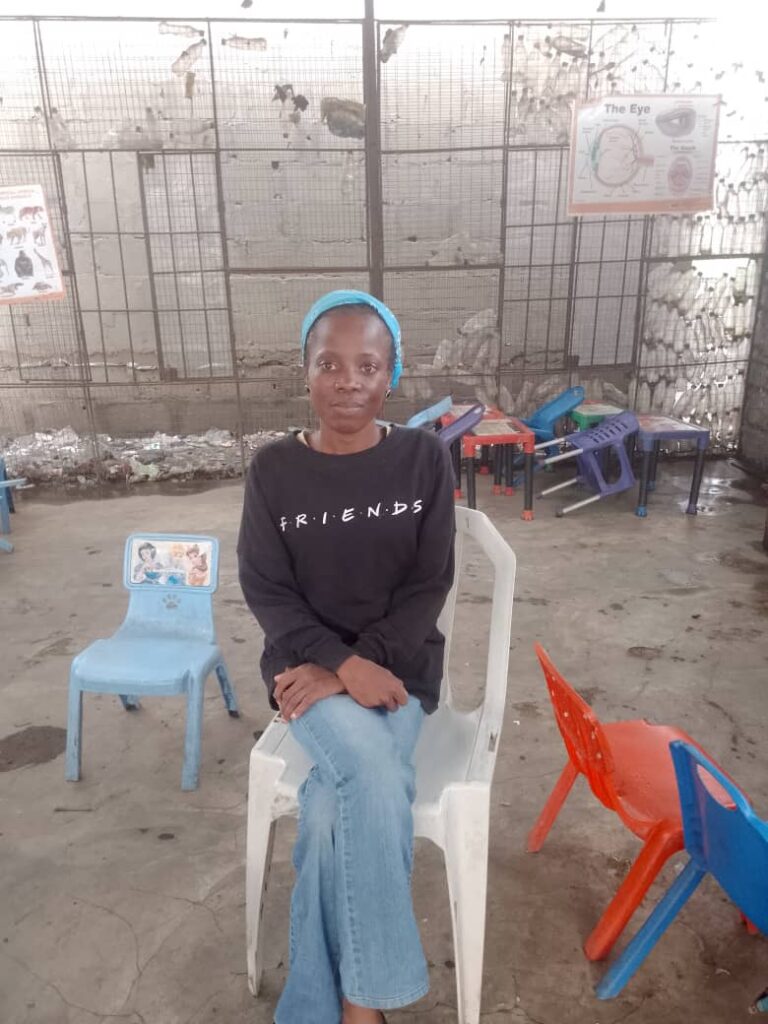
Photo credit: Abdullahi Abdullateef
Experimenting the right language teaching methodology, she noted that the foundation commenced instruction using Yoruba language and subsequently transitioned to teaching in English to facilitate comprehension. “I communicate with them in English. At present, many students have shown improvement. Therefore, it is advisable for us to converse with them in English. While some students can comprehend what is being said, they are not yet fluent in communication, though they can speak a little.”
Regarding the curriculum, “the majority of the children here are unable to read or write. If I were to employ the standard curriculum used in regular schools, most of them would struggle to follow the pattern like other children. Consequently, I sometimes use the curriculum, but it often leads to confusion. It is necessary to start with the basics to teach them how to read and write, which is an ongoing effort. We also teach other subjects offered by the school, such as social studies, computer science, mathematics, and English. We incorporate these subjects, including moral instruction, to enhance their understanding,” Ms Ganiyu affirmed.
Upon her arrival, she introduced examinations, as some individuals perceived it as a typical school where students merely attend and return home by noon. They began doing exams in 2022, and students have been participating in first and second-term exams. Noting that the use of report cards to provide them with an understanding of the school experience, beyond merely learning the alphabet and returning home, as is common in regular schools, extended the school day, initially closing at one o’clock and later at two o’clock, to familiarize them with the structure of a school day. Many of these students have never attended school before, while some have attended public schools, which are located at a considerable distance. This is how we initiated the curriculum development process.
Does the counts really great?
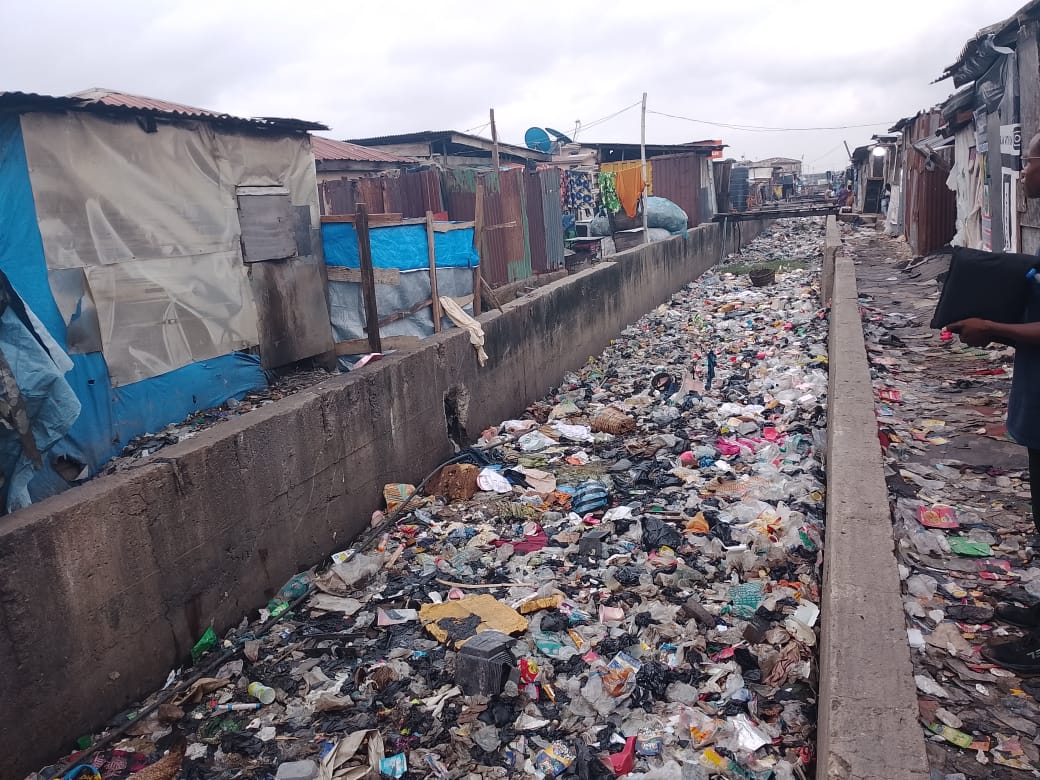
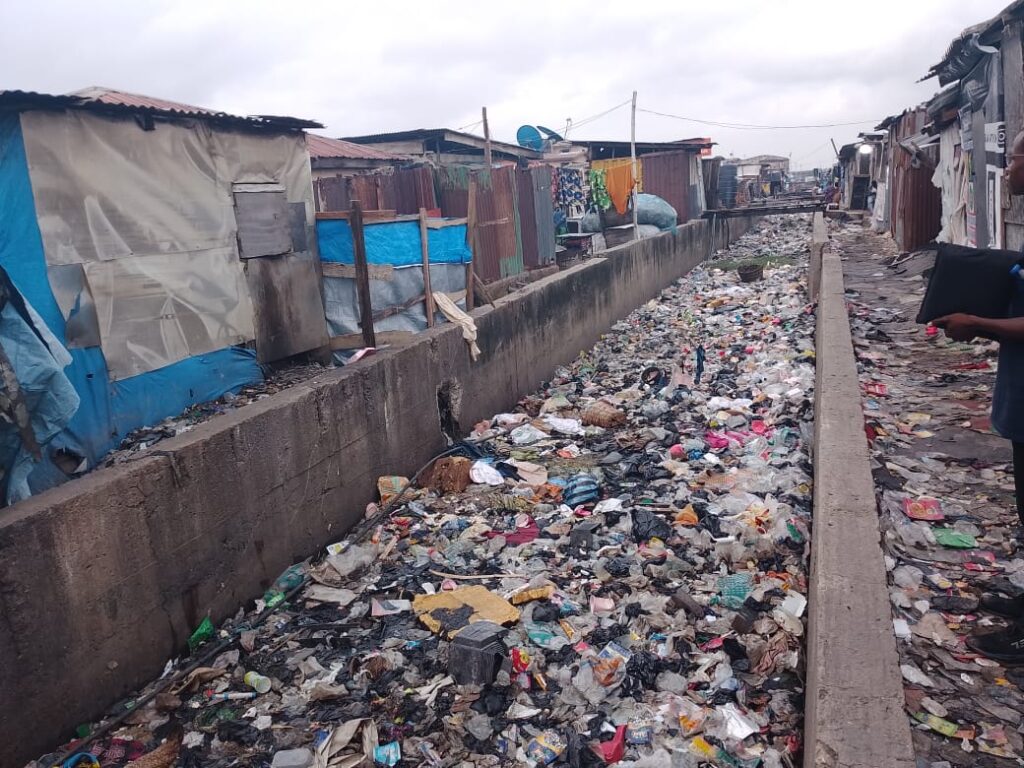
Lagos houses over 22 million residents and report suggests that over 60 percent are living in the slums. Areas like Makoko, Iwaya, Ilaje, Amukoko and Ijora are near the coastline of the State, necessitate proper attention for children’s education. Given these at stake, foundation addressing poor education and poverty are to gear effort towards bringing in more children and young people as many have not been covered or not aware about the activity. Some residents outside Gangari axis of the community described the foundation as non- operational. Also, the foundation peddling over collaboration with the government is taking the impact aback.
As rightly recommended by Oluwaseyi et al, the significance of education in the development of slums cannot be overstated. Indicating that a substantial number of household heads lack basic primary education. Although a minority of households have experienced school dropouts, the majority have school-age children enrolled in local schools. The quality of education these children receive will significantly influence their future skill levels. Consequently, it is imperative for the government and other educational stakeholders to enhance the quality of public-school education. This improvement is essential to ensure that children from less privileged backgrounds can compete effectively with their peers from privately-owned schools.
______________________









 EduTimes Africa, a product of Education Times Africa, is a magazine publication that aims to lend its support to close the yawning gap in Africa's educational development.