


















































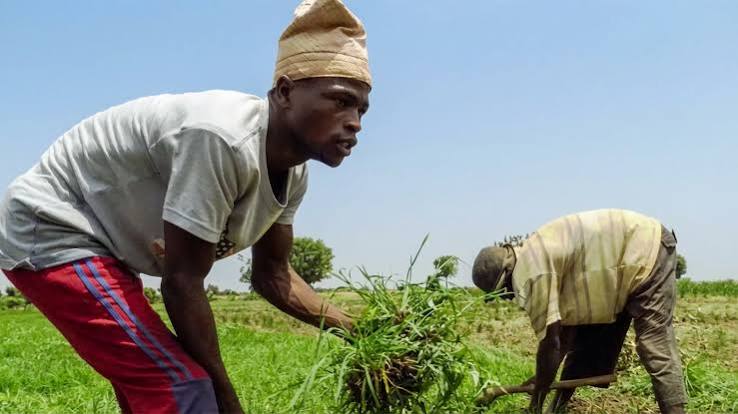


Access to finance remains one of the major challenges facing farmers and agribusiness operators in Nigeria. For smallholder farmers in particular, the cost of seeds, fertiliser, equipment, land preparation and other inputs can make it difficult to expand production.



The Federal Government and development partners have therefore introduced several interventions covering grants, subsidised farm inputs, concessional financing, credit guarantees and other forms of agricultural support.

However, farmers need to be careful when searching for funding opportunities online. A programme described as a “grant” may actually be a loan or an input subsidy, while some opportunities are designed for young agripreneurs or organised farmer groups rather than individual farmers.
Here are some verified agriculture-related funding and support programmes Nigerian farmers should know about.

1. Youth in Agribusiness Land Trust Fund
The Federal Government launched the Youth in Agribusiness Land Trust Fund (YiALTF) in June 2026 in partnership with the International Institute of Tropical Agriculture (IITA).
The initiative is designed to increase youth participation in agriculture by addressing challenges such as access to land, finance, technology, mechanisation, training and markets.
At the launch, 10 young farmers received grants of ₦1 million each to expand their agribusinesses.
The government said the wider initiative would use 42 Youth Development Centres as agribusiness hubs, while aiming to train six million young Nigerians and support the creation of 500,000 youth-led agribusiness enterprises over three years.
Important: The ₦1 million grants announced at the launch were awarded to 10 selected beneficiaries. The existence of the programme should not be interpreted as an announcement that every applicant will receive ₦1 million.
2. Lagos Agrithon
For agripreneurs in Lagos, the Lagos Agrithon is another funding opportunity worth watching.
The 2026 edition offered ₦200 million in funding for innovative agribusiness ventures in Lagos State.
However, this is not a simple application where every farmer receives a fixed grant. The programme is structured as an innovation competition involving application screening, business assessment, pitching, due diligence and technical reviews.
The 2026 application window ran from June 19 to July 19, 2026, meaning that particular application period has already closed.
Farmers and agribusiness owners should therefore monitor official Lagos State agriculture channels for announcements about subsequent editions rather than relying on old application links.
3. NADF Farm Input Support Programme
The National Agricultural Development Fund (NADF) operates support programmes that provide farmers with agricultural inputs rather than simply handing out cash.
In June 2026, NADF announced the distribution of 515,720 bags of urea and NPK fertilisers to 128,930 smallholder farmers across 25 states and the Federal Capital Territory.
The intervention targets smallholder farmers cultivating less than 0.5 hectares and is intended to reduce production costs and improve yields.
The fertiliser supplied under the programme was marked “Not for Sale”, meaning beneficiaries are not expected to sell the inputs.
4. NADF AgGrow Farm Support Programme
Another NADF initiative is the AgGrow Farm Support Programme, valued at ₦19.5 billion.
According to NADF, the programme is designed to support 50,000 smallholder farmers with a 50 per cent subsidy on inputs, including improved seeds, fertilisers and crop protection products.
The programme focuses on crops including maize, rice, cassava and soybeans and also seeks to connect farmers with processors through outgrower arrangements.
This is therefore an input subsidy programme, not a cash grant paid directly to every farmer.
5. NADP-1 On-Lending Programme
Farmers looking for financing rather than grants can also explore the National Agricultural Development Programme-1 (NADP-1) on-lending facility.
NADF launched the ₦1.5 billion pilot programme in 2025 in partnership with Flour Mills of Nigeria and NOVA Merchant Bank.
The pilot initially targeted 1,500 farmers cultivating maize in Kaduna State and was designed to provide access to finance, agricultural inputs and markets.
Unlike a grant, an on-lending facility is financing that is expected to be repaid. NADF says it intends to expand the model to reach more farmers and priority agricultural value chains.
6. Agricultural Credit Guarantee Scheme
Farmers who cannot access conventional bank financing because of the risks associated with agriculture may also encounter the Agricultural Credit Guarantee Scheme Fund (ACGSF).
The scheme does not simply give farmers free cash. Instead, it provides guarantees for agricultural loans issued by participating financial institutions.
The Federal Ministry of Agriculture and Food Security said in July 2026 that it was strengthening collaboration with ACGSF to improve farmers’ access to credit.
The scheme was established in 1977 and became operational in 1978.
7. National Agricultural Development Fund
The National Agricultural Development Fund (NADF) itself is an important institution for farmers to monitor.
Established under the National Agricultural Development Fund (Establishment) Act 2022, the Fund is mandated to address agricultural financing gaps and support the development of Nigeria’s food and agricultural systems.
Its interventions cover areas including crop production, livestock, fisheries, agro-forestry, research, training, market information and financing.
NADF also says it develops financial products and loan guarantee programmes tailored to farmers’ needs.
8. Renewed Hope Smallholder Support and Value Chain Fund
Another major Federal Government intervention is the Renewed Hope Smallholder Support and Value Chain Fund (RH-SVCF).
In July 2026, the Federal Government announced the distribution of more than 10 million bags of fertiliser under the programme and said it was targeting two million smallholder farmers nationwide.
The programme also includes a Guaranteed Price Model, designed to provide greater certainty around the market for participating farmers.
As of the July announcement, close to 300,000 farmers had reportedly been onboarded.
9. Bank of Industry agricultural financing
Farmers and agribusinesses should also distinguish between grants and business financing.
The Bank of Industry has a Smallholder Farmer Cluster product under its agricultural value-chain financing offerings. It is designed to support the production of quality agricultural commodities.
BOI also offers broader MSME financing that can be relevant to agricultural processing and other businesses along the agricultural value chain.
10. BOI-Aliko Dangote Foundation Fund
Agricultural businesses involved in agro-processing and manufacturing may also consider the BOI-Aliko Dangote Foundation Fund.
The facility provides concessional loans ranging from ₦500,000 to ₦75 million, at a stated interest rate of 5 per cent per annum.
The fund gives priority consideration to areas including agro-processing and manufacturing, women-owned businesses, youth entrepreneurs and enterprises in underserved communities.
Again, this is a loan, not a grant, so beneficiaries are expected to repay the money.
What should farmers prepare before applying?
Farmers should not wait until a funding opportunity opens before putting their documents together.
Depending on the programme, applicants may need:
– Valid means of identification
– NIN and, where required, BVN
– Evidence of farming activity
– Farm location and size
– Bank account details
– Farmer or cooperative registration
– Business registration, where applicable
– Production records
– Business plan or proposal
– Details of crops, livestock or other agricultural activities
– Evidence of previous business activity
– Contact details and other supporting documents
A credible programme should also clearly state its eligibility requirements, application procedure, selection process and official contact channels.
How to avoid fake agriculture grants
Farmers should be particularly cautious about social media posts promising guaranteed grants.
Before submitting personal information or paying any “registration fee”, check:
1. Who is offering the grant?
Look for the official government agency, development organisation or financial institution.
2. Is the programme on the organisation’s official website?
3. Is there a clearly stated application deadline?
4. Are the eligibility requirements publicly available?
5. Is the application process transparent?
6. Is the programme actually a grant, or is it a loan or subsidy?

Never assume that a WhatsApp message, Facebook post or online advert is genuine simply because it uses the name or logo of a government agency.
Grant, loan or subsidy: Know the difference

This distinction is important.
A grant generally does not have to be repaid, subject to the programme’s conditions.
A loan must normally be repaid, usually according to an agreed repayment schedule.
A subsidy reduces the cost of a product or service. For example, a farmer may receive fertiliser or improved seeds at a subsidised rate.
A credit guarantee helps reduce the lender’s risk and can make it easier for an eligible farmer or agribusiness to obtain a loan.
Many agricultural interventions combine two or more of these forms of support.
Final advice for farmers
There is no single agricultural grant that is suitable for every farmer.
A maize farmer, poultry farmer, fish farmer, young agripreneur and agro-processing company may qualify for completely different programmes.
The safest approach is to identify the programme that matches your age, location, type of farming, farm size, business stage and funding need, and then apply only through the official channel.
Farmers should also keep checking the websites and verified platforms of the Federal Ministry of Agriculture and Food Security, National Agricultural Development Fund, relevant state ministries of agriculture, Bank of Industry and other recognised agricultural finance institutions for new application windows.
Most importantly, do not pay anyone simply because they promise to secure a government agricultural grant for you. Verify the programme first.
















 EduTimes Africa, a product of Education Times Africa, is a magazine publication that aims to lend its support to close the yawning gap in Africa's educational development.