






























































Some intercontinental ballistic missiles (ICBMs) are so massive that their dimensions resemble small buildings rather than conventional battlefield rockets. These strategic weapons are designed to travel thousands of miles and deliver nuclear warheads, making them among the most powerful systems ever built.



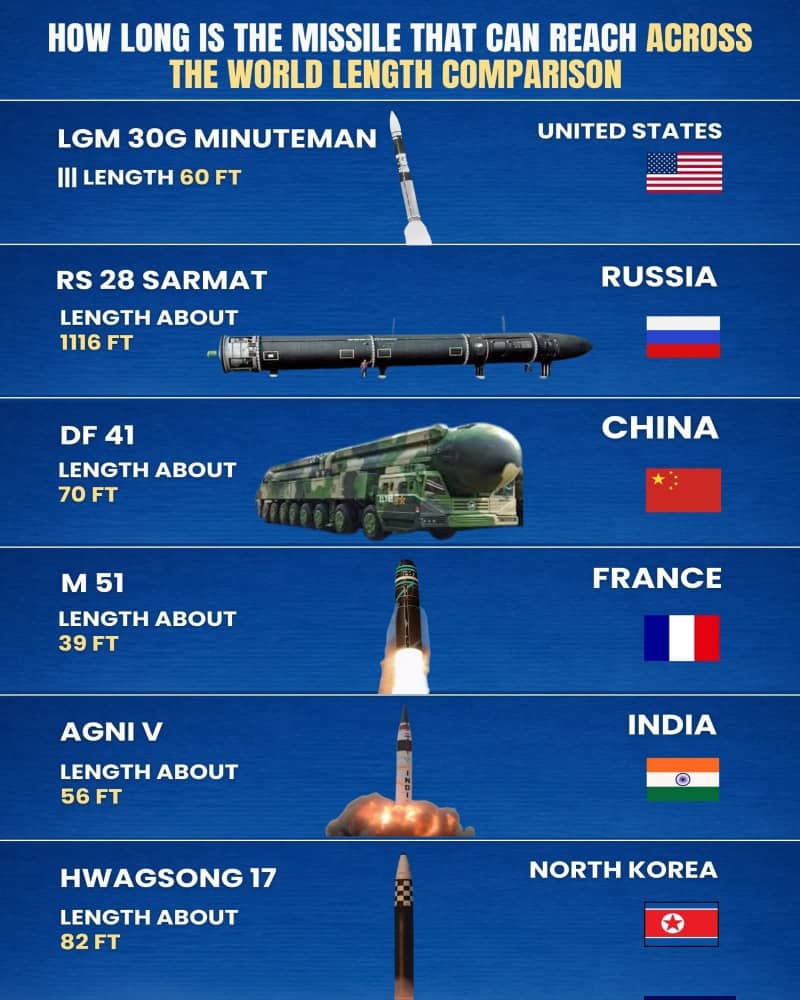
One missile that stands out in sheer size is Russia’s RS-28 Sarmat. The missile is estimated to be about 116 feet long, placing it in a completely different size category compared with many other operational systems.

For context, several other well-known strategic missiles are significantly shorter:
The United States’ LGM-30G Minuteman III measures about 59.9 feet.

France’s M51 missile is roughly 39 feet long.

India’s Agni-V stands at about 57.4 feet.
China’s DF-41 is commonly reported to be between 69 and 72 feet.
North Korea’s Hwasong-17 is estimated to measure between 79 and 85 feet.
These comparisons show that while many strategic missiles are enormous machines, the Sarmat sits at the extreme end of the scale.
Size vs Strategic Role
Despite these differences in size, a missile’s length alone does not determine its strategic importance. Each system is designed for a specific deterrence role.
The LGM-30G Minuteman III, for instance, is a silo-based missile forming a key part of the United States’ land-based nuclear deterrent and capable of travelling more than 6,000 miles.

France’s M51 missile, on the other hand, is a submarine-launched ballistic missile (SLBM). Because it is designed to be fired from submarines at sea, it is shorter than many land-based missiles while still maintaining intercontinental range.
India’s Agni-V is a road-mobile missile stored in launch canisters, allowing it to be transported and deployed from different locations.
China’s DF-41 is also designed for mobility and rapid deployment, helping improve survivability in the event of a conflict.
Meanwhile, North Korea’s Hwasong-17 is a large liquid-fuelled missile that analysts believe could potentially carry multiple nuclear warheads.
The RS-28 Sarmat is built as a heavy silo-based missile with an exceptionally large payload capacity and extremely long range, which explains why it is significantly larger than most other systems.
Why the Comparison Matters
Comparing these missiles highlights not only their massive scale, but also the different strategic approaches countries use when developing nuclear deterrent forces.
While some prioritize mobility and survivability, others focus on payload capacity or sea-based stealth, demonstrating how military strategy shapes the design of these powerful weapons.















 EduTimes Africa, a product of Education Times Africa, is a magazine publication that aims to lend its support to close the yawning gap in Africa's educational development.