













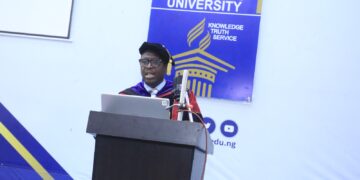














































As Artificial Intelligence continues to transform classrooms, research laboratories and workplaces across the world, the Vice-Chancellor of the University of Lagos, Professor Folasade Ogunsola, has warned universities against allowing technology to replace human reasoning and critical thinking.


Speaking at the 8th Research and Innovation Fair of Lagos State University (LASU), Professor Ogunsola urged educators, students and institutional leaders to embrace AI as a powerful assistant rather than a substitute for human judgment.

Delivering the Guest Lecture during the second plenary session of the fair, held on September 8, 2026, she noted that AI has rapidly moved from the margins to the mainstream of education. According to her, the challenge is no longer whether AI will become part of teaching and research, but how institutions will manage its use responsibly.

Professor Ogunsola acknowledged the enormous opportunities AI offers to education. She pointed to personalised learning, instant feedback, AI-assisted grading, curriculum development, predictive analytics and enhanced teaching capacity as some of the ways the technology is reshaping learning.

To illustrate its potential, she cited a World Bank-supported project involving 800 senior secondary school students in Edo State. Under teacher supervision, students used Microsoft Copilot during structured after-school English lessons. The intervention reportedly produced learning gains equivalent to about two years of conventional instruction within six weeks, with female students making some of the fastest progress.
She also referenced the growing use of AI among Nigerians, noting reports that 88 per cent of Nigerians used AI chatbots in 2025, largely for learning, work-related tasks and entertainment.
Beyond the classroom, the UNILAG Vice-Chancellor highlighted how AI can support students by generating practice questions, summarising academic materials, providing explanations and extending learning support beyond lecture hours. Such tools, she argued, can free lecturers to focus more on critical thinking, analysis and higher-order learning.
However, Professor Ogunsola cautioned that the benefits of AI could easily be undermined by misuse and overdependence.
She identified several risks, including academic dishonesty, data privacy concerns, algorithmic bias, misinformation, job displacement, widening digital inequality and the gradual erosion of students’ cognitive abilities.
One of her strongest warnings centred on the growing tendency of students to outsource thinking to technology.
According to her, students who become excessively dependent on AI may struggle to solve problems independently when such tools are unavailable.
She also warned that AI-generated responses can often appear convincing despite containing inaccurate or fabricated information, making verification and critical evaluation indispensable skills.
Professor Ogunsola further raised concerns about digital inequality, noting that access to AI tools often depends on internet connectivity, electricity and digital devices.
With Nigeria’s internet penetration estimated at about 53 per cent in early 2026, she warned that poorly managed AI adoption could deepen existing educational inequalities by favouring students and institutions with stronger digital infrastructure.

To address these challenges, she called on universities to develop clear governance structures for AI deployment.
Among her recommendations were the establishment of AI governance committees, risk-based classification of AI applications, clear academic-integrity rules, compliance with data-protection regulations, fairness reviews, transparency standards and mechanisms for appeal in AI-assisted decisions affecting stu…














 EduTimes Africa, a product of Education Times Africa, is a magazine publication that aims to lend its support to close the yawning gap in Africa's educational development.