






















In many parts of Nigeria, the challenge is not convincing children to go to school. It is getting a school close enough for them to attend.
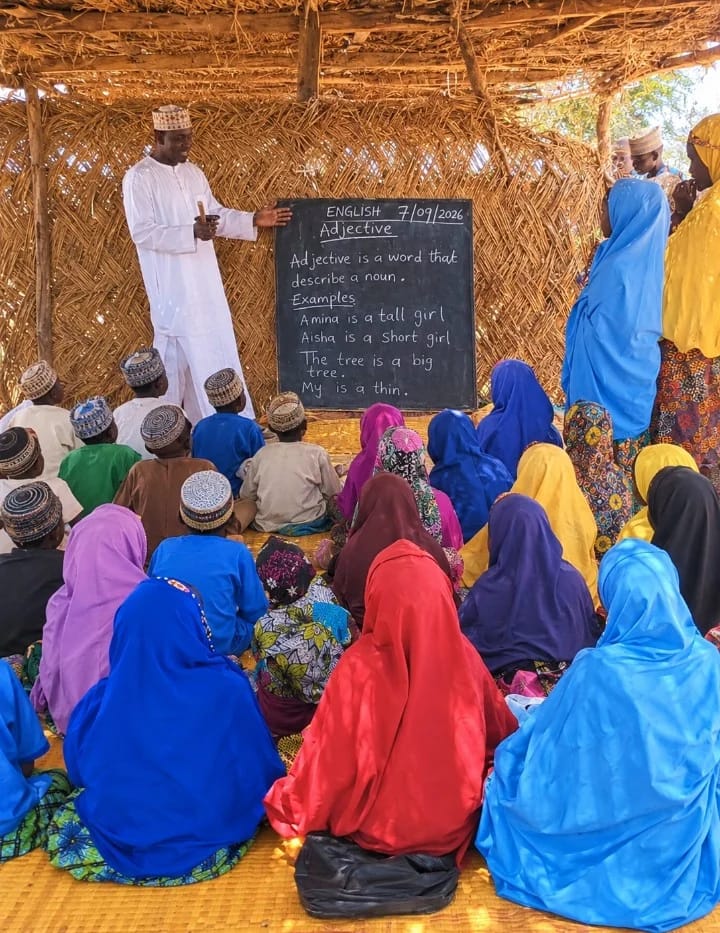
For years, children in Rugar Jatau, a remote settlement in Jigawa State’s Malam-Madori Local Government Area, learned under trees or remained completely outside the classroom. With the nearest schools located far from the community, many families simply had no realistic way of giving their children access to formal education.

That reality is now beginning to change.
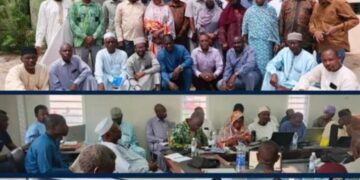
A grassroots organisation, The Transit Education Initiative, has established a thatched learning centre, locally known as makarantar zana (hut school), to bring education directly to children in the underserved community.

The intervention is part of a broader effort to reduce the number of out-of-school children and expand access to both Western and Islamic education in remote settlements across Jigawa State.
According to the Coordinator of the organisation, Dr. Tijjani Mukaddas, the project was conceived to address one of the biggest barriers to education in nomadic and hard-to-reach communities: distance.
“This is part of our grassroots effort to take education closer to children in underserved nomadic communities across Jigawa State,” he said.

For many families, the impact has been immediate.
More than 300 children have already been enrolled in the Rugar Jatau learning centre, where four teachers currently provide instruction across different subjects.
The initiative has also extended beyond the community, mobilising parents in more than 10 settlements across Kafin Hausa and areas bordering Jahun and Miga Local Government Areas to enrol their children in school.
For residents, the project represents more than the construction of a simple structure. It offers hope that children who once had little or no access to education can now begin a different journey.
A father of nine, Ibrahim Ado, described the intervention as life-changing for the community.
“For years our children have been learning under trees with no chairs, no books and no teachers. We are very happy that this project has remembered us,” he said.
“We want our children to receive education that will prepare them for the future while also giving them Islamic knowledge. This programme is giving us an opportunity that we have been waiting for.”
Another resident, Musbahu Ammai, said many children previously stayed at home because schools were too far away.
“Before this school was established, many children had to stay at home because the existing schools were too far away. Now, parents are encouraged because their children can learn within the community,” he said.
Yet Rugar Jatau is only one of many communities facing similar challenges.
Mukaddas said several settlements across Jigawa still have no access to formal schools, including Ataru Karate, Alimawa, Garin Malammai, Gidan Gabar, Gidan Lilo, Salamawa, Ataru, Gidan Na Dabo, Rukumawa, Goran and Jata.
In Tsuburowa community, also in Malam-Madori Local Government Area, children reportedly continue to learn under trees due to the absence of school facilities.
The organisation plans to establish additional hut schools in such communities, while also extending its interventions to border settlements in Maigatari and Birniwa local government areas, where many children remain outside the education system.
The effort builds on an earlier intervention through which more than 100 out-of-school children in Malam-Madori returned to learning after receiving educational materials, uniforms and other forms of support.
For Mukaddas, the challenge of out-of-school children cannot be solved by government alone.
He believes stronger collaboration between government agencies, local authorities, development partners, philanthropists and community leaders is necessary to ensure that children in remote settlements enjoy the same educational opportunities as those living in urban areas.
“There is a need for government and stakeholders to work together to bring every out-of-school child back into the education system,” he said.
As the small thatched structure in Rugar Jatau fills with eager learners each day, it stands as a reminder that sometimes the first step towards solving a national education crisis is as simple as taking a classroom to where the children are.











 EduTimes Africa, a product of Education Times Africa, is a magazine publication that aims to lend its support to close the yawning gap in Africa's educational development.