





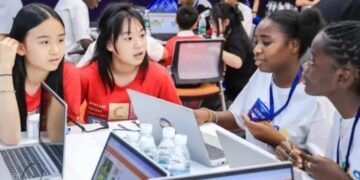




















I was walking along a road on the premises of a tertiary institution when I encountered a familiar Nigerian academic scene. Students were scattered under trees and along the roadside, flipping through their books as they waited for examination papers. Their eyes moved rapidly across pages, their faces were tense, and anxiety was written all over them.
What I saw was not learning personified. I saw pressure cookers in human skin, simmering under the weight of examination tension.

Welcome to the season of “la cram, la pour” – cram everything, pour it out in the examination hall, and hope for the best!
But a fundamental question deserves our attention: are our educational institutions teaching students to understand knowledge or merely to reproduce it under examination conditions?

Examinations are important. They help teachers evaluate students’ progress and identify learning gaps. However, problems arise when examination scores become the principal measure of intelligence, competence and academic success. Students may memorise definitions, theories and lengthy notes without understanding their practical implications. Their immediate objective becomes passing examinations rather than mastering their subjects.
This raises a troubling question: if students can reproduce information but cannot apply it to real-life situations, have they truly learnt?

Imagine a medical student who memorises disease symptoms but struggles to apply that knowledge to a patient. Consider an engineering graduate who can reproduce equations but cannot use them to solve a practical problem. What about a sociology student who understands social theories but cannot investigate a community problem and recommend workable solutions?
These examples illustrate the difference between possessing information and knowing how to use it. Nigeria needs graduates who can transform ideas into innovations, not merely reproduce what lecturers have dictated. Memorisation has its place, but memorisation without understanding and examination success without demonstrated competence should concern us.
Interestingly, the Indian comedy movie 3 Idiots offers a powerful lesson on this issue. Through the experiences of three engineering students, the film challenges an educational culture that prioritises grades, competition and certificates over curiosity, creativity and genuine understanding. Its central character, Rancho, questions the practice of learning simply to pass examinations and encourages his friends to understand what they study.
The film also exposes the emotional consequences of excessive academic pressure, including fear of failure and the belief that examination results determine a person’s worth. Its message is not that academic discipline is unnecessary, but that education should inspire students to understand, explore and innovate. Although fictional, 3 Idiots reflects a reality familiar to many students in Nigeria: the pressure to succeed academically can overshadow the joy of learning.
Other countries offer useful lessons. In Finland, there are no routine national standardised tests for pupils throughout primary and lower secondary education. Teachers use classroom activities, assignments, examinations and continuous feedback to monitor learning. The emphasis is on helping students improve rather than constantly ranking them through high-stakes tests.
Sweden also combines formal examinations and national tests with teacher-led assessments. Students’ progress is evaluated through different forms of evidence rather than relying exclusively on a single examination.
In New Zealand, the National Certificate of Educational Achievement (NCEA) combines internally assessed coursework with external examinations. Depending on the subject, students may demonstrate achievement through research, projects and practical activities. This provides opportunities to demonstrate competence beyond written tests.
Estonia similarly emphasises feedback, independent learning and the development of students’ abilities. Teachers use different assessment methods to identify progress and learning difficulties. These countries have not abolished examinations; instead, they recognise that no single test can adequately measure every dimension of a student’s knowledge and potential.
Nigeria should learn from these approaches without assuming that foreign systems can be copied wholesale. Our educational institutions should reduce their excessive dependence on written examinations by incorporating practical projects, presentations, laboratory work, portfolios, case studies and field assignments.
Agricultural students should demonstrate sustainable farming techniques. Engineering students should design and test solutions to local problems. Nursing students should demonstrate clinical competence through supervised practical assessments alongside theoretical examinations. Sociology students should investigate social problems and propose evidence-based interventions.
Teachers and lecturers must also move beyond questions that reward memorised definitions. Students should be encouraged to analyse evidence, question assumptions, evaluate competing arguments and explain how they would solve real-life problems. Continuous assessment must measure genuine progress rather than simply increase the number of tests students must pass.
Such reforms require investment in teachers, laboratories, workshops, libraries and digital learning resources. Practical education cannot thrive without adequate facilities and trained personnel.
Ultimately, the purpose of education is not merely to obtain certificates; it is to prepare people to contribute meaningfully to society. A certificate may open a door, but competence determines what happens after entry.
The next time we see students under trees, desperately cramming their books before an examination, we should ask ourselves: are they preparing to demonstrate what they have learnt, or simply trying to survive another test?
Nigeria must move from “la cram, la pour” to “learn, understand, apply and innovate.” Like the lesson in 3 Idiots, we must remember that education should develop minds, not merely train memories. Our ultimate goal should be graduates who do not just pass examinations but can also pass the test of real life.
——————-

Agholor Ndunka Henry is a Nigerian writer and social commentator with a background in Social Studies Education and an MSc in Sociology and Anthropology from Obafemi Awolowo University, Ile-Ife. His writing explores education, youth development, technology, and contemporary social issues, with a focus on inspiring meaningful conversations and promoting positive social change.
Below are my social media handles and contact information.
LinkedIn: /henryndunkaagholor
Facebook: /Ndunka
Instagram: @henrindunca
TikTok: @henry.ndunka
YouTube: @HenryNdunkaAgholor
WhatsApp: 08139000453
Email: henryndunka@gmail.com










 EduTimes Africa, a product of Education Times Africa, is a magazine publication that aims to lend its support to close the yawning gap in Africa's educational development.
