

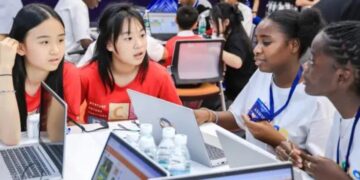























Ghana has launched a revised national curriculum that introduces artificial intelligence (AI), coding and computer programming into basic education, making it one of the few African countries to integrate emerging technologies into learning from kindergarten through junior high school.



The curriculum reform, unveiled by Ghana’s Minister of Education, **Haruna Iddrisu**, is part of the government’s broader effort to modernise education and equip young learners with the digital and technical skills required in an increasingly technology-driven world.

Under the new curriculum, pupils will study AI, coding, electronics, and Technical and Vocational Education and Training (TVET), alongside strengthened Science, Technology, Engineering and Mathematics (STEM) education. Ethics and civic education have also been expanded to promote patriotism, responsible citizenship and moral values.
Speaking at the launch, Iddrisu described the revised framework as a “Smart Start curriculum” designed to integrate technology into learning from an early stage.

He said the reforms would ensure that Ghanaian pupils develop the knowledge and competencies needed to thrive in an economy increasingly shaped by digital innovation.
According to the minister, one of the government’s major decisions was to overhaul the education curriculum from kindergarten to junior high school to better prepare learners for a future dominated by artificial intelligence, e-learning and other emerging technologies.
He stressed that Africa must not lag behind in the ongoing digital revolution, noting that the initiative is intended to position Ghana’s future workforce for global competitiveness.
Beyond digital literacy, the curriculum also places significant emphasis on ethics, civic responsibility and patriotism, with learners expected to develop a stronger understanding of national values and responsible citizenship.
The initiative has been welcomed by students, many of whom believe AI-powered learning tools will enhance classroom understanding, improve independent study and strengthen problem-solving abilities.
Nhyiraba Asiedua Asiedu Otchere, a pupil at Orange Star Roman Catholic Basic School Complex in Mampong-Akuapem, said AI could help students better understand difficult lessons by simplifying complex concepts and providing additional learning support outside the classroom.
Another pupil, Isaac Siaw of Susec Model School in Sunyani, expressed excitement over the reform, saying exposure to AI and coding would prepare young people for future careers in the digital economy.
Education stakeholders have also praised the policy while urging the government to provide the infrastructure needed for its successful implementation.

Executive Director of the Institute for Education Studies, Peter Anti, described the initiative as timely and consistent with global education trends, saying it would help Ghanaian learners acquire critical thinking, digital literacy and problem-solving skills.
However, he cautioned that curriculum reform alone would not achieve the desired outcomes without substantial investment in electricity, internet connectivity, digital devices and teacher training.
He warned that inadequate infrastructure could widen the educational gap between well-resourced urban schools and underserved rural communities, limiting equitable access to the benefits of the new curriculum.












 EduTimes Africa, a product of Education Times Africa, is a magazine publication that aims to lend its support to close the yawning gap in Africa's educational development.