




























































The basic premise of a student loan is a beautifully simple form of financial time travel. At 19, you may have little or no money, and your most marketable skills might include debating on social media and surviving on instant noodles. However, in five years, you could be an engineer, an accountant, or even a highly paid prompt engineer. You will earn money then.
A student loan allows you to borrow from that future income, bring it into the present, pay your school fees, and sustain yourself—before repaying the debt over time.
In Nigeria, this “time machine” has historically been powered by what many jokingly call the Bank of Mum and Dad, often supplemented by a generous relative in the diaspora. Over time, however, that informal system reached its limit. Enter President Bola Ahmed Tinubu.
In what may be regarded as one of the most pragmatic policy decisions of his administration, the President recognised that human capital development cannot rely indefinitely on financially exhausted families. This gave rise to the Nigerian Education Loan Fund (NELFUND), backed by the administration’s “Renewed Hope” agenda.

Rapid Growth and Quiet Efficiency
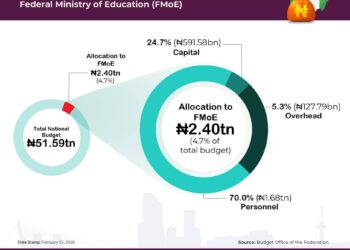
By all measurable standards, NELFUND has scaled at an extraordinary pace. Between March 2025 and March 2026, it evolved from a modest pilot into a significant macroeconomic intervention.
2025: ~451,000 applicants; ₦45 billion disbursed
2026: 1.7 million applicants; over 1.1 million beneficiaries; ₦206.2 billion disbursed
This represents nearly a fourfold increase in participation and a 4.5-fold increase in funds disbursed within a year—growth figures more commonly associated with high-performing technology startups.
What is particularly striking is the operational efficiency. Historically, large-scale government interventions of this magnitude are often accompanied by system failures, irregularities, and public scrutiny. Yet, under the leadership of Managing Director/CEO Mr Akintunde Sawyerr, NELFUND has functioned with notable transparency and discipline, resembling a well-run financial technology institution.
The disbursement structure is also strategic:
₦128.8 billion (65%) paid directly to institutions for tuition
₦77.4 billion (35%) distributed to students as upkeep allowances
This dual approach ensures accountability while simultaneously providing liquidity directly to students.
An Accidental Economic Stimulus
Beyond education, NELFUND is effectively functioning as a targeted economic stimulus.
Unlike traditional government stimulus programmes—often channelled through infrastructure projects—NELFUND injects money directly into the hands of young Nigerians. Students, by nature, spend rather than save. They pay rent, purchase books, buy data, and patronise local businesses.
As a result, campus economies are experiencing a surge in activity. From transport operators and food vendors to photocopying centres, local enterprises are benefiting from increased cash flow.
The ripple effects extend further. Parents, who previously bore the full financial burden of tertiary education, are now relieved of some of that pressure. This allows households to redirect resources towards other needs or investments, subtly reshaping Nigeria’s social and economic fabric.
The Inflation Factor: A Hidden Subsidy
From a financial perspective, the long-term value of these loans is influenced heavily by inflation.
A loan of ₦1 million issued in 2025 will likely have significantly reduced real value by the time repayment begins several years later. In practical terms, this transforms the loan scheme into a form of indirect subsidy.
Rather than functioning as a profit-driven credit facility, NELFUND operates as a strategic investment in human capital. The government appears to accept reduced real returns in exchange for long-term economic benefits.
The ‘Japa’ Challenge
One major structural concern is Nigeria’s ongoing emigration trend, commonly referred to as “Japa”.
There is a legitimate risk that beneficiaries of publicly funded education may leave the country shortly after graduation, effectively turning the scheme into a taxpayer-funded export of talent.
However, restricting academic transcripts or mobility may be counterproductive, particularly as many graduates initially travel abroad for further studies rather than immediate employment.
A Smarter Recovery Approach
A more effective solution lies in adapting repayment mechanisms to global realities. Two possible strategies include:
1. Diaspora Moratorium and Direct Debit System
Graduates relocating abroad could be granted a structured repayment moratorium (e.g. 24 months). Thereafter, repayments could be automated through international payment platforms, with modest monthly deductions aligned with their earning capacity.
2. Consular Integration Mechanism
Loan repayment compliance could be linked to essential consular services, such as passport renewal. This ensures long-term accountability without restricting mobility.
Finally, Managing a ₦200 billion unsecured loan portfolio for young people is, by conventional banking standards, highly risky. However, as a national development strategy, NELFUND represents one of the most direct and impactful policy interventions in recent years.
While challenges remain particularly around repayment and migration, the programme’s scale, efficiency, and economic impact are undeniable. If sustained and properly managed, NELFUND may well prove to be one of Nigeria’s most important investments in human capital this decade.
Tunde Alao-Olaifamni
Group CFO & Head of Strategy, Principal Investment Leadway Holdings Limited.












 EduTimes Africa, a product of Education Times Africa, is a magazine publication that aims to lend its support to close the yawning gap in Africa's educational development.