


























By Olasunkanmi Olajide, Femi Dansu & Rasheed Amisu



The Federal University of Agriculture, Abeokuta (FUNAAB), has reaffirmed its position as one of Nigeria’s fastest-rising universities and an institution of global relevance, as the Vice-Chancellor, Prof. Babatunde Kehinde, reiterated the University’s commitment to inclusiveness, excellence, innovation, and stakeholder engagement.

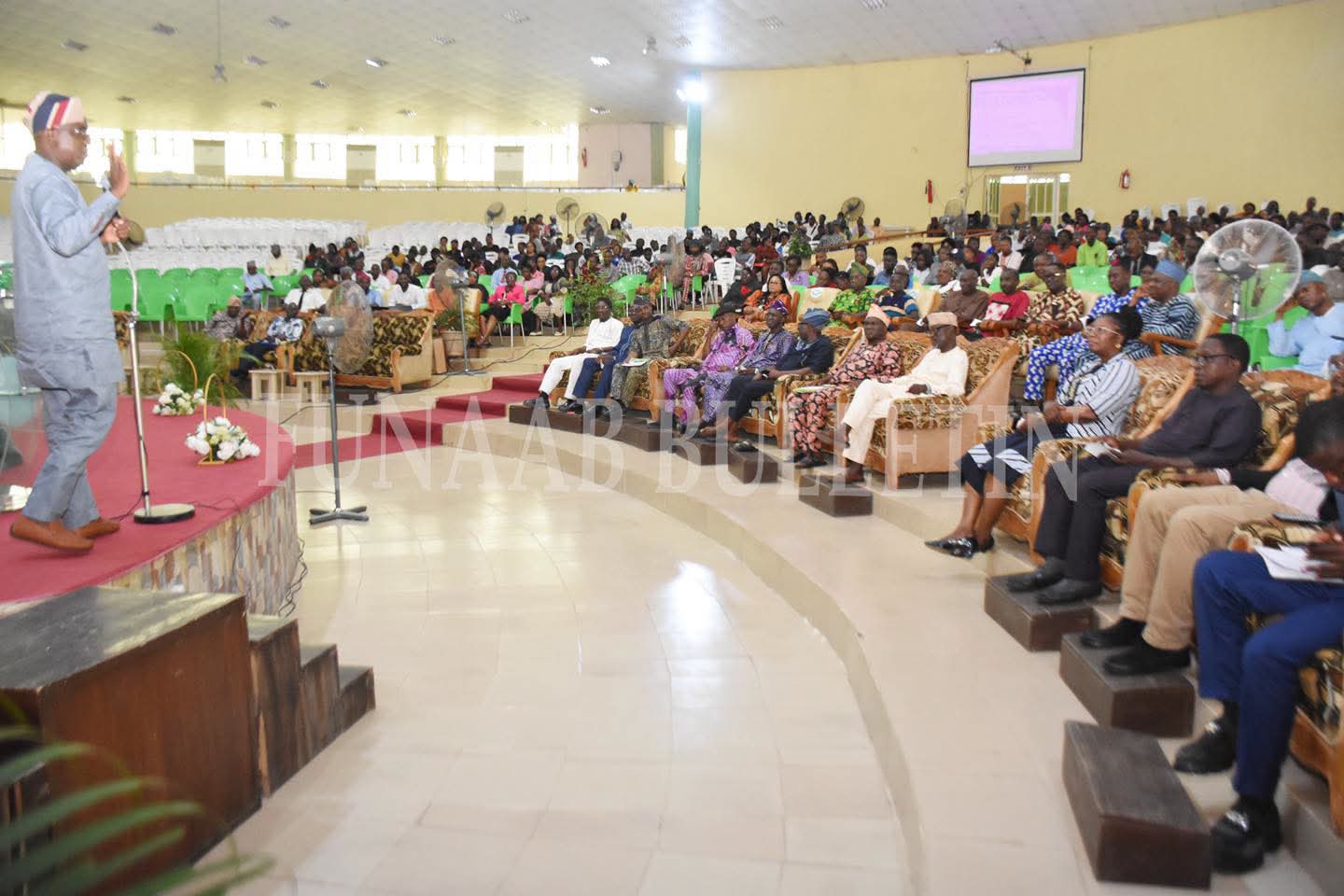
Speaking at the 38th Congregation Meeting held on June 24, 2026, at the Prof. Oluwafemi Balogun Ceremonial Building, the Vice-Chancellor assured members of the University Community that the Administration would continue to operate an open-door policy anchored on fairness, transparency, and collective progress. “We are ready to work with everybody; we won’t discriminate against anyone. Our focus is to build a stronger, more innovative, and globally competitive FUNAAB through excellence, unity, mutual respect, and shared responsibility,” Prof. Kehinde stated.
He commended members of the Senate, Congregation, staff unions, students, alumni, development partners, and other stakeholders for their support in advancing what he described as the “FUNAAB Project”, a collective vision aimed at positioning the University among the world’s leading institutions of higher learning.

Highlighting the University’s growing national and international profile, the Vice-Chancellor noted that FUNAAB was recently ranked among Nigeria’s Top Ten Universities in the 2025 Times Higher Education (THE) Impact Rankings. He further disclosed that the University emerged as the Second-Best Performing Federal University in Nigeria in Graduate Employability, reflecting the quality, relevance, and impact of its academic programmes.

According to him, the University’s academic expansion recently received a significant boost with the approval of six new Undergraduate Programmes by the National Universities Commission (NUC), further strengthening its capacity to respond to emerging national and global developmental challenges.
Prof. Kehinde also revealed that FUNAAB recorded its highest student enrolment in history during the 2025/2026 Academic Session, matriculating 6,356 students. The development, he said, was a clear indication of growing public confidence in the University’s academic excellence, innovative learning environment, and expanding opportunities for students.
The Vice-Chancellor further disclosed that more than 13,000 candidates selected FUNAAB as their first-choice institution in the recently concluded Unified Tertiary Matriculation Examination (UTME), while over 11,000 of the applicants scored 160 and above. He described the figures as a strong endorsement of the University’s rising reputation as a preferred destination for quality education, cutting-edge research, and innovation.
Beyond academic achievements, Prof. Kehinde outlined key interventions aimed at improving staff welfare and institutional efficiency. He stated that intervention funds received by the University had been utilised to enhance office accommodation and working conditions through the procurement and distribution of furniture, air-conditioning units, and other essential equipment across Colleges, Departments, and Administrative Units.
He also announced the recruitment of 266 Academic and Non-Teaching staff members, describing it as the first major recruitment exercise undertaken by the University since 2019. According to him, the process was guided by merit, competence, transparency, and fairness, in line with the University’s commitment to good governance and institutional excellence.

On infrastructural development, the Vice-Chancellor disclosed that the University is currently executing several landmark projects, including a 76-room multi-storey Administrative Complex, which is expected to become the tallest building on campus upon completion, a Governing Council Lodge, an ultra-modern Staff Club, a College of Computing Sciences Building, an Advanced Engineering Laboratory, and the second phase of the Veterinary Anatomy Laboratory. He added that several strategic projects had already been completed, including Principal Officers’ Residential Quarters, a 240-capacity Computer Laboratory, a 120-bed Student Hostel, an Automated Greenhouse Facility, and a Modern Animal Demonstration Laboratory.
Addressing concerns over the Camp–Alabata Road, Prof. Kehinde explained that delays in completing drainage works were largely due to funding constraints. He, however, assured stakeholders that the University would continue engaging relevant government agencies while implementing temporary measures to improve accessibility and ease vehicular movement.
The Vice-Chancellor further reiterated Management’s commitment to environmental sustainability and campus beautification through a decentralised maintenance strategy that empowers Colleges and Directorates to take ownership of their immediate surroundings. He expressed confidence that the initiative would further enhance the University’s physical environment and strengthen its reputation as one of Nigeria’s most attractive and environmentally conscious campuses.
As FUNAAB continues to expand its academic offerings, deepen international collaborations, strengthen research capacity, and invest in transformative infrastructure, Prof. Kehinde restated his Administration’s commitment to inclusiveness, prudent management of resources, and excellence. “Our collective responsibility is to sustain the momentum of growth and continue positioning FUNAAB as a globally respected institution that delivers impactful education, cutting-edge research, innovation, and solutions to societal challenges,” he said.











 EduTimes Africa, a product of Education Times Africa, is a magazine publication that aims to lend its support to close the yawning gap in Africa's educational development.