




















































At a time when Nigeria is grappling with revenue challenges and rising development demands, conversations around tax reform are beginning to take a more forward-looking turn—one driven by technology, innovation, and trust.



At the centre of this evolving dialogue is Summit University, where stakeholders recently gathered to examine how Artificial Intelligence (AI) can transform Nigeria’s tax administration system and redefine accounting practice for the modern era.

The discussion unfolded during the maiden edition of the Isiaq Family Foundation Annual Accounting Lecture—a platform that brought together academics, professionals, and policy influencers to reflect on the country’s fiscal realities and future possibilities.
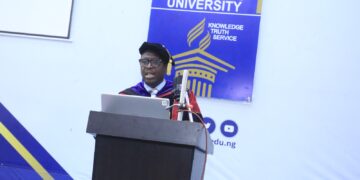
Delivering the keynote on behalf of the Registrar/Chief Executive of the Institute of Chartered Accountants of Nigeria, Adesola Okunola painted a sobering picture of Nigeria’s economic structure, describing it as a “revenue paradox.”

Despite ambitious development goals, the
country continues to operate with limited financial capacity. With a tax-to-GDP ratio hovering around 9.5 per cent, Nigeria lags behind comparable economies, not necessarily because citizens are unwilling to pay taxes, but due to systemic inefficiencies that weaken trust and compliance.
But beyond diagnosis, the lecture leaned heavily into solutions and that is where AI emerged as a game-changer.
Across the world, tax systems are increasingly powered by intelligent technologies capable of predicting revenue trends, detecting fraud, automating audits, and monitoring compliance in real time. For Nigeria, adopting such tools could mark a significant shift from reactive enforcement to proactive, data-driven governance.

Yet, as Okunola noted, technology alone cannot fix a broken system. Without strong institutions, clear regulations, and public trust, even the most advanced tools risk falling short. Issues such as data privacy, cybersecurity, and algorithmic bias must be carefully addressed to ensure that innovation does not create new vulnerabilities.
Beyond technology, the conversation also touched on structural reforms, particularly the proposed 2025 Tax Reform Agenda.
Central to this is the idea of consolidating multiple taxes into a unified framework—an approach aimed at simplifying compliance, reducing administrative bottlenecks, and improving efficiency across the system.
For the organisers, the lecture was more than an academic exercise. According to Kolawole Balogun, President of the Isiaq Family Foundation, the initiative reflects a broader commitment to advancing knowledge and supporting the next generation of accounting professionals.
Within the university, the impact is already taking shape. Faculty members see the platform as a bridge between theory and practice, one that exposes students to the realities of a rapidly changing global economy where digital transformation is no longer optional.
In many ways, the conversation at Summit University reflects a deeper shift in education itself—one where classrooms are no longer confined to textbooks, but are increasingly shaped by real-world challenges and emerging technologies.
As Nigeria continues its search for sustainable economic solutions, preparing students for the future of work now means equipping them with the tools to navigate and shape a technology-driven financial system.
Credit:ThePunch













 EduTimes Africa, a product of Education Times Africa, is a magazine publication that aims to lend its support to close the yawning gap in Africa's educational development.