
























A teacher shortage that training alone cannot quickly solve
Sub-Saharan Africa needs 15 million additional teachers by 2030, according to UNESCO’s Global Report on Teachers. The shortage is particularly severe in low-income countries, which averaged 52 primary school pupils for every trained teacher in 2022. In high-income countries, the figure was 15.
Training and deploying more teachers will take years. An AI tutor, on the other hand, can be set up on a school computer in an afternoon. That makes generative AI look like an obvious answer.

For policymakers, the harder question is whether the evidence supports this hope, and which children stand to benefit.
Promising results from Edo State
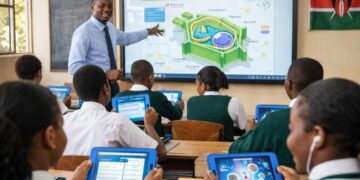
Some of the strongest evidence so far comes from Nigeria. Between June and July 2024, the World Bank conducted a six-week after-school pilot in secondary schools in Benin City, Edo State. Students used generative AI as a virtual tutor to improve their English. The results were striking. Students in the programme gained approximately 0.3 standard deviations on English tests, which the researchers equate to nearly two years of typical learning. The pilot also outperformed 80% of the education interventions in developing countries included in the team’s comparison.


Two findings are particularly relevant for education policymakers. Girls, who started the programme with lower scores than boys, made greater gains. Teachers also guided the sessions throughout. The researchers describe the results as evidence that AI can work as a tutor “when implemented thoughtfully with teacher support.”
That distinction matters. The pilot demonstrated the potential of AI to support learning alongside teachers. It did not establish that AI could deliver the same results without them.
Most schools lack the infrastructure to use AI tutors
The Edo pilot was conducted in schools with access to computers and electricity. However, many primary schools across the region lack both. According to UNESCO’s Global Education Monitoring Report team, the share of primary schools in Sub-Saharan Africa with electricity barely changed between 2015 and 2020, increasing from 30% to 32%. In rural areas of the region, fewer than three in ten people had access to electricity at home in 2021.
Even in Benin City, maintaining consistent attendance proved difficult. The World Bank team reported that flooding and teacher strikes kept students away, while learning gains increased with each additional session attended. This highlights a significant challenge: the children who need additional learning support are often the hardest to reach with technology.
Without targeted investment, AI tutoring could widen the gap between urban schools that can run these tools and rural schools that cannot.
The danger of treating AI as a cheaper alternative to teachers
The biggest risk may be political. With limited education budgets, AI chatbots may appear to be a cheaper alternative to recruiting and training teachers. UNESCO’s Global Report on Teachers warns against this approach. It argues that AI becomes a threat mainly when it is seen as a substitute for teachers, and that teachers need proper training to get any benefit from technology at all.
The protection of children’s data presents another concern. When UNESCO published its first global guidance on generative AI in education in 2023, it urged governments to protect learners’ data privacy and consider an age limit of 13 for classroom use. It also recommended that schools validate AI systems before allowing students to use them.
Yet most pupils in African primary schools are younger than 13. Children in some of the most overcrowded classrooms, who could potentially benefit from additional learning support, are also among those most vulnerable to poorly regulated AI use.
Put AI in teachers’ hands first
AI tutors alone cannot solve Africa’s teacher shortage. However, they could help address some of the gaps if governments make the right decisions about how the technology is introduced and used.
The first priority should be to use AI to support teachers rather than replace them. The Edo pilot’s learning gains came from teacher-led sessions, while UNESCO’s report also highlights the potential of technology to improve teacher training. Education ministries could build on this by introducing tools that help teachers prepare lessons and give feedback.
The second priority is to address basic infrastructure gaps before investing heavily in educational software. Solar power offers one possible solution, particularly as the global price of solar panels fell by 88% between 2010 and 2021.
Finally, governments need reliable data on where trained teachers and basic infrastructure are missing, so they can target support where it is needed most. AI could reshape African classrooms, but its impact will depend on the choices governments make today.

Used thoughtfully, it could extend learning support to children who have historically had limited access to it. Introduced without addressing existing inequalities, however, it risks widening the very gaps it is expected to close.
Credit: Oluwademilade Olanrewaju

Oluwademilade Olanrewaju is a First Class graduate of International Relations from Covenant University, Nigeria, and a Research and Writing Intern at EduTimes Africa, writing on education access and equity across the continent.
Her interests lie at the intersection of education policy and international development, particularly in how data and digital technology can address learning inequalities. Her recent work includes developing a Python pipeline to map shortages of trained teachers across Sub-Saharan Africa using UNESCO data.
Oluwademilade hopes to pursue graduate studies in public policy and build a career shaping evidence-based education and technology policy in Africa.













 EduTimes Africa, a product of Education Times Africa, is a magazine publication that aims to lend its support to close the yawning gap in Africa's educational development.