
























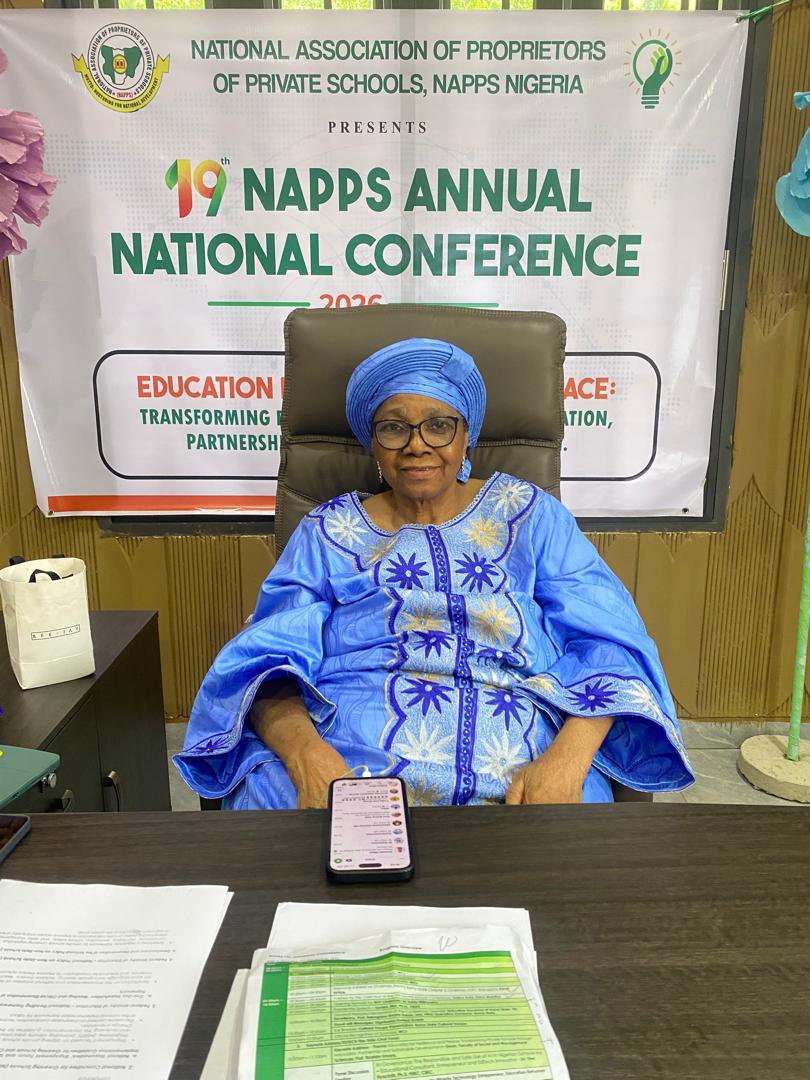


The National Association of Proprietors of Private Schools (NAPPS) has urged private school owners across Nigeria to strengthen resilience, embrace innovation and deepen partnerships with government and communities to address emerging challenges in the education sector.
The call was made at the association’s 19th Annual National Conference, held on 19 and 20 November 2026 in Maiduguri, Borno State, under the theme, “Education for Resilience and Peace: Transforming Private Schools through Innovation, Partnership, and Sustainable Development.”

The two-day conference brought together private school proprietors, education stakeholders, government representatives, technology experts, regulatory agencies and development partners to discuss strategies for improving school management, teaching, learning, security and sustainability amid economic pressures, insecurity and technological changes.
During the opening ceremony, the Chairman of the Local Organising Committee, Babagana Alkali, welcomed delegates and highlighted the resilience of Borno State’s education sector, while representatives of the state government and education agencies underscored the importance of public-private collaboration in advancing education.

The Chief Host, Haja Ase Abba Wakilbe, called for a Borno Declaration to support efforts towards eliminating out-of-school children and urged delegates to promote the safety and positive image of Borno State.
NAPPS highlights technology, AI and inclusive education
Technology integration and artificial intelligence featured prominently during the conference, with experts calling on private schools to prepare learners for a technology-driven future while adopting responsible practices in the use of emerging technologies.
During a panel discussion on EdTech in Nigerian schools, Dr. Timi highlighted the need for AI governance frameworks to address concerns around student safety, academic honesty and data privacy, while Alex Onya discussed how technology could improve school operations and productivity.
Aaron, representing iCode, highlighted the platform’s role in developing students’ logical thinking and confidence, while Engineer Abbasaidu advocated preparing learners for emerging technological challenges through robotics, hackathons and related initiatives.
Obi Brown also introduced Classpace.io, a learning platform offering digital technology resources, including coding, robotics and network configuration, to support curriculum implementation.
The conference further featured discussions on inclusive education, with Dr. Joanne Ndapu advocating learning approaches that accommodate diverse student needs without necessarily requiring expensive infrastructure.
Dr. Ahmed Amshi, in a presentation on artificial intelligence and emerging technologies, challenged schools to move from being technology consumers to producers, outlining practical steps for digital transformation, including assessing digital readiness, investing in teachers, building partnerships and prioritising solutions to real educational problems.
Resilience framework for private schools

On the second day, Dr. Hassan Zanna Boguma delivered a presentation titled “Resilience in Education: Building Private Schools that Survive Conflicts, Climate, and Economic Shocks”, outlining seven pillars for building resilient private schools.
The pillars include governance, security, climate resilience, financial sustainability, human capital development, digital continuity and community engagement.
He stressed the need for schools to develop structures and strategies capable of sustaining operations amid insecurity, environmental challenges, economic instability and other disruptions, particularly in vulnerable communities.
Discussions also highlighted the importance of collaboration among school proprietors, government and local communities in strengthening school safety, continuity and institutional sustainability.
Government agencies address examination, teacher certification issues
Representatives of education agencies, including the Teachers Registration Council of Nigeria (TRCN), West African Examinations Council (WAEC) and National Examinations Council (NECO), participated in discussions on examination administration, teacher certification, registration and regulatory compliance.
The TRCN representative addressed questions about teacher certification, requirements for educators with non-education qualifications and the Accelerated Teacher Professionalisation Pathway (ATPP), which seeks to support teachers in obtaining professional education qualifications.
Members also raised concerns about teacher registration timelines and certificate verification on the TRCN portal, with the association expected to follow up with the council.
WAEC representatives discussed examination malpractice, registration procedures and the importance of accurate candidates’ biodata, while defending the use of computer-based examination approaches as part of efforts to strengthen examination integrity.
NECO representatives also addressed questions relating to centre accreditation, examination personnel, examiner and supervisor payments, and the involvement of private school teachers in examination duties.
Meanwhile, Dr. Abubakar Isa presented updates from the National Education Management Information System (NEMIS), announcing that 85 per cent of school data had been collected, including information covering 96.2 per cent of public school pupils and 82 per cent of private school pupils, describing the exercise as a significant milestone in national education data collection.
Financial sustainability, partnerships and policy advocacy
Other sessions focused on financial planning, school security, curriculum implementation, teacher development and sustainable school management.
Patrick Ita emphasised the importance of budgeting, financial planning and building reserves, while also advocating stronger security measures in schools.
Dr. Buki outlined strategies for repositioning schools towards lifelong learning, including mindset changes, curriculum adaptation and the development of technical and vocational skills.
NAPPS leadership also discussed challenges facing private schools, including taxation, the proposed coalition of private school associations, pension arrangements for private school teachers and the need for stronger engagement with government.
The association highlighted its advocacy efforts and the approval of the National Policy on Non-State Schools, while urging members to strengthen participation in the association and fulfil their financial obligations.
Representatives of NAPTEP, the Universal Basic Education Commission (UBEC) and TRCN also delivered goodwill messages, reaffirming the importance of collaboration with private schools in improving education delivery, curriculum support, digital learning and teacher professionalism.
The conference also featured presentations by educational technology providers, publishers and organisations showcasing school management software, learning platforms, educational puzzles, digital learning solutions and student development programmes.
NAPPS is expected to follow up on discussions with regulatory agencies and government ministries, circulate the conference communique for further review, and coordinate initiatives aimed at strengthening partnerships and supporting member schools.
The conference concluded with renewed calls for unity among private school proprietors, innovation, improved school governance and collective action towards building resilient educational institutions capable of contributing to national development.


















 EduTimes Africa, a product of Education Times Africa, is a magazine publication that aims to lend its support to close the yawning gap in Africa's educational development.