
























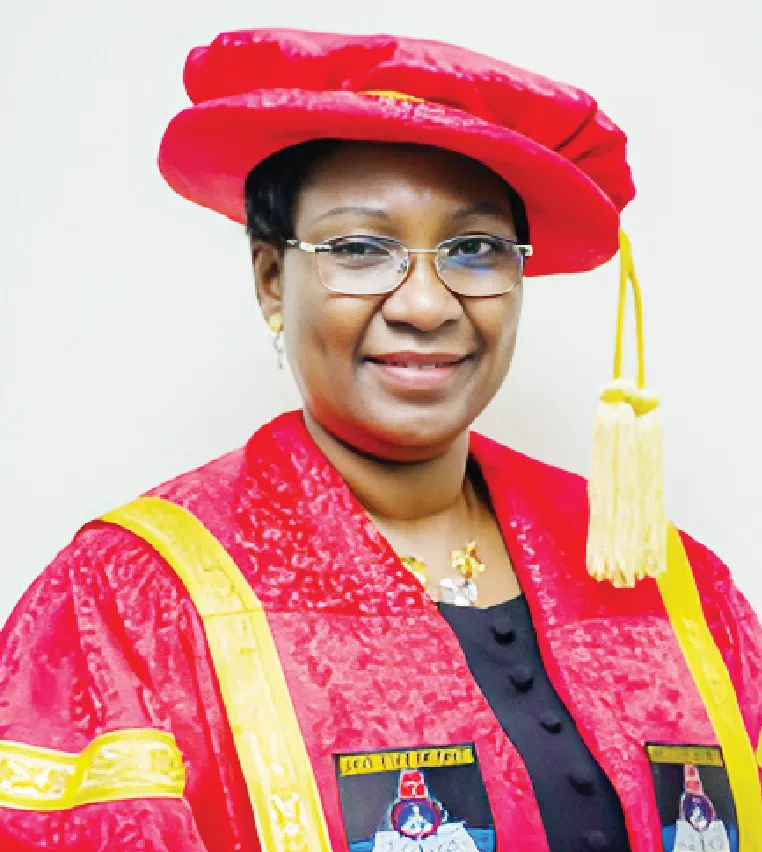


Former Vice-Chancellor of Lagos State University, Professor Ibiyemi Olatunji-Bello, has said public universities in Nigeria may need to charge at least N1 million per student annually to achieve financial sustainability.



Olatunji-Bello, who completed her five-year tenure as the ninth Vice-Chancellor of LASU on September 19, 2026, made the remarks while reflecting on her administration’s achievements, challenges and the future of the university.

The former Vice-Chancellor said although universities could increase their internally generated revenue, such income might still be insufficient to cover the rising cost of running tertiary institutions.
She disclosed that LASU’s internally generated revenue increased from about N3 billion when she assumed office in 2021 to N13 billion during her tenure. According to her, the increase was driven by new academic programmes, digital services, postgraduate programmes, consultancy, short-term courses and other revenue-generating ventures.

However, Olatunji-Bello said LASU’s financial needs remained significantly higher, noting that the university’s monthly wage bill alone exceeded N1 billion.
She also disclosed that the university’s electricity bill was about N140 million monthly, while LASU still needed to provide funds to augment salaries by about N240 million each month.
According to her, these expenses demonstrate the financial pressure facing public universities and the difficulty of achieving self-sustainability under the current funding structure.
“Any public university that wants to sustain financial independence will have to charge school fees of not less than N1m per student,” she said.
She argued that quality education requires substantial investment, urging parents to prioritise the education of their children.
Despite the financial challenges, Olatunji-Bello said LASU made significant progress during her tenure, including improvements in infrastructure, drainage, sanitation, academic accreditation, hostel accommodation and digitalisation.
She said the university’s student population was about 85,000, including postgraduate and part-time students, although about 12,000 students were on campus at any given time.

According to her, LASU currently accommodates about 8,000 students through its university-owned hostels and facilities operated under public-private partnership arrangements.

Olatunji-Bello also highlighted LASU’s performance in admissions, saying the university was declared the most subscribed institution by UTME candidates in Nigeria in 2025 and maintained the position in 2026.
She said LASU was also awarded N25 million for maintaining compliance with JAMB regulations in 2026.
On research and innovation, the former Vice-Chancellor disclosed that the university established a N5 million competitive internal research grant for academic staff.
She added that seven LASU academics secured more than N29 million in grants from the Lagos State Research and Innovation Council between 2022 and 2025.
The university also secured a N3 billion TETFund Centre of Excellence in 2026, which she said was the only centre of its kind in the South-West.
Olatunji-Bello further disclosed that LASU had digitalised several processes, including admission, screening and certificate collection. She said graduates could obtain certificates online, while an instant verification system had also been introduced.
On artificial intelligence, she said LASU had an AI policy approved by its Senate, which promotes the ethical use and proper citation of AI-generated or AI-assisted work.
She said the policy was introduced following the university’s earlier efforts to strengthen its plagiarism policy and research ethics processes.
The former Vice-Chancellor also identified the completion of the university’s Innovation Hub and a proposed Central Research Laboratory as projects she would have liked to see completed during her tenure.
She urged the Lagos State Government to support the completion of the Innovation Hub and other outstanding infrastructure projects at the university.
Olatunji-Bello also said her administration focused on maintaining industrial harmony by engaging regularly with staff unions and addressing concerns before they escalated into major strikes.
She further stated that LASU had maintained its position as the highest-ranked university in West Africa under the UI GreenMetric World University Rankings for several years, while also securing a vice-chairmanship position in the ranking system.
As she leaves office, Olatunji-Bello said her successor would need to sustain ongoing projects and continue efforts to strengthen LASU’s research, infrastructure, financial capacity and academic standing.










 EduTimes Africa, a product of Education Times Africa, is a magazine publication that aims to lend its support to close the yawning gap in Africa's educational development.