





















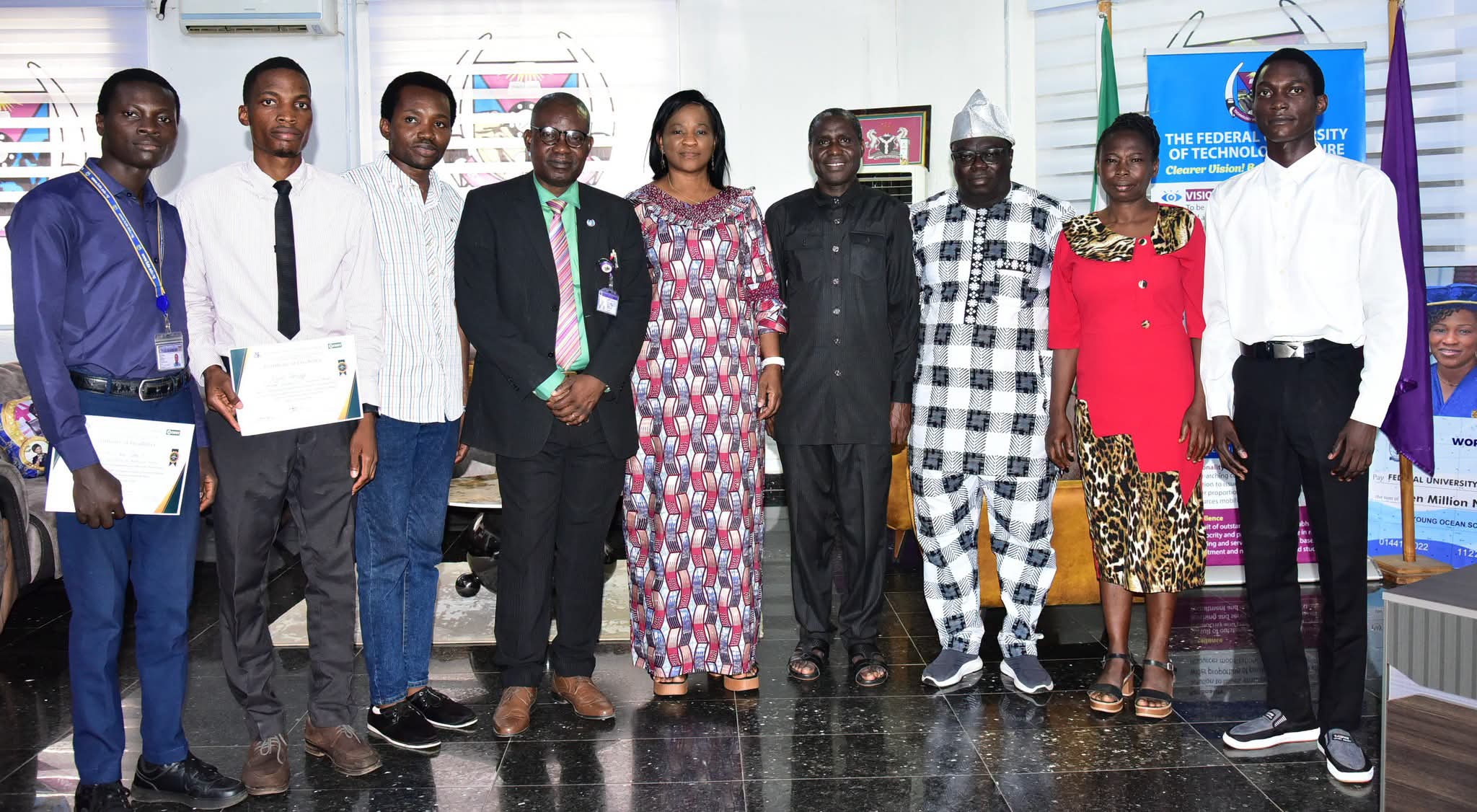


The Federal University of Technology, Akure, FUTA has once again demonstrated its leading position in engineering research in Nigeria, with a team of researchers from its School of Infrastructure, Minerals, and Manufacturing Engineering, SIMME, securing the highest honor in a recent publication competition organized by the Committee of Deans of Engineering and Technology of Nigerian Universities CODET. Also ,Heritage Ayeni a final student in the Department of Agricultural Engineering also won the First position in the 2026 CODET ,South West Zone 1 Students competition which took place on Wednesday June 17 ,2026
Presenting the awards and winners to the Vice Chancellor , Professor Adenike Oladiji on Tuesday June 30,2026, Dean SIMME Professor Christopher Akinbile stated that the School recorded a landmark national feat as one of its publications was adjudged the best nationwide, with Engr. Dr. Fidelis Ajibade emerging as the lead author of the top-ranked work. He noted that the School also recorded first-place wins in the individual and joint project categories at the student level, with 500-level students leading the effort. According to the Dean, the official communication confirming the results was received on the 29th of June, 2026, and the assessors have invited the awardees to Abuja for the formal activation of their projects and recognition.

The national ranking also highlighted the strength of engineering scholarship across the country, with other institutions recording impressive performances. SIMME’s winning paper, titled “Impact of biochar amendment on antibiotic removal and ARGs accumulation in constructed wetlands for low C/N wastewater treatment,” scored 95.3% and was authored by Engr. Dr. F. O. Ajibade and Co in the field of Civil Engineering, Water Resource and Environmental Engineering FUTA. In second position with 94% was a paper on “A dynamic maintenance planning methodology for HVAC systems based on Fuzzy-TOPSIS and Failure Mode and Effect Analysis,” submitted by Prof. Oluwafemi Olugboji, Dean, FUT Minna, in Mechanical Engineering. The third position, with 92.7%, went to “Optimization and techno-economic analysis of a mixed power system for sustainable operation of cellular sites in 5G era,” submitted by Engr. Prof Emmanuel Ufuah, Dean, Faculty of Engineering, Ambrose Alli University, Ekpoma, in Electrical & Electronic Engineering. By emerging first among these strong contenders, SIMME’s work on sustainable wastewater treatment has drawn national attention to FUTA’s leadership in environmental engineering and public health.


Responding to the presentation, the Vice-Chancellor, Professor Adenike Oladiji, expressed deep appreciation to the Dean and the award winners for bringing the news and for the diligence that made it possible. She stated that the achievement helps to further project and sell the University, because people now speak on FUTA’s behalf and associate the institution with development and excellence. Professor Oladiji observed that FUTA has reached a point where it needs no introduction, even among funding agencies and international organizations, and that this is because of scholars like those in SIMME who continue to protect the image of the University. She added that the University now maintains a database of achievers, so that in years to come the records of winners will still be referenced and celebrated, and she expressed confidence that those who win once will win again. The Vice-Chancellor also commended the spirit of voluntary participation, noting that excellence comes from those who put themselves forward for healthy competition and accept mentorship, and she charged the School to sustain that drive.

The achievement underscores FUTA’s commitment to producing scholarship that addresses critical national challenges and sets new benchmarks for academic excellence across Nigerian universities.













 EduTimes Africa, a product of Education Times Africa, is a magazine publication that aims to lend its support to close the yawning gap in Africa's educational development.