


























Sixty-one percent of employers surveyed say corporate reskilling programmes have delivered less value than expected. This is a quiet admission buried in MSM Unify’s The Future of Skills Report 2026 that deserves more attention than it has received. Eighty-two percent of students say they would rather learn durable skills inside university than reskill later, after the job has already exposed the gap. Both groups are describing the same failure from opposite ends. The retraining machine that was supposed to fix skills obsolescence after graduation is not working, and almost everyone downstream of it already knows this. What remains unresolved is whether universities are prepared to act on that knowledge before students and employers act on it for them.
The honest answer, according to the report’s own institution-leader data, is not yet. Only 22 percent of institution leaders surveyed say they have already restructured at least one degree around durable skills. The remaining 78 percent say they intend to within three years. That gap between intention and action is where the real competitive question for the next several admissions cycles now sits, and it applies with particular force to universities recruiting across Africa, where 71 percent of agents in the report’s partner network already say programme-level skill documentation, not institutional prestige, is their top request when evaluating a partner institution.



Redesign has to be structural, not decorative
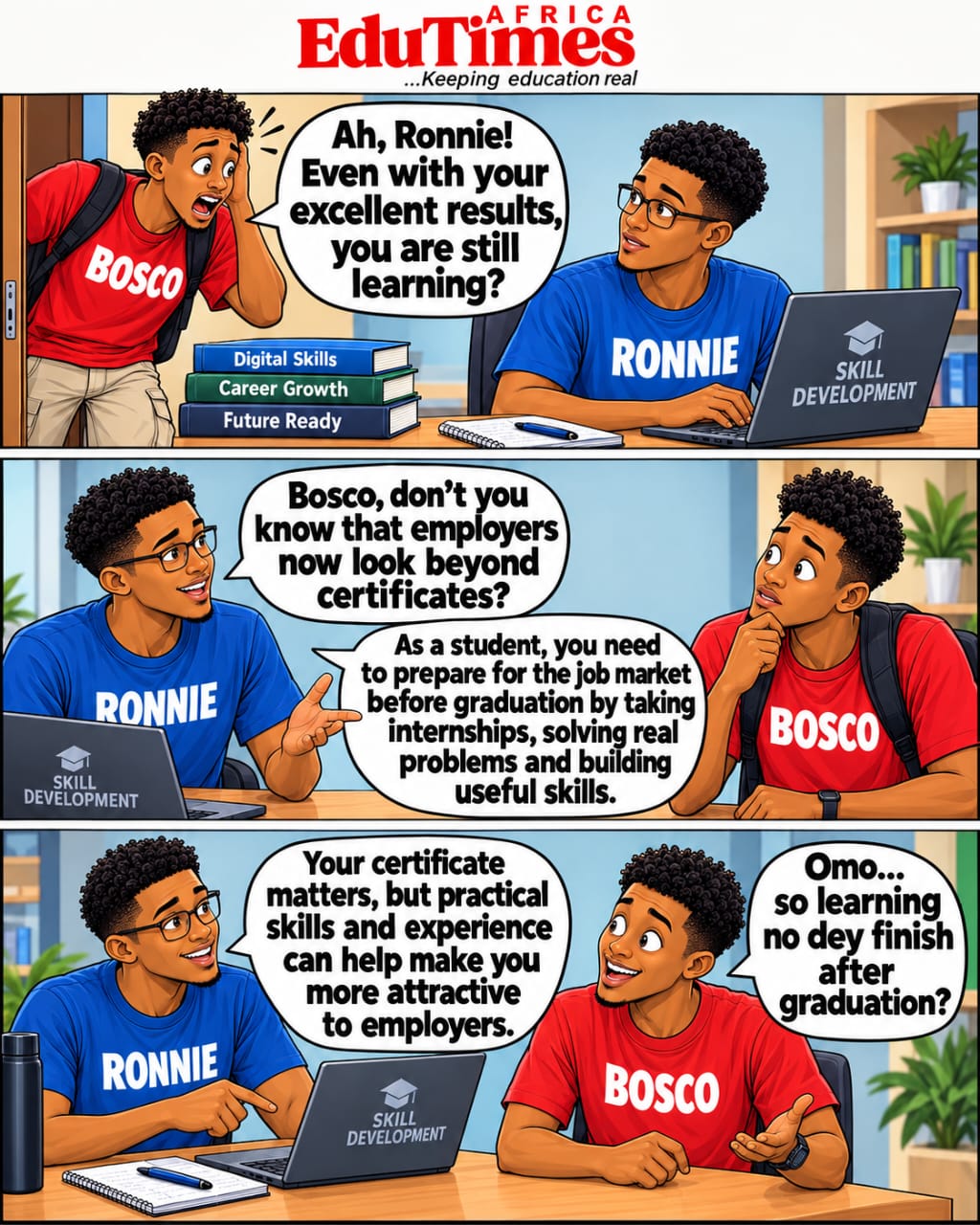
The change most universities have made so far is the easy one: adding an AI module, listing durable skills in a course description, updating marketing language. The report is specific about why this does not move the needle. Eighty-five percent of employers say durable skills develop primarily through life and work experience, not classroom instruction, which means listing a skill on a syllabus without building the experience that actually forms it changes nothing measurable about a graduate’s readiness.
Work-integrated learning needs to function as a graduation requirement rather than an elective, the model Arizona State University has built at scale, generating 1.8 million experiential-learning hours per cohort through its National Work-Integrated Learning Accelerator. AI literacy needs to be taught after critical thinking is established, not alongside it or before it. Building the AI layer on top of an unformed foundation does not produce an AI-literate graduate. It produces a graduate who has learned to skip the thinking the tool was supposed to assist.
For African universities and their international partners, this distinction carries a specific weight. Kenyan research cited in the report found that a university graduate now takes an average of five years to secure a first formal job, a delay employers link directly to training quality. A curriculum that adds AI content without first securing the critical thinking and communication foundation underneath it is not closing that gap. It may be widening it.

Disclosure is the harder, more urgent half
Structural redesign is the visible half of this problem. Disclosure is the half universities have been slower to confront, and it is arguably the more consequential one. The report is blunt about what agents and families are actually asking institutions for now: programme-level employment outcomes, published with methodology, not institutional averages or brochure prestige. Forty-four percent of international students already rely on recruitment agents to make this exact judgement on their behalf, and agents cannot advise well on information institutions will not release.

This is where the report’s Curriculum Redesign Maturity Index is useful less as a scoring exercise and more as an honest diagnostic question. An institution sitting ‘the skills-aware’ stage lists durable skills in its programme outcomes but does not assess them with any rubric. An institution at the ‘skills-ecosystem’ stage publishes programme-level graduate data publicly, ties employer partners to capstone assessment, and tracks outcomes after graduation as a matter of course, not as a marketing exercise undertaken once a year. Most universities, including many with genuinely strong teaching, sit somewhere in between, and the report’s finding that only one in five graduates say their programme actively helped them build professional connections suggests the gap between quality instruction and disclosed outcomes is real even at institutions doing good work.
The credibility premium now belongs to institutions willing to be measured

None of this is a call for universities to overhaul their academic identity. It is a call to close the distance between what an institution believes about its own graduates and what it is willing to prove, in public, with programme-specific data. The report’s African findings make the stakes concrete: students are already choosing international mobility at high rates, agents are already screening for documentation over prestige, and employers are already saying, plainly, that they hire for durable skills the classroom is supposed to build but rarely demonstrates having built.
Universities that redesign structurally and disclose specifically are not making a marketing choice. They are answering a question families, agents, and employers are already asking, whether or not the institution has decided to respond.














 EduTimes Africa, a product of Education Times Africa, is a magazine publication that aims to lend its support to close the yawning gap in Africa's educational development.