













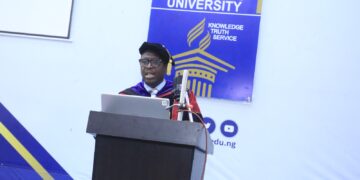









































The President of the Academic Staff Union of Universities, Chris Piwuna, has warned that Nigeria risks mismanaging large research funds if strong institutional structures are not established.



Piwuna gave the warning on Sunday while speaking at the Toyin Falola Interview Series, themed “Research, Innovation and Development.”

He proposed the establishment of a legally backed national research council to coordinate and regulate the country’s numerous research institutions.
According to him, Nigeria currently has more than 60 research institutions, many of which are underperforming due to weak coordination and a lack of clear strategic direction.

Piwuna said without proper oversight by statutory bodies, the country risks misusing large research allocations.
“We need to have a legal backing for a research council that would harmonise, streamline and bring all these research institutions and their activities together,” he said.
He also raised concerns about how potential funding could be handled if accountability mechanisms are not strengthened.
“If we flood the research space with N4tn in Nigeria today, where would it go? Let us answer it honestly. Will it go into people’s pockets? Could it be used for the 2027 general election? Or are we truly going to use it for research?” he asked.
While acknowledging the recent agreement between ASUU and the Federal Government, Piwuna cautioned that funding alone would not solve the problems facing Nigeria’s research sector.
He noted that the government had committed to allocating one per cent of the country’s annual GDP to research, which economists estimate could amount to about ₦4 trillion annually.
Despite this, he stressed the need for stronger collaboration between universities and private sector players.
Using Aliko Dangote as an example, Piwuna suggested that companies could sponsor advanced academic research targeted at solving industry challenges.
“What if Dangote decides to sponsor 100 PhDs in selected Nigerian universities, and whatever they are doing should improve his refinery or cement factory?” he said.
Piwuna added that a strong partnership between government, academia and industry is essential for building a sustainable research ecosystem.

“We cannot do this successfully without a genuine handshake with the private sector. Let them tell us what they want; let us tell them what we can give,” he said.
He also highlighted a disconnect between policymakers and researchers, warning that it continues to slow national development.
“The research environment in Nigeria needs to change fundamentally. There is a total disconnect now between what the policies are and those of us who should produce research whose outputs would meaningfully make the country make progress,” he said.

The panel session was chaired by renowned historian Toyin Falola and featured academics including Ilesanmi Adesida, Akintunde Ibitayo Akinwande, Chimay Anumba, and Lola Eniola-Adefeso.
The discussion focused on how research, innovation and development can shape Africa’s future, with participants highlighting the need for strategic investment, institutional support and multidisciplinary collaboration to strengthen the continent’s knowledge economy.












 EduTimes Africa, a product of Education Times Africa, is a magazine publication that aims to lend its support to close the yawning gap in Africa's educational development.