













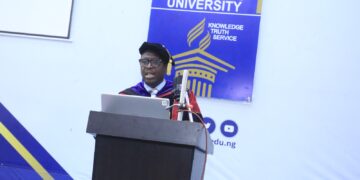














































In a move that reflects a growing shift toward skills-driven education, the Vice-Chancellor of Olabisi Onabanjo University, Adedeji Olayinka Johnson Agboola, has announced the introduction of 50 self-paced short courses aimed at equipping students with practical, industry-relevant skills.



The initiative, unveiled at the university’s main campus in Ago-Iwoye during a meeting with the Director General of the Nigerian Tourism Development Authority, Ola Awakan, is designed to address the persistent gap between academic qualifications and employability in Nigeria’s labour market.

According to the Vice-Chancellor, the programme will be offered free to all students and structured in a flexible format, allowing participants to complete courses at their own pace alongside their regular academic work.
“Our goal is to ensure students don’t just graduate with certificates, but are employable and can also become employers of labour,” Agboola said, underscoring the university’s commitment to practical education.

The courses, which will be introduced in phases, span high-demand areas such as technology, entrepreneurship, communication, data analytics, and tourism. They are intended to complement existing degree programmes by providing students with additional competencies that align with real-world demands.

For the university, the initiative represents more than curriculum expansion—it signals a deliberate repositioning toward outcome-based education. Agboola noted that traditional academic training alone is no longer sufficient in a rapidly evolving economy.
“The curriculum must meet real-world needs. These short courses will bridge gaps we have identified and give students additional credentials they can use immediately,” he added.
He emphasised that skills acquisition is central to the institution’s mandate, warning that graduates without practical competencies risk being left behind in an increasingly competitive job market.
“If a graduate is not skilled, there is no way they can compete. We are committed to changing that,” he said.
Beyond improving employability, the university also sees the programme as a pathway to fostering entrepreneurship and innovation among students. By integrating industry-focused learning into the academic experience, OOU aims to produce graduates who can create jobs rather than depend solely on them.

The initiative forms part of the university’s broader strategy to establish itself as a hub for practical learning and enterprise development, not just within Ogun State but across Nigeria’s higher education landscape.
As universities across the country grapple with the challenge of producing job-ready graduates, OOU’s approach highlights an emerging consensus: that the future of education lies in blending academic knowledge with practical, market-driven skills.
Credit: Tribune















 EduTimes Africa, a product of Education Times Africa, is a magazine publication that aims to lend its support to close the yawning gap in Africa's educational development.