























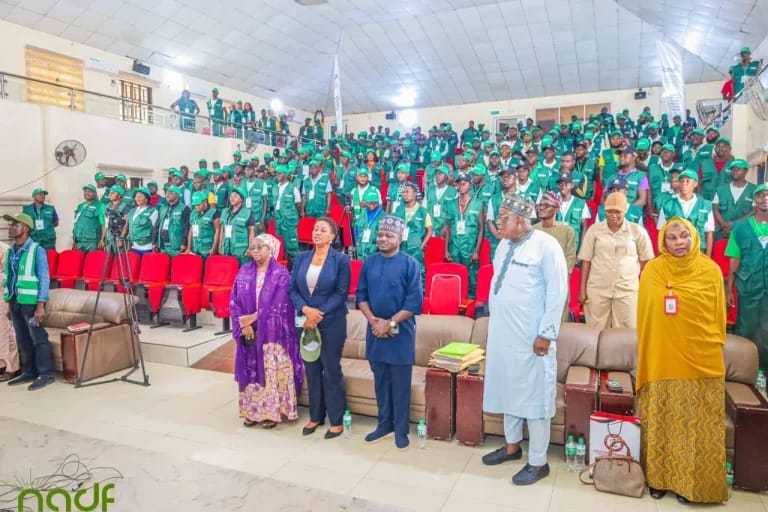


The National Agricultural Development Fund (NADF) has graduated the first cohort of participants trained under its National Agricultural Mechanisation Service Providers Training Programme, as part of efforts to strengthen agricultural mechanisation and improve food production in Nigeria.



The programme is targeting the training of 4,000 tractor drivers and mechanics across the country, with the first phase drawing about 250 participants from the six geopolitical zones.

Speaking in a statement issued by NADF on Thursday, the Executive Secretary and Chief Executive Officer of the fund, Mohammed Ibrahim, described the graduation as an important step in the Federal Government’s efforts to modernise agriculture through mechanisation, innovation and human capital development.

According to Ibrahim, the programme goes beyond teaching participants how to operate and maintain agricultural machinery.

He said it is designed to build the technical skills, maintenance culture and systems required to keep agricultural machines operational and support sustainable food production.
The trainees received intensive training in agricultural mechanisation service delivery, machinery and equipment management, occupational safety, enterprise development, sustainable maintenance, environmental conservation and environmental sustainability.
“Beyond technical skills, the programme has strengthened professionalism, enterprise mindset and operational discipline required to sustain an efficient mechanisation ecosystem,” Ibrahim said.
The NADF boss said the pilot cohort consisted of about 232 trainees, who were certified by the Industrial Training Fund.
The certification will qualify the graduates for inclusion in a national database of proficient agricultural mechanisation service providers being developed by NADF.
According to Ibrahim, the database is expected to support long-term public and private-sector investment in agricultural machinery and implements. It could also enable certified service providers to be entrusted with multimillion-naira agricultural assets.
However, he stressed that the success of agricultural mechanisation should not be measured simply by the number of tractors and other machines acquired.

Rather, he said the focus should be on keeping the machines operational, productive and economically viable.
Ibrahim noted that previous investments in agricultural mechanisation had sometimes failed to achieve their full potential because of inadequate technical capacity, weak maintenance systems and poor accountability.
“The future of agricultural mechanisation in Nigeria depends not only on acquiring machines, but on sustaining them through technical competence, accountability, and responsible asset and environmental stewardship,” he said.
The training programme forms part of NADF’s wider interventions across the agricultural value chain.
The fund said its Farm Input Support Programme currently supports 109,000 smallholder farmers, while its Grassroots Digital Extension Corps initiative has trained 1,884 extension agents and food security specialists nationwide.
NADF is also investing in agricultural research institutions through modern laboratories, digital extension infrastructure, biotechnology facilities, renewable energy systems, irrigation infrastructure and innovation platforms.
Ibrahim said the newly trained participants represented a new generation of skilled practitioners who could improve machinery utilisation, reduce downtime, expand access to mechanisation and protect investments in agricultural assets.
The National President of the Tractor Owners and Hiring Facilities Association of Nigeria, Abdullahi Mohammed, commended NADF for bringing participants from different parts of the country together for the training.
He noted that although machinery manufacturers and vendors often provide initial training, their technical teams may not always be available in every location where tractors operate.
“We need much of this training. The service provider wants training; the operator and the mechanic also need this type of training,” he said.
Mohammed called for continued collaboration among NADF, machinery manufacturers, vendors and service providers, as well as government support to make agricultural machinery more affordable.














 EduTimes Africa, a product of Education Times Africa, is a magazine publication that aims to lend its support to close the yawning gap in Africa's educational development.