


















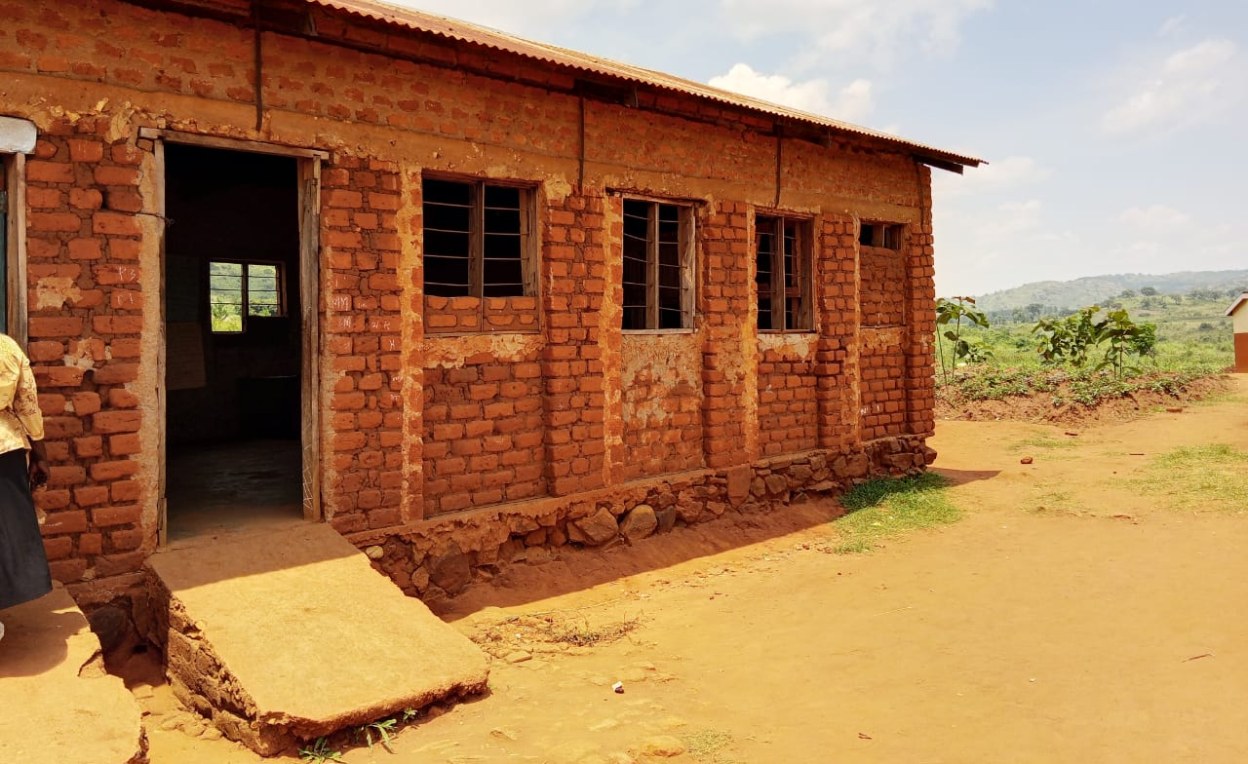


A primary school in Uganda’s Nebbi District is facing severe overcrowding and a critical shortage of teachers, classrooms and desks, with 538 pupils currently being taught by just three teachers.
Paleo NFE School, which has operated for about 25 years on a half-acre piece of land, has only three teachers serving pupils from Primary One to Primary Three.

According to school records, Primary One has 340 pupils, while Primary Two and Primary Three have 134 and 64 pupils respectively.
The situation has resulted in an extreme pupil-teacher ratio, with one teacher responsible for about 340 pupils in Primary One and another handling 134 pupils in Primary Two. This is far above the recommended ratio of one teacher to 53 learners.

The overcrowding extends to the classrooms. The 340 Primary One pupils are taught in a single classroom, while pupils in the lower classes reportedly have no desks and sit on the floor during lessons.

Primary Three pupils study in a one-room grass-thatched structure donated by a well-wisher in 2000.
The school’s headteacher, Teddy Oyeru, said the institution initially offered only Primary One and Primary Two, leaving pupils with no option but to travel several kilometres to other schools after completing Primary Two.
«“Each year when children finished P.2, they had nowhere to go. To continue, they had to trek 4km to Azingu or 3km to Omyer, and so many of them dropped out,” Oyeru said.»
She said the school once had more teachers, but several were terminated after failing to meet the required academic qualifications.
“We had more teachers before. But the Ministry terminated them for lacking qualifications. Now it is just three of us struggling with 538 pupils,” she said.
The teacher shortage has also placed additional pressure on the headteacher, who must combine administrative duties with teaching full lessons.
Oyeru said most parents are peasant farmers and have limited financial capacity to provide additional support for the school.
She appealed to education stakeholders and local authorities to help the school acquire more land, saying the limited space was making it difficult to develop adequate infrastructure.
District Seeks Government Intervention
Innocent Openjtho, the Nebbi District education officer, said the district had written to Uganda’s Ministry of Education and Sports requesting that all seven Non-Formal Education (NFE) centres in the district be upgraded into fully fledged primary schools.
He acknowledged the challenges facing the centres but said shutting them down could push many children out of school.
“We are aware of the overwhelming number of learners in those NFE schools, but we can’t just close them because we have few teachers or limited structures. We fear these learners may drop out, so we rather keep them in school,” Openjtho said.
Data from the Nebbi District education department shows that 979 teachers currently serve 102 government-aided primary schools in the district.
Paleo NFE School received Shs1.7 million in capitation grants in 2025, with the allocation increasing to Shs2 million in 2026. However, school administrators say the funds remain inadequate to address the institution’s needs, including efforts to support additional teachers through Parent-Teacher Association contributions.
Paleo is one of seven NFE centres operating as Complementary Opportunities for Primary Education (COPE) centres in Nebbi District. Collectively, the centres have 3,882 learners.
Alala COPE Centre has the highest enrolment, with 1,687 learners from Primary One to Primary Seven, while Kulekule has 633 learners up to Primary Four.
Paleo follows with 538 learners up to Primary Three, while Nyaful in Akworo has 505 learners.
The COPE programme was developed in 1994 and 1995 by Uganda’s Ministry of Education and Sports in collaboration with UNICEF to provide flexible alternative education for children and young people who missed conventional schooling because of poverty, conflict, child labour and other barriers.
However, the rapid growth in enrolment at Paleo NFE School has placed immense pressure on its limited classrooms, teachers, desks and other learning resources, leaving hundreds of pupils to learn in highly constrained conditions.







 EduTimes Africa, a product of Education Times Africa, is a magazine publication that aims to lend its support to close the yawning gap in Africa's educational development.