
























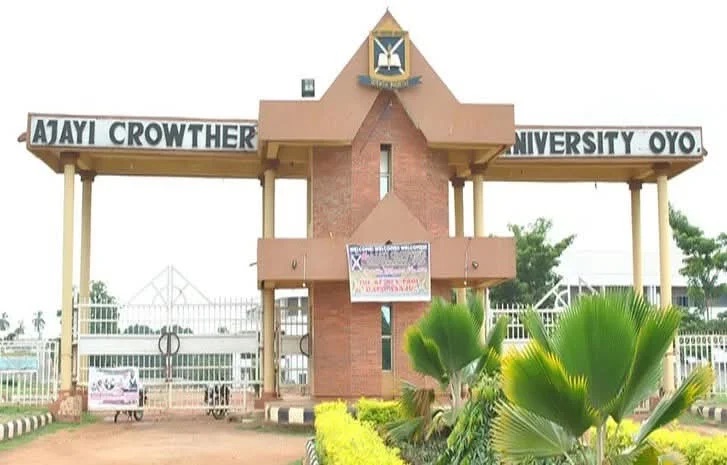


Ajayi Crowther University (ACU), Oyo State, has rewarded its three best graduating students with a combined ₦10 million in cash prizes at its 18th convocation ceremony, in recognition of their outstanding academic performances.

The overall best graduating student, Elizabeth Ayomide Obarotimi, from the Department of Industrial Chemistry, Faculty of Natural Sciences, received ₦5 million after recording a Cumulative Grade Point Average (CGPA) of 4.91 out of 5.0.

The second-best graduating student, Olufunmilayo Adesewa Owoeye, from the Department of Economics, Faculty of Social Sciences, received ₦3 million for graduating with a CGPA of 4.88.

Similarly, Opeyemi Joy Oloyede, of the Department of Radiography and Radiation Science, Faculty of Basic Medical Sciences, received ₦2 million after finishing as the third-best graduating student with a CGPA of 4.86.
Presenting the awards, the Pro-Chancellor and Chairman of the Governing Council, Dr Olutoyin Okeowo, announced that the university would double the cash rewards at its next convocation to encourage academic excellence and motivate students to maintain high standards.
He urged the graduates to apply their knowledge and skills to addressing societal challenges, while maintaining discipline, integrity and commitment to excellence in their chosen professions.
Beyond her ₦5 million cash reward, Obarotimi received eight additional academic prizes in recognition of her outstanding performance, including awards for the overall best graduating student, best female graduating student and best graduating student in her faculty and department.
Meanwhile, the Vice-Chancellor, Prof. Ebunoluwa Oduwole, disclosed that 4,104 graduands would receive various academic qualifications at the university’s 18th convocation.
She said 116 students graduated with First Class honours, while 1,207 obtained Second Class Upper Division degrees. Another 693 earned Second Class Lower Division degrees, while 45 graduated with Third Class honours.
At the postgraduate level, 158 graduands received postgraduate diplomas, 1,798 earned master’s degrees and 87 received doctoral degrees.
Oduwole also renewed calls for the Federal Government to extend the interventions of the Tertiary Education Trust Fund (TETFund) and the Nigerian Education Loan Fund (NELFUND) to private universities and their students.
She argued that access to government-supported educational funding should be determined by students’ needs rather than the ownership of their institutions.
According to her, excluding private universities and their students from the funding arrangements limits opportunities for infrastructure development, research support and access to affordable higher education.
She disclosed that the Committee of Vice-Chancellors of Private Universities in Nigeria was engaging the Federal Ministry of Education, the National Assembly, TETFund and NELFUND managements to seek amendments to the relevant laws.

The vice-chancellor maintained that private universities also contribute to national development by training Nigerian students and should therefore be considered in policies designed to strengthen the country’s higher education system.
She further disclosed that the National Universities Commission had approved new academic programmes for the university’s 2026/2027 academic session, including Medicine and Surgery, Pharmacy, Public Health and Artificial Intelligence.
The university also secured approval from the Council of Legal Education to increase its Law admission quota from 50 to 100 students.
Oduwole added that the university was strengthening its infrastructure, research capacity and academic partnerships to improve the quality of teaching and learning.













 EduTimes Africa, a product of Education Times Africa, is a magazine publication that aims to lend its support to close the yawning gap in Africa's educational development.