
























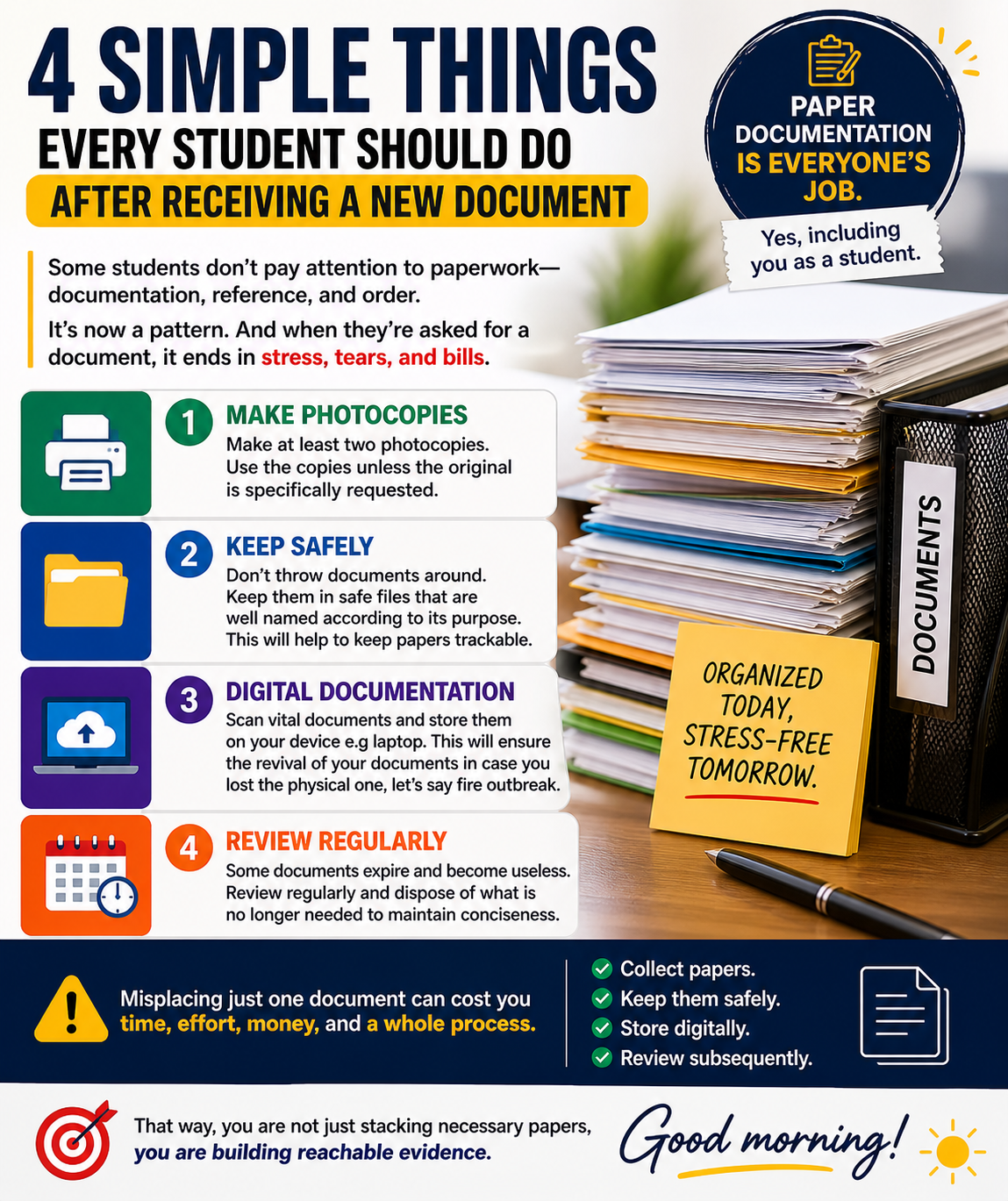


Paper documentation is everyone’s responsibility, including students.
Across Nigerian tertiary institutions, a subtle but costly habit is gaining ground: poor attention to paperwork. From documentation and referencing to name arrangement and proper filing, many students treat important documents with a level of carelessness that often backfires.

In registration centres, submission points, and administrative offices, the pattern is easy to spot. When asked to produce a document, some students begin a frantic search—bags opened, files scattered, calls made. What should be a simple process quickly turns into stress, delays, and, in many cases, extra expenses.
This is not always due to lack of intelligence or effort. It is often the absence of a simple but essential system—proper document management.

In an academic environment where paperwork plays a central role, losing or misplacing just one document can disrupt an entire process. It can delay admission, stall clearance, or even lead to financial loss.
To avoid these setbacks, students must begin to treat documentation as a skill to be learned and practiced. Here are four simple but effective habits to adopt after receiving any new document:
📌Make Photocopies
Every important document should have at least two photocopies. These copies should be used for submissions unless the original is specifically requested. This reduces the risk of loss or damage to original documents.
📌Keep Documents Safely
Documents should not be handled casually. They should be stored in clearly labeled files and arranged according to purpose. When papers are properly organized, they become easy to access and track.
📌Go Digital
Students should scan and store vital documents on their devices—phones or laptops. In cases of loss, theft, or unforeseen incidents like fire outbreaks, digital copies serve as a reliable backup.
📌Review Regularly
Not all documents remain relevant forever. Some expire or become obsolete over time. Regular review helps identify such papers, making it easier to discard what is no longer useful and maintain order.

The importance of documentation cannot be overstated. A single missing paper can cost time, money, effort, and sometimes an entire academic opportunity.
Students must move beyond merely collecting papers to managing them effectively.
Collect documents.
Keep them safe.
Store them digitally.
Review them regularly.
In doing so, students are not just gathering papers, they are building accessible and reliable evidence for their academic journey.
EduTimes Africa wishes you the best.














 EduTimes Africa, a product of Education Times Africa, is a magazine publication that aims to lend its support to close the yawning gap in Africa's educational development.