


















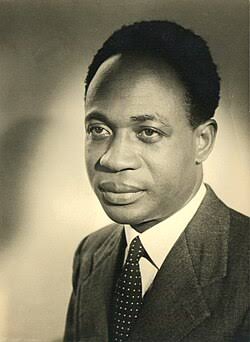


Dr Kwame Nkrumah was a Ghanaian nationalist, educator, political philosopher and one of Africa’s most influential independence leaders. He led the Gold Coast to independence in 1957, making Ghana the first sub-Saharan African country to gain independence from British colonial rule. Beyond politics, Nkrumah was a passionate advocate for education, African unity and national development.


15 Facts About Kwame Nkrumah

1. Kwame Nkrumah was born on 21 September 1909 in Nkroful, then part of the British Gold Coast (now Ghana).
2. His birth name was Francis Kwame Nkrumah, although he later became widely known simply as Kwame Nkrumah.

3. He trained as a teacher after graduating from Achimota College, beginning his career in education before entering politics.
4. He studied in the United States, earning degrees from Lincoln University and later the University of Pennsylvania.
5. Nkrumah spent about 10 years studying and working in the United States, where he developed many of his political and Pan-African ideas.
6. He later moved to the United Kingdom, where he helped organise the historic Fifth Pan-African Congress in Manchester in 1945.
7. He returned to the Gold Coast in 1947 to join the struggle for independence from British colonial rule.
8. In 1949, he founded the Convention People’s Party (CPP), which became the leading force in Ghana’s independence movement.
9. He became Ghana’s first Prime Minister on 6 March 1957, when the country gained independence.

10. In 1960, he became the first President of the Republic of Ghana.
11. Nkrumah invested heavily in education, expanding schools, teacher training and higher education to support national development.

12. He was a leading advocate of Pan-Africanism, believing that African countries should unite politically and economically.
13. He played a key role in the establishment of the Organisation of African Unity (OAU) in 1963, the organisation that later evolved into the African Union (AU).
14. He authored several influential books, including Africa Must Unite, Neo-Colonialism: The Last Stage of Imperialism, and The Autobiography of Kwame Nkrumah.
15. Kwame Nkrumah died on 27 April 1972, but he remains one of Africa’s most celebrated statesmen, with monuments, universities and institutions bearing his name across the continent.
Kwame Nkrumah’s legacy extends far beyond Ghana’s independence. His commitment to education, self-determination and African unity continues to inspire leaders, students and scholars across the continent. More than five decades after his death, he remains one of the most influential figures in modern African history.









 EduTimes Africa, a product of Education Times Africa, is a magazine publication that aims to lend its support to close the yawning gap in Africa's educational development.