

























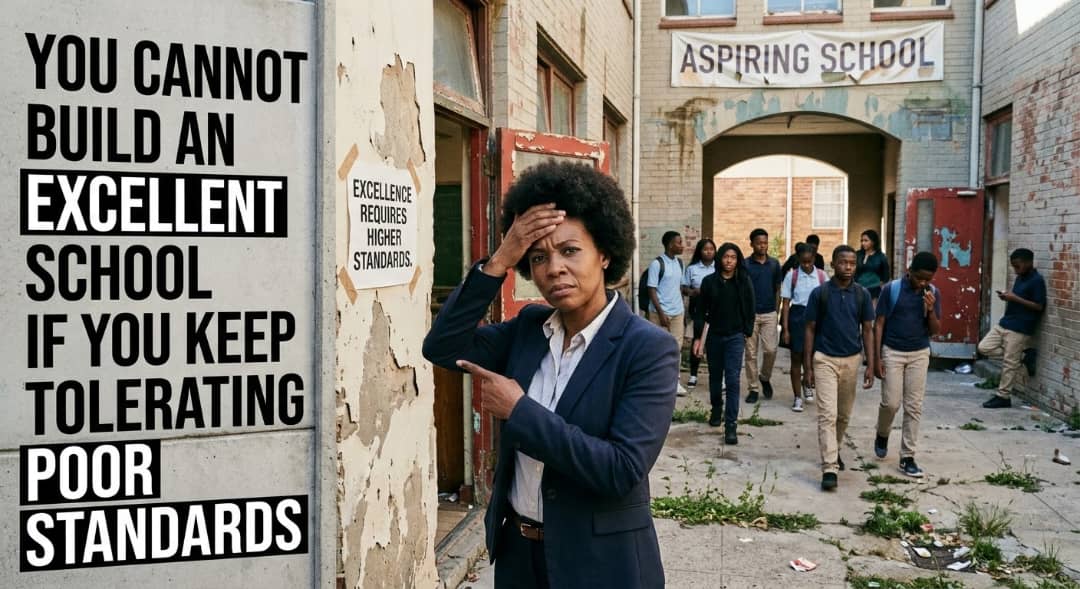


You can talk about educational excellence, high academic standards, and student-centered values all day, but if poor lesson preparation goes uncorrected, late grade submissions keep being excused, teachers ignore curriculum policies, and nobody is held accountable, your staff will quickly learn the school’s real standard.
Not the vision statement printed in your handbook or painted on the reception wall but the standard you tolerate.
School culture isn’t built during orientation week or staff retreats.

It is built every single day by what school leaders correct, what they overlook, what they reward, and what they allow to continue in classrooms and hallways.
Let me show you 6 behaviors school management must correct before they become embedded school culture:

1. Poor Quality of Instruction and Preparation
When a teacher consistently comes to class unprepared, delivers disengaged lessons, or turns in low-quality assessments, and school leadership says nothing, you send a clear message: student learning is secondary.

* Set explicit expectations for instructional delivery, lesson planning, and assessment design.
Conduct frequent learning walks not just formal appraisals and provide immediate, constructive feedback. Show teachers what exemplary instruction looks like and offer the coaching needed to reach it.
2. Chronic Late Grading and Report Submissions:
Missing deadlines for lesson plans, report cards, or student intervention records is rarely just an administrative inconvenience; it impacts student feedback, parent trust, and smooth school operations. When leadership excuses habitual lateness, deadlines become optional across the entire campus.
* Establish realistic, clear operational timelines, but hold the line once set. If a pattern develops, address it directly in private, identify if workload issues exist, and establish clear accountability structures before “late” becomes the baseline.

3. Toxic or Disrespectful Behavior Staff-Wide:
Never tolerate toxicity, gossiping, or unprofessional behavior from a staff member simply because their students get top exam scores or parents like them.
High-performing individuals who create a hostile staff room or undermine colleagues erode the morale of the entire school.
* Remind your leadership team that professional conduct is a non-negotiable core competency. Address interpersonal friction and unprofessional communication head-on. Protect your school’s emotional environment with the same rigor you protect physical safety.
4. Blaming Students, Parents, or “System” Issues:
When learning outcomes drop or classroom management fails, the response reveals a educator’s mindset. If staff routinely blame student backgrounds, unsupportive parents, or lack of resources rather than evaluating their own practice, growth halts completely.
* Shift the culture from excuse-making to professional agency. Teach leaders and teachers to ask: “What was within our control that we could have done differently?”
Encourage honest reflection, continuous learning, and action-oriented problem solving.
5. Bypassing School Policies and Safeguarding Protocols
Whether it’s ignoring classroom behavior management frameworks, skipping required attendance checks, or taking shortcuts on student safeguarding protocols, policy drift is dangerous in a school environment. A policy that is not enforced is not a policy, it is just a suggestion.
* Ensure staff clearly understand the why behind every key policy, particularly those involving student safety, equity, and discipline. When policies are bypassed, intervene immediately to re-establish standards before non-compliance spreads.
6. Inconsistent Leadership Standards:
You cannot demand strict punctuality, thorough preparation, and deep commitment from teachers if school leaders show up unprepared, communicate erratically, or enforce rules arbitrarily. If standards are only applied during inspections or parent-teacher conferences, staff will treat compliance as a game.
* Model the exact discipline, respect, and professionalism you expect from your teachers. Hold your leadership team to an even higher standard of consistency than the teaching staff. Alignment between management actions and words builds trust.
You do not build an outstanding school simply by hiring talented educators.
You build it by defining clear operational and pedagogical standards and having the moral courage to protect them every single day.
What school leadership tolerates today will inevitably become the school culture you have to fight tomorrow.
Correct poor practice while it is still just an isolated behavior, before it becomes “how we do things around here.”
How does this alignment reflect the current dynamics within your school’s leadership team?
My name is Stephen Aremu, I am an Education Strategist and a School Growth Consultant. 08055266237
Credit: Stephen Aremu











 EduTimes Africa, a product of Education Times Africa, is a magazine publication that aims to lend its support to close the yawning gap in Africa's educational development.
