























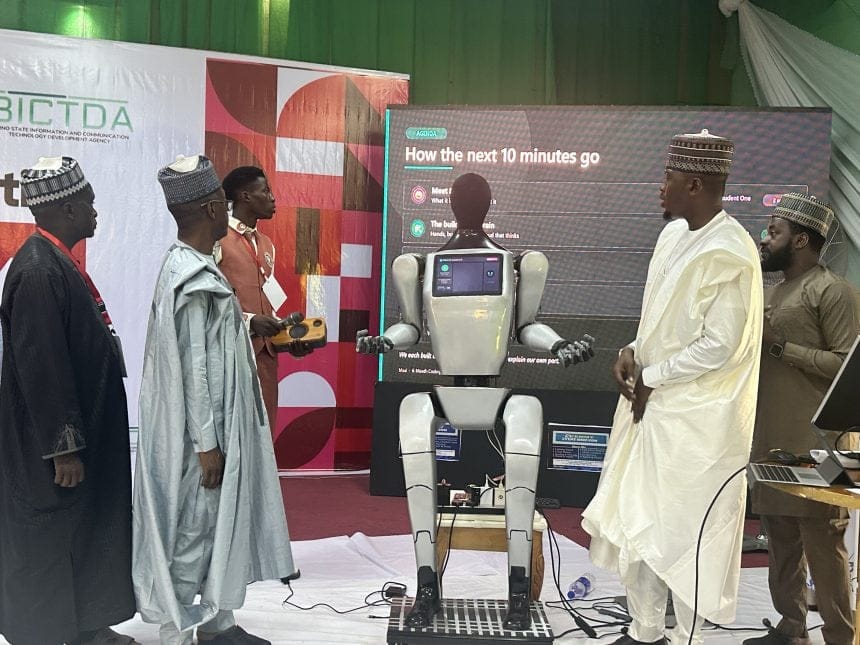


What started as an artificial intelligence training programme has produced an innovation that could support learning in classrooms, as secondary school students in Borno State developed a humanoid robot designed to answer questions and assist children with their studies.



The robot was unveiled on Tuesday in Maiduguri during the graduation ceremony of participants in the “Empowering Ideas, Empowering Communities” Artificial Intelligence Bootcamp and Data Analytics Fellowship, organised by Maxzeeton Technology in collaboration with the Borno State Information and Communication Technology Development Agency (BICTDA).

Speaking at the event, the Managing Director of Maxzeeton Technology, Abdullahi Usman Alkali, said the robot was designed and built by the students after months of training in artificial intelligence and robotics.
According to him, the programme, which began in September 2024, was initially scheduled to last six months but was extended to give participants enough time to develop practical innovations.


Alkali explained that the project was inspired by challenges in the education sector, particularly the shortage of teachers in some communities.
He said the robot can support learning both at home and in the classroom, especially by helping pupils solve mathematics problems.
“The robot is designed to guide learners step by step, especially when they are faced with difficult mathematical problems,” Alkali said.
He added that the project shows what young people can achieve when they are equipped with the right skills and opportunities.
Also speaking, the Executive Secretary of BICTDA, Kabir Wanori, said the initiative forms part of the Borno State Government’s digital transformation agenda aimed at equipping young people with practical technology skills.
He noted that students received training in ICT, robotics and innovation, enabling them to transform their ideas into real-life solutions.
Wanori described the robot as an important first step toward expanding the use of robotics in sectors such as education, agriculture and healthcare.
“We want a situation where, in the future, robots can perform tasks in industries and other areas of life,” he said.

He added that the programme is also intended to create talent, generate wealth and promote innovation, while promising additional training and international exposure for the students.
One of the participants, Al-Mustapha Kabir Matazu, said the training covered programming, coding, robotics and artificial intelligence, leading to the development of the robot, which the team named “Max Zulum.”
According to him, the robot features a screen on its chest for interaction and voice communication and is designed to help children learn through simple, step-by-step explanations.
Another participant, Fatima Abdulrahman, said the bootcamp had transformed her life, especially after she emerged as a competition winner.
She added that the experience had inspired her to continue developing her technology skills and use innovation to make a positive impact in her community.
The event concluded with demonstrations of the students’ projects, marking the successful completion of their training in artificial intelligence, robotics and data analytics.
The innovation highlights how early exposure to emerging technologies can empower students to develop practical solutions to real-world challenges while preparing them for careers in the digital economy.












 EduTimes Africa, a product of Education Times Africa, is a magazine publication that aims to lend its support to close the yawning gap in Africa's educational development.