



























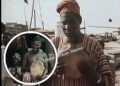
His name was Omoba Benjamin Aderounmu, popularly known as Kokoro, the legendary blïnd minstrel. Born on February 25, 1925, into a royal family in Owo, present-day Ondo State, Kokoro’s life took a difficult turn when he lost his sight as a child. Accounts differ on whether he was 10 or 12 years old when he became blïnd.
But losing his sight did not silence his musical talent. Instead, music became his means of survival and his pathway to recognition.

FROM OWO TO THE STREETS OF LAGOS
Kokoro began developing his musical career in southwestern Nigeria before eventually moving to Lagos in 1947. He initially accompanied his singing with a small drum but later became famous for using a tambourine-like instrument known as the samba. With his distinctive voice and rhythmic accompaniment, he developed a style that allowed him to perform without needing a large musical band.

His songs, often delivered in Yoruba, explored everyday experiences, love, money, human relationships and the challenges of society. During the 1960s and 1970s, Kokoro became a familiar voice on Nigerian radio. His musical knowledge and insightful lyrics earned him respect among listeners and fellow musicians.


A MUSICIAN WHO INFLUENCED OTHERS
Kokoro lived through an important period in the development of Nigerian popular music. He encountered celebrated musicians of his era, including Ayinde Bakare, Bobby Benson and Victor Olaiya. His influence extended beyond entertaining people and got recognised for his understanding of rhythm, songwriting and musical arrangement.
Despite his talent, however, Kokoro did not enjoy the financial security that many might expect from a celebrated performer. He sometimes struggled to find accommodation and earn enough møney to live comfortably.
THE GOVERNOR WHO GAVE HIM A HOME
In 2007, Kokoro received a two-bedroom apartment from the Lagos State Government under Governor Babatunde Raji Fashola. The gesture followed a meeting with the governor at an event featuring King Sunny Adé. For a musician who had spent years struggling despite his fame, the donation was a significant moment of recognition and relief.
WAS HE THE INSPIRATION FOR THE DRUMMER BOY?
Kokoro is often associated with The Drummer Boy, a novel by celebrated Nigerian writer Cyprian Ekwensi. The book features Akin, a blïnd boy who earns a living through music and drumming. The similarities between the fictional character and Kokoro’s life have led many people to connect the two.
However, Ekwensi explained that the original inspiration for his character came from a blïnd boy he encountered at Igbobi Orthopaedic Hospital in Lagos.
THE FINAL CHAPTER
After nearly six decades of performing, Kokoro dïed in a Lagos hospital on January 25, 2009, just one month before his 84th birthday. He passed away shortly before the planned release of an album titled Igi Araba.
ℹ️Ethnic African Stories












 EduTimes Africa, a product of Education Times Africa, is a magazine publication that aims to lend its support to close the yawning gap in Africa's educational development.
