
























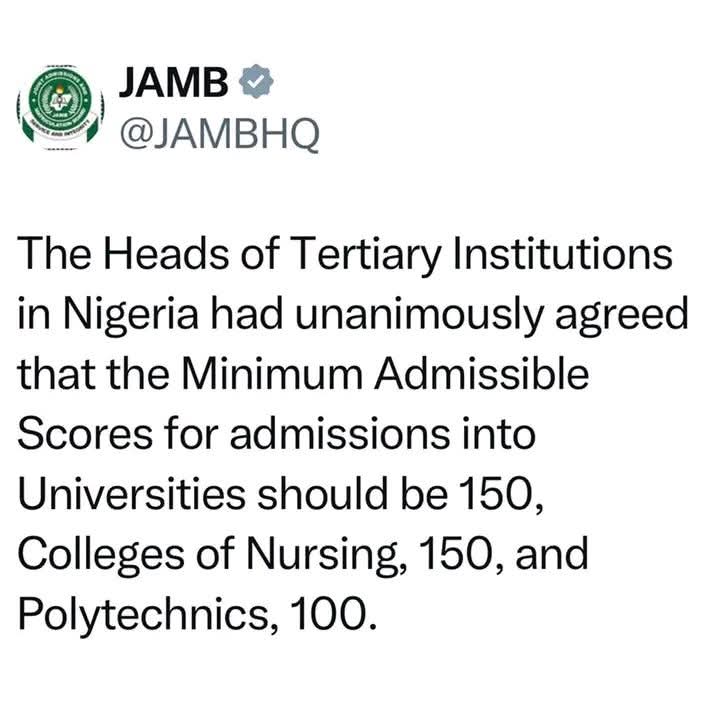


The recent decision by the Joint Admissions and Matriculation Board and heads of tertiary institutions to adopt 150 as the minimum admissible score for university admission has ignited intense debate across Nigeria’s education sector. While some education stakeholders view the move as a practical response to existing realities within the country’s learning system, others fear it signals a dangerous lowering of academic standards at a time when global competitiveness increasingly depends on educational quality and technical competence.



At the heart of the controversy is a troubling statistic. A score of 150 out of the total obtainable 400 in the Unified Tertiary Matriculation Examination translates to 37.5 percent.


\frac{150}{400}\times100 = 37.5\%
For many Nigerians, that figure is difficult to ignore. In most academic environments, a performance below 40 percent is generally considered weak. Consequently, critics have questioned whether candidates who answer barely over one-third of examination questions correctly should be regarded as academically prepared for university education.

The controversy becomes even more significant because universities are traditionally seen as centers of intellectual development, innovation, critical thinking, and professional training. Many fear that lowering admission benchmarks could gradually weaken the quality of graduates produced by the system. Already, concerns exist about declining reading culture, examination malpractice, poor foundational education, and inadequate infrastructure across many schools in the country. To critics, officially recognizing 150 as an acceptable benchmark may unintentionally normalize mediocrity within the academic environment.
However, supporters of the benchmark argue that the reality facing Nigeria’s education sector is far more complicated. National UTME performance statistics over the years have consistently revealed weak overall outcomes among candidates. A large percentage of students score below 200 annually. If institutions insist on significantly higher cut-off marks nationwide, many universities — especially newer federal, state, and private institutions — may struggle to meet admission quotas.
Educational inequality also remains a major concern. Students from rural communities, conflict-affected regions, and poorly funded public schools often compete under severe disadvantages compared to students from elite private schools in urban areas. For supporters of the lower benchmark, broader access to higher education represents an attempt to create opportunities for students who may possess potential but lack educational privilege.
Economic realities facing universities themselves cannot also be ignored. Many institutions depend heavily on tuition revenue for survival. Declining enrollment figures can create serious financial pressure, particularly for private universities. In such circumstances, broader admission access becomes not only an academic issue but also an institutional survival strategy.
Yet, beyond the controversy surrounding the cut-off mark itself lies a deeper crisis within Nigeria’s higher education system. Some analysts argue that the larger problem is not necessarily who gains admission into universities, but what happens after admission. Questions surrounding teaching quality, lecturer competence, curriculum relevance, research funding, laboratory facilities, and graduate employability remain central to the conversation about educational standards in Nigeria.
A student admitted with a relatively low UTME score could still excel academically if exposed to effective teaching, mentorship, strong academic support, and practical learning opportunities. Unfortunately, many Nigerian universities themselves continue to struggle with underfunding, infrastructural decay, overcrowded classrooms, and outdated learning facilities. Without addressing these structural weaknesses, simply raising admission cut-off marks may not necessarily improve educational quality.
The timing of the debate is also significant. The global economy is becoming increasingly driven by knowledge, technology, and innovation. Countries investing aggressively in artificial intelligence, engineering, biotechnology, software development, and advanced research are strengthening their educational systems to produce globally competitive graduates. Interestingly, Nigeria’s highest-performing UTME candidates increasingly gravitate toward disciplines such as Computer Science, Software Engineering, Medicine, Engineering, and Mechatronics. This suggests that many of the country’s brightest students already understand the importance of competing within a highly technological global economy.
Critics worry that lower admission benchmarks may widen the gap between Nigeria’s elite students and the broader university population. While students from wealthy backgrounds and high-performing schools may continue competing at international standards, average students could become trapped within a weakened local educational structure. Over time, this may create two parallel educational realities — a globally competitive elite class and a struggling mass university population.
Employers are also paying close attention to the situation. Many organizations already complain that graduates require extensive retraining before becoming productive in the workplace. Concerns persist about weak communication skills, poor analytical reasoning, and limited technical competence among some graduates. If admission standards continue to decline without corresponding improvements in learning quality, employers may increasingly rely on aptitude tests, certifications, and practical skills rather than university degrees alone when making recruitment decisions.
The debate over the 150 cut-off mark ultimately reflects a broader national dilemma: how to balance educational access with academic excellence. Nigeria, with its rapidly growing youth population, cannot afford to shut millions of young people out of higher education opportunities. Yet access without quality carries its own long-term dangers. Universities are expected to produce doctors, engineers, scientists, innovators, researchers, and policy leaders capable of driving national development. Weakening academic standards without strengthening institutional capacity risks undermining the future quality of these professions.

Ultimately, the controversy surrounding the 150 benchmark should serve as a wake-up call rather than merely an admissions debate. The deeper challenge lies in fixing the structural problems that continue to weaken educational outcomes across the country. Issues such as poor teacher quality, inadequate infrastructure, weak funding, examination malpractice, and ineffective foundational education require urgent attention. Without addressing these problems, Nigeria may continue struggling to produce graduates capable of competing effectively in an increasingly demanding global environment.
The future of higher education in Nigeria will not be determined solely by cut-off marks. It will depend on whether the country is willing to invest seriously in building an educational system that combines both accessibility and excellence in preparing young Nigerians for the realities of the modern world.














 EduTimes Africa, a product of Education Times Africa, is a magazine publication that aims to lend its support to close the yawning gap in Africa's educational development.