
























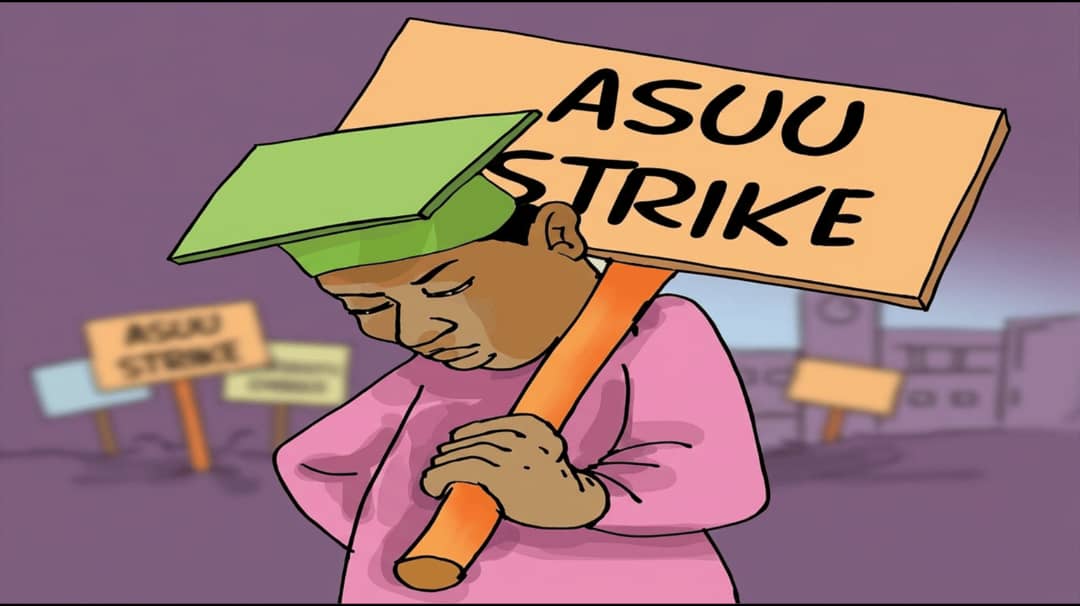


The Academic Staff Union of Universities has raised fresh concerns over the implementation of its December 2025 agreement with the Federal Government, warning that Nigeria’s public universities could face another round of industrial unrest if outstanding issues are not addressed.



In a statement issued on Monday by its president, Chris Piwuna, the union described the implementation process as “distorted and uncoordinated,” expressing dissatisfaction with what it called the government’s slow and selective compliance with agreed terms.

The position was part of resolutions reached at the union’s National Executive Council meeting held at Modibbo Adama University between May 9 and 10, 2026
ASUU noted that while it had maintained silence since the signing and public presentation of the agreement in January, recent developments compelled it to speak out.
“The momentum generated with the unveiling of the 2025 FGN-ASUU Agreement is fast waning and may soon be lost if the government’s promise to fully implement the agreement is not kept,” the union said.

A major concern raised by ASUU is the failure of the Federal Government to inaugurate the Implementation Monitoring Committee, which was meant to ensure smooth execution of the agreement and prevent bureaucratic delays.
The union also accused some federal universities of selectively implementing components of the agreement, particularly allowances such as the Consolidated Academic Tool Allowance, Earned Academic Allowance, and Professorial Allowance, instead of fully integrating them into the salary structure.
ASUU further alleged that only a few state governments have shown commitment to implementing the agreement, despite being part of the negotiation process.
It warned that growing frustration among lecturers could trigger fresh industrial action.
“The increasing frustration occasioned by the seeming government’s disinterestedness in the welfare of Nigerian academics is brewing a pent-up anger which could erupt into a new wave of industrial unrest if not addressed,” the union stated.
The agreement, which took effect on January 1, 2026, included a 40 per cent salary increase for academic staff in federal institutions, alongside provisions addressing funding, welfare, and university autonomy.
However, ASUU said several issues remain unresolved, including arrears of salary awards, promotion arrears, unpaid third-party deductions, salary shortfalls linked to the IPPIS system, and the withheld salaries from the 2022 strike.
The union also criticised delays in pension payments to retired lecturers, particularly in state universities, and accused the National Pension Commission of slowing the harmonisation process.

On policy matters, ASUU faulted the Federal Government’s proposed National Research and Innovation Development Fund, arguing that it does not align with provisions of the 2025 agreement, which recommends funding research with at least one per cent of Nigeria’s GDP.
The union questioned the decision to denominate the proposed fund in dollars, raising concerns about possible external borrowing.
ASUU also opposed several recent education policy directions, including the reversal of the mother-tongue policy in early education, the proposed establishment of a foreign university campus in Nigeria, and the compulsory enrolment of academics into the Nigeria Education Repository Databank.

It described these moves as threats to academic autonomy and national development.
The union further criticised what it termed increasing maladministration in universities, alleging the creation of questionable academic positions and lack of transparency in governance.
ASUU called on Bola Ahmed Tinubu to intervene urgently to resolve lingering issues and prevent a breakdown of industrial peace in the university system.
The warning comes weeks after the Minister of Education, Tunji Alausa, declared that strikes in Nigeria’s tertiary institutions had become a thing of the past, assuring that universities would remain open.
Despite those assurances, ASUU insisted that failure to fully implement the agreement could reverse recent gains and plunge the sector into another cycle of disruption.
Credit: ThePunch













 EduTimes Africa, a product of Education Times Africa, is a magazine publication that aims to lend its support to close the yawning gap in Africa's educational development.