





















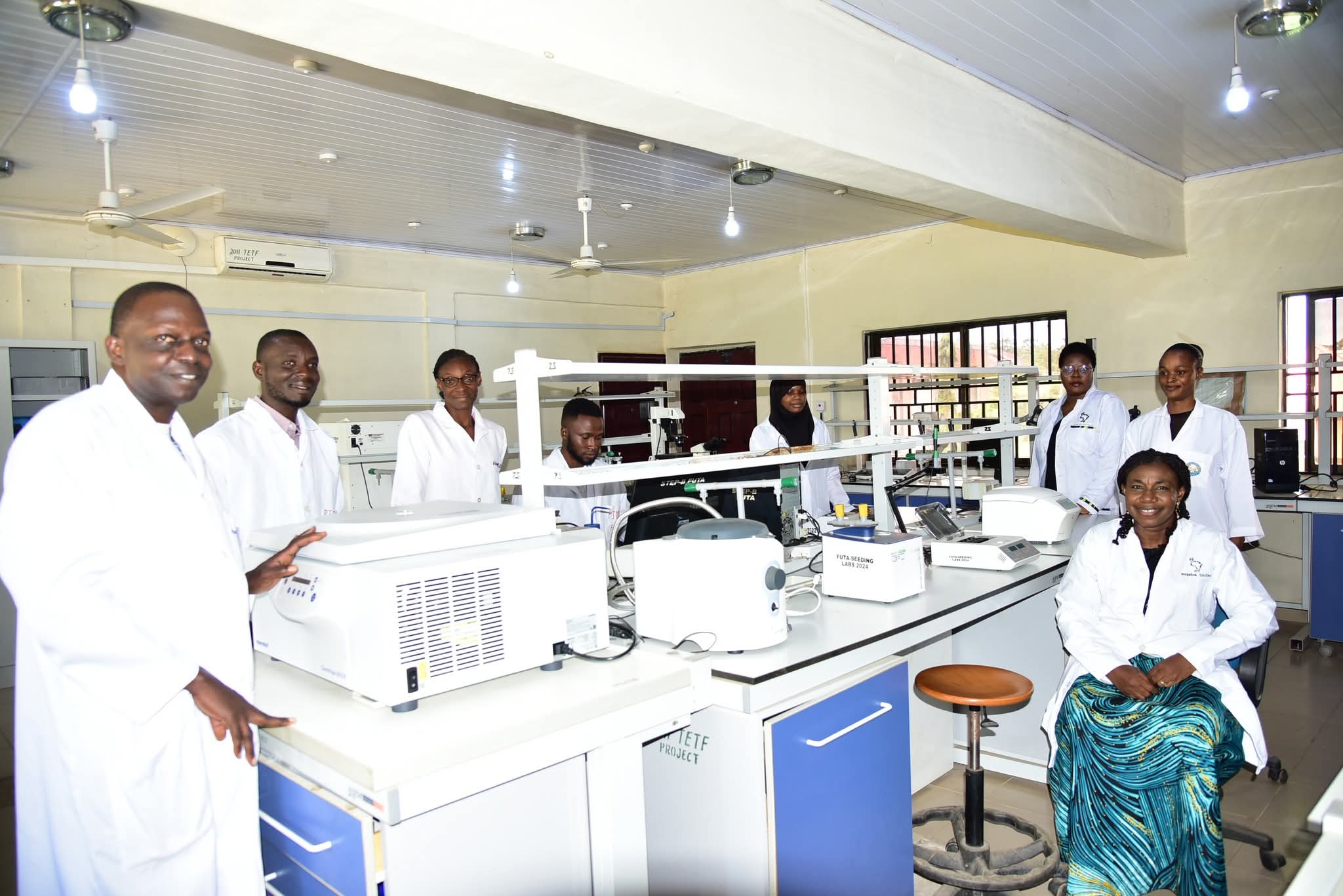


The Federal University of Technology Akure (FUTA) has commemorated the World Laboratory Day with a seminar at the Central Research Laboratory (CRL) on April 27, 2026. The global observance, held annually on April 23, recognizes the pivotal role of laboratories as engines of scientific discovery, innovation, and sustainable development. In aligning with this global mandate, FUTA’s CRL used the occasion to showcase its contributions to research translation and to reaffirm its commitment to driving impact from ideas.
Delivering the keynote lecture during the maiden meeting of the Inter School Research Lab Committee themed “From Ideas to Impact: The Role of the Laboratory in Driving Innovation and Development,” Director of the Central Research Laboratory (FUTA), Professor Folasade Olajuyigbe, provided an overview of the mandate and scope of the CRL, highlighting its role as a multidisciplinary hub for advanced scientific investigation. She addressed common misconceptions about the facility, noting that many perceive it as just a large building with unclear functions or question whether its equipment are operational. She firmly stated that the Research Lab is fully functional, with state-of-the-art equipment actively supporting research across the University which is a testament to the day’s call to recognize laboratories as active drivers of progress.
The concept of the Central Research Laboratory, she explained, arose from the need to achieve cost-effectiveness in the provision of advanced research infrastructure. She stated that rather than duplicating expensive equipment across individual schools, the Research lab was established as a centralized facility to support academics, investigators, and researchers across FUTA, reflecting the collaborative and resource-sharing ideals that International Laboratory Day promotes globally.
The Director also noted that the research laboratory is not restricted to a particular school or to staff alone, but is designed to serve all within the University, while encouraging schools that have not yet fully utilized the CRL’s services to communicate their research needs so that relevant equipment and support can be made available.
Echoing the theme of this year’s World Laboratory Day, Professor Olajuyigbe cautioned against conducting research merely to accumulate degrees or publications and urged researchers to ensure that, beyond academic outputs, their work creates tangible impact in the society. Research outputs, she said, must not remain on shelves; they must evolve into prototypes, patents, policies, startups, and practical solutions. She stated that globally leading universities have demonstrated that strong laboratory systems drive innovation ecosystems, and Nigeria faces urgent challenges in food security, energy, health, and industrial development. She stated that FUTA, through the Central Research Laboratory, is well positioned to respond to these challenges, and by aligning its work with national priorities, the University can reduce dependence on imported technologies and stimulate homegrown innovation which is a direct response to the global charge of International Laboratory Day to harness laboratories for sustainable development.

The Director stated that to achieve this, the CRL is strengthening interdisciplinary collaboration across schools, including Engineering, Science, Environmental Technology, Agriculture, and Life Sciences, because powerful solutions often emerge at these intersections adding that at the same time, it is building platforms for engagement with industry, government, and development partners to align research with user needs and national priorities, thereby increasing the likelihood that research outcomes will be adopted and sustained.
She emphasized that as part of strengthening its operations, the Central Research Laboratory has constituted an Inter-School Research Committee with representation from all schools of the University. The committee, she explained, will enhance coordination, improve responsiveness to research needs, and deepen progress across the University.

Professor Olajuyigbe said that the Central Research Laboratory is more than a collection of equipment; it is a platform for generating value, and every facility within the CRL represents an opportunity to address real-life challenges and that to this end, the Central Research Lab is committed to fair and transparent access to its facilities, supported by efficient scheduling systems and strong technical services with principles that resonate with International Laboratory Day’s emphasis on equitable access to scientific infrastructure.
While outlining the structure of the CRL, she explained that it comprises four distinct units designed to service the diverse research needs of FUTA: the Analytical Laboratory, the Bioresearch Laboratory, the Nutritional Laboratory, and the Diagnostic Laboratory.
Professor Olajuyigbe listed some of the key equipment currently in use in the listed laboratories to include spectrophotometer, rapid physical analyzer, two new refrigerated centrifuges, vertical and horizontal gel systems, the Nutritional Laboratory, freeze dryer, bomb calorimeter for energy determination, Soxhlet apparatus, water distiller, hematology analyzer, a 50-liter autoclave for sterilizing equipment, glassware, static incubator, and tissue flotation bath for histology, among others.

In the spirit of International Laboratory Day’s call to sustain and strengthen laboratory capacity, Professor Olajuyigbe appealed to the university community to increase patronage of the Research Lab, stressing that analyses are offered at affordable rates noting that the modest charges are essential for maintaining the equipment, as institutional funding alone is insufficient.
She further emphasized that the CRL is investing heavily in capacity building, because sophisticated equipment without skilled users cannot deliver impact which is a concern central to International Laboratory Day’s focus on human capital in science.
She concluded by stating that for two years, the CRL has organized an Annual Research Seminar, and this year’s edition is planned to hold after the maiden meeting of the Internal Research Committee to ensure that the training reflects the actual needs of the various schools of the University and plans are underway to ensure that capable hands will be on ground to ensure the equipment are optimally managed.

Speaking at the Inter-School Research Committee meeting , Dr. Oluwayemisi Aderibigbe, a lecturer from the School of Logistics and Innovation Technology (SLIT), observed that most of the equipment cuts across fields in the Sciences and Life Sciences and stressed the importance for the Research Lab to consider the diverse needs of all schools.
Dr Aderigbigbe pointed out that there are departments with specific equipment needs that could benefit from the CRL and that the laboratory cannot acquire every specialized instrument and recommended that the CRL prioritizes equipment with broad, cross-cutting relevance so that every school can be a beneficiary.
Dr. Aderibigbe acknowledged the Director’s earlier comment that a special rate exists for students on the use of the Laboratory’s equipment and stressed that affordability is key to attracting users, especially students, who often struggle to fund quality research due to the high cost of analysis in developing countries. She therefore appealed that student rates be kept at a level that they can easily afford, while encouraging them to freely access the Lab to carry out their research.
She also suggested that service charges should be significantly discounted compared to external rates and argued that preferential pricing for FUTA staff would increase patronage and reinforce the sense of ownership and value of the Central Research Laboratory.
Also speaking at the event, a lecturer at the School of Basic Medical Sciences (SBMS), FUTA, Dr. Titi Ologunagba emphasized the need for aggressive awareness to improve the visibility of the Laboratory noting that many members of the University community remain unaware of the existence and functions of several equipment housed in the CRL. To address this, she suggested producing short videos to showcase the equipment and explain the operations, the kind of results expected, and the types of analysis that can be carried out with them adding that such videos could be shared on platforms like Facebook to reach a wider audience and create awareness that the equipment are available.
Dr. Ologunagba further proposed that once awareness is created, the CRL should organize targeted workshops to train people on how to use the equipment, focusing on one instrument at a time. She stated that participants would be willing to pay to learn how to use the equipment, and such workshops would enable laboratory scientists and technologists to gain hands-on knowledge, thereby enhancing utilization and maximizing the value of the facility.












 EduTimes Africa, a product of Education Times Africa, is a magazine publication that aims to lend its support to close the yawning gap in Africa's educational development.