


























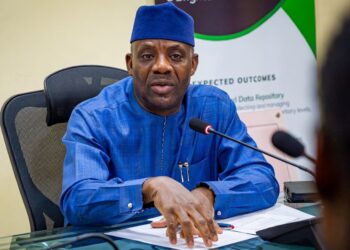
A journalism lecturer at Crescent University, Abeokuta, Dr Kola Adesina, has proposed a new education framework known as MASHET, arguing that it offers a more balanced approach to learning than the widely adopted STEAM model.



According to Adesina, MASHET stands for Maths, Arts, Science, Humanities, Engineering and Technology, and is designed to address what he describes as key gaps in STEAM, which stands for Science, Technology, Engineering, Arts and Mathematics.

The lecturer unveiled the framework through a post on his LinkedIn page, where he outlined the thinking behind the new model.
“For 20 years we’ve pushed STEAM, which stands for Science, Technology, Engineering, Arts and Maths. STEAM got us far. But it has three blind spots,” he wrote.

STEAM was officially introduced in Nigeria as a federal initiative in 2023 when pilot projects were launched across Adamawa, Ebonyi, Nasarawa, Ondo, Rivers and Sokoto states.
Adesina argued that Mathematics is wrongly placed at the end of the STEAM acronym despite serving as the foundation for other disciplines.
According to him, Mathematics should come first because it provides the language and framework upon which science, engineering and technology are built.
He also questioned the way Science and Technology are often grouped together, noting that scientific research and technological application are fundamentally different fields.

Another concern raised by the lecturer is the absence of the Humanities as a clearly defined component of the model.
While STEAM includes Arts, Adesina said the term is often associated mainly with design and creative disciplines, leaving out subjects such as history, philosophy, ethics and journalism.
“So I coined MASHET: Maths, Arts, Science, Humanities, Engineering, Technology,” he wrote.

Explaining the structure of the framework, Adesina said the Humanities deserve a central place in modern education, especially as technology and artificial intelligence continue to shape society.
“The Humanities are explicit because AI ethics, storytelling, critical thinking aren’t extras. They’re core,” he stated.
He further argued that separating Science from Technology acknowledges the different roles played by researchers who generate knowledge and technologists who apply it to solve real-world problems.
According to him, unlike STEAM, which he described as “STEM plus one add-on,” MASHET gives equal importance to all six disciplines.
“STEAM taught us how to build,” he wrote. “MASHET teaches us what to build, and why it matters to humans.”
Adesina said his background in journalism influenced the framework’s emphasis on ethics, context and human-centred innovation.
“Journalism taught me that facts without context are noise. Tech without ethics is dangerous,” he wrote.
The proposal comes amid growing global conversations about how education systems can better prepare students for a future shaped by technology, creativity, critical thinking and ethical decision-making.
While MASHET is still a personal proposal, it has added a new perspective to ongoing debates about what skills students need most in the 21st century.










 EduTimes Africa, a product of Education Times Africa, is a magazine publication that aims to lend its support to close the yawning gap in Africa's educational development.