


























FG Targets 15 Million Out-of-School Children with Data-Driven Reforms



The Federal Government has intensified efforts to address Nigeria’s out-of-school children crisis, unveiling a data-driven strategy aimed at returning an estimated 15 million children to the classroom.

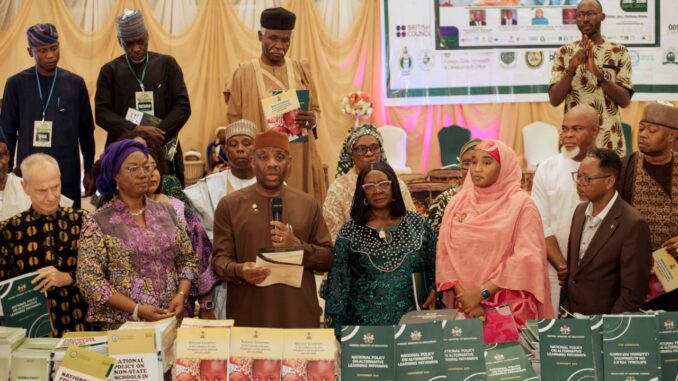
This commitment was reinforced at the 2026 Basic Education in Nigeria Bootcamp held in Jos, where policymakers, development partners, and key stakeholders convened to chart practical solutions for improving access, retention, and learning outcomes across the basic education sector.
Speaking at the event, the Minister of Education, Maruf Tunji Alausa, emphasised that credible data and effective learner tracking systems are essential to solving long-standing challenges in the sector. He noted that understanding where children are and why they are out of school is critical to designing targeted interventions.

“Reliable data remains the backbone of effective education reform. Without knowing where the children are and why they are out of school, meaningful solutions cannot be implemented,” he said.

To strengthen planning and accountability, the Federal Ministry of Education is expanding the Digital National Education Management Information System (NEMIS) and accelerating the rollout of the Learner Identification Number (LIN), enabling real-time tracking of learners nationwide.
Findings from the 2025/2026 Annual School Census, which has already captured over two million learners, are expected to guide enrolment strategies and policy decisions. The government has also mapped nearly one million out-of-school children for reintegration into formal education and alternative learning pathways.
The Minister highlighted ongoing investments supporting the reforms, noting that over ₦106 billion in Universal Basic Education Commission matching grants has been accessed by states between January 2025 and January 2026. Additionally, ₦22 billion has been committed to teacher development, resulting in the training of about 978,000 teachers nationwide. More than 10,000 classrooms have also been renovated, while 7.8 million textbooks have been distributed to improve learning conditions.
Efforts to reach vulnerable groups are being expanded through strengthened Almajiri and non-formal education programmes. So far, 1,400 Tsangaya teachers have been trained, 119 learning centres identified nationwide, and 760 enumerators deployed to improve grassroots data collection and planning.

In her remarks, the Minister of State for Education, Suwaiba Said Ahmad, described the Bootcamp as a critical platform for tackling persistent gaps in the education system. She noted that initiatives such as LUMINA 2030, EduRevamp, Skill-Up, and Communities of Practice are designed to enhance curriculum delivery, strengthen teacher capacity, and expand digital learning nationwide.
Also speaking, Plateau State Governor, Caleb Mutfwang, warned that the out-of-school crisis poses significant social and economic risks, including poverty, insecurity, and exclusion. Represented by Deputy Governor Josephine Piyo, he outlined ongoing efforts by the state to improve learning environments through infrastructure upgrades and provision of essential resources.
Delivering the lead paper, education expert Titus Syengo described the crisis as a national emergency, noting that Nigeria’s education challenges have wider implications for Africa due to the country’s scale and influence. He urged stakeholders to prioritise foundational learning and adopt locally relevant, Afrocentric approaches.
The Federal Ministry of Education reiterated that sustained investment, credible data systems, and coordinated national action remain central to achieving inclusive and equitable education for all Nigerian children.












 EduTimes Africa, a product of Education Times Africa, is a magazine publication that aims to lend its support to close the yawning gap in Africa's educational development.