























The Federal Ministry of Education has hailed the improved performance of Nigerian universities in the 2026 Times Higher Education (THE) World University Rankings and the Times Higher Education Sub-Saharan Africa University Rankings, describing it as evidence that ongoing education reforms are yielding measurable results.



In a statement issued on Friday by the Director of Press and Public Relations, Mrs. Folasade Boriowo, the ministry said the achievement reflects the impact of President Bola Ahmed Tinubu’s Renewed Hope Agenda and the Nigerian Education Sector Renewal Initiative (NESRI).

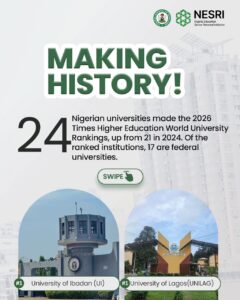
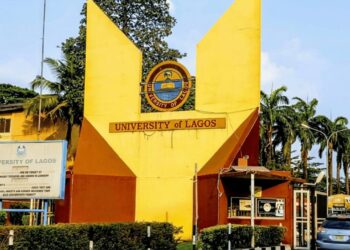
According to the ministry, the latest rankings placed the University of Ibadan and the University of Lagos among Nigeria’s highest-ranked universities, while Bayero University Kano emerged as one of the country’s top-performing institutions.
The statement noted that Nigeria increased its representation in the global rankings from 21 universities in 2024 and 2025 to 24 institutions in 2026, making it the most represented country in Sub-Saharan Africa.

It added that 17 of the ranked institutions are federal universities, a development attributed to improvements in research, innovation, quality assurance, governance, digital transformation, infrastructure and human capital development.
Reacting to the rankings, the Minister of Education, Dr. Maruf Tunji Alausa, said the results demonstrate the growing impact of government efforts to reposition higher education as a catalyst for national development.

“These rankings are more than numbers; they show that our universities are strengthening their global standing and that investments in education are yielding measurable results. They reflect the dedication of our institutions and stakeholders to advancing teaching, research and innovation,” he said.
Alausa described the rankings as credible international validation of ongoing efforts to strengthen institutions, improve governance and promote academic excellence across the education sector.
He commended the University of Ibadan, the University of Lagos, Bayero University Kano, Covenant University, Landmark University, Ahmadu Bello University and other ranked institutions for their contributions to teaching, research, innovation and national development.
The minister said Bayero University Kano’s performance further demonstrates that academic excellence is expanding across different regions of the country.
He noted that the progress recorded reflects the collective efforts of both public and private universities, adding that it reinforces growing confidence in Nigeria’s higher education system.
Alausa also disclosed that, in addition to the 24 institutions officially ranked in 2026, another 27 Nigerian universities submitted data for assessment, indicating a growing commitment to accountability, institutional benchmarking and adherence to global standards.
Highlighting the role of universities in economic development, the minister said Nigeria accounts for about 28 per cent of Africa’s fintech companies, underscoring the importance of higher education in producing the skilled workforce, research and innovation needed to drive economic growth and global competitiveness.
The ministry expressed appreciation to President Tinubu for his continued support for education sector reforms and commended university governing councils, managements, academic staff, students and other stakeholders for their contributions to strengthening Nigeria’s higher education system.

It reaffirmed its commitment to implementing NESRI and other strategic initiatives aimed at improving quality, expanding access, promoting research and innovation, and positioning Nigeria’s education sector among the most competitive in Africa and globally.











 EduTimes Africa, a product of Education Times Africa, is a magazine publication that aims to lend its support to close the yawning gap in Africa's educational development.