




























A Nigerian entrepreneur and business leader, Taopheek Babayeju, has warned that Africa is gradually slipping into a human capital crisis driven by emigration, declining educational standards, weak work ethics, and poor institutional investment in talent development.



Babayeju made the assertion while reacting to recent comments by Tosin Eniolorunda, who revealed that Moniepoint was struggling to fill more than 500 job vacancies due to a shortage of qualified and globally competitive professionals in Nigeria.

Speaking on the growing debate sparked by Eniolorunda’s remarks at The Platform event in Lagos, Babayeju said many critics failed to understand the deeper issue confronting businesses across Africa.
According to him, the continent is not suffering from a lack of population or ambition, but from an increasing inability to deliberately build, retain, and sustain globally competitive human capital.

“The problem is no longer just unemployment,” he said. “It is increasingly becoming unemployability and underdevelopment of talent.”
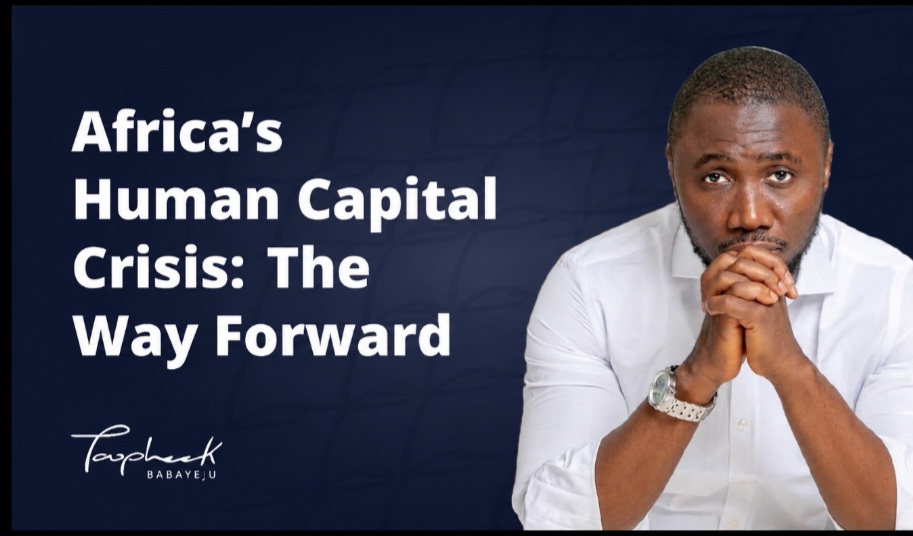
Babayeju identified five major factors fueling the crisis, including the migration of experienced professionals abroad, declining educational quality, weak workplace discipline, unrealistic career expectations among young professionals, and poor investment in employee development by organizations.
On emigration, he noted that African institutions are steadily losing experienced professionals in sectors such as healthcare, technology, finance, engineering, and education, creating leadership and mentorship gaps within organizations.
“What is leaving the continent is not just manpower, but experience, institutional memory, leadership maturity, technical depth, mentorship capacity, and execution discipline,” he stated.

He warned that many organizations are now forced to recycle underprepared talent and lower performance expectations due to the shortage of experienced professionals.
Babayeju also expressed concern over what he described as a growing culture of “visibility before competence,” arguing that social media has created unrealistic expectations among young people who now seek rapid success without undergoing the process of mastery and professional development.
“Too many people now want influence without substance, leadership without preparation, and rewards without endurance,” he said.
On education, the entrepreneur lamented the widening disconnect between academic training and industry realities, stressing that many graduates lack critical thinking ability, communication skills, workplace readiness, and practical execution capability.
He called for stronger collaboration between academic institutions and industries, alongside greater emphasis on technology, innovation, entrepreneurship, and practical learning.
Babayeju further accused some organizations of contributing to the crisis by underinvesting in employee training, mentorship, leadership development, and knowledge-sharing systems.
According to him, institutions that fail to deliberately invest in people would remain fragile and overly dependent on a few individuals.

Despite the challenges, Babayeju expressed optimism about Africa’s future, saying the continent still possesses exceptional young people committed to learning, growth, and value creation.
“Africa’s future will not be determined by population size alone. It will be determined by the quality, competence, discipline, and mindset of its people,” he said.
He added that if Africa succeeds in building human capital intentionally, its greatest resource would ultimately be its people rather than natural resources.














 EduTimes Africa, a product of Education Times Africa, is a magazine publication that aims to lend its support to close the yawning gap in Africa's educational development.