




















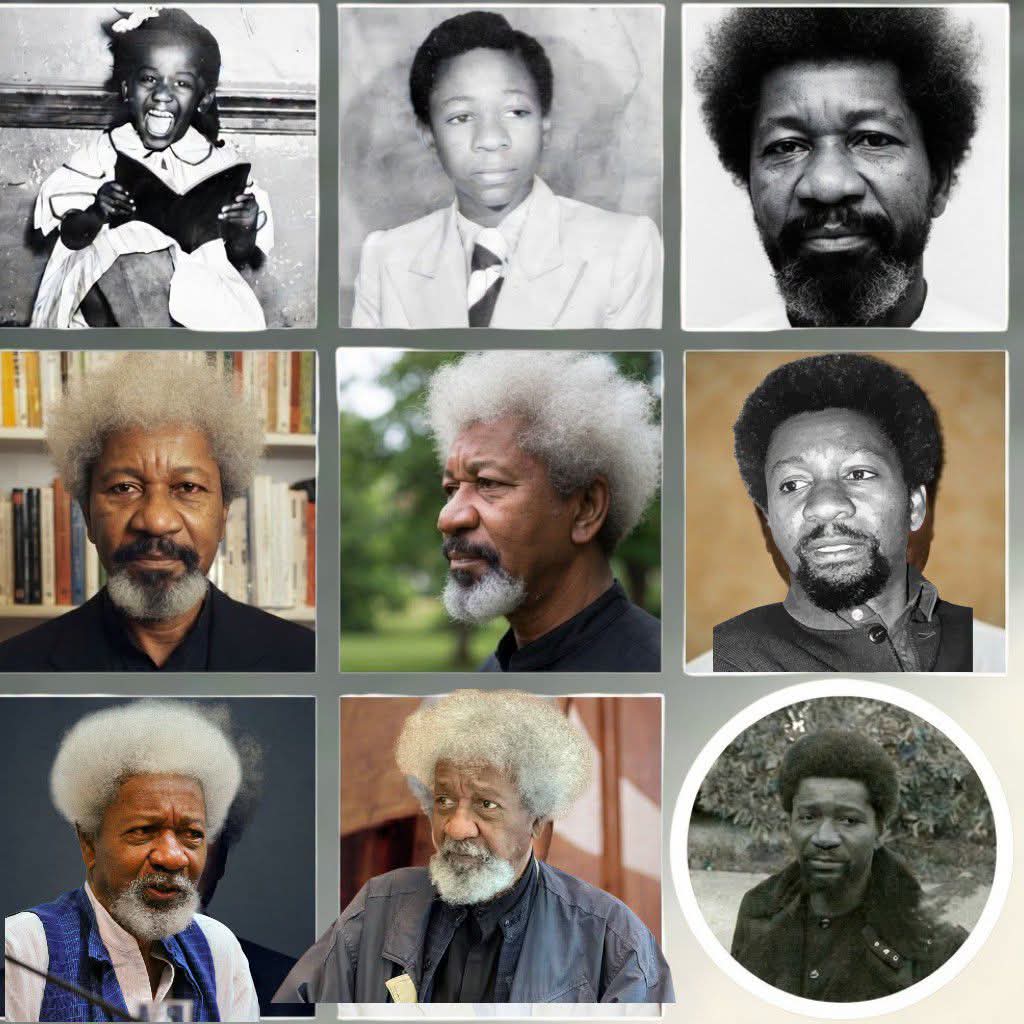


Today, Professor turns 92. While many know him as Africa’s first Nobel Prize winner in Literature, his life extends far beyond the famous award. It is a story of courage, activism, scholarship, creativity, and an unwavering commitment to justice.
Here are some fascinating facts that explain why Soyinka remains one of Africa’s most influential intellectuals.

Born into a family that valued education
Soyinka was born on July 13, 1934, into a family of educators in Abeokuta, Ogun State. His father was a school headmaster, while his mother, Grace Eniola Soyinka, popularly known as “Wild Christian,” was a teacher and prominent social activist. Their influence shaped his lifelong passion for learning and social justice.

He risked his freedom for democracy
In 1965, during the Western Region political crisis, Soyinka entered a radio station in Ibadan and replaced a recorded political broadcast with a message urging that the genuine election results be respected. The daring action made him one of Nigeria’s most fearless public intellectuals.
He endured nearly two years in solitary confinement
During the Nigerian Civil War, Soyinka attempted to mediate between the Federal Government and Biafran leaders in pursuit of peace. Instead, he was arrested and detained without trial, spending about 22 months in solitary confinement.
He refused to let prison silence his voice
Despite harsh prison conditions, Soyinka continued writing. Unable to access proper writing materials, he recorded his thoughts on tissue paper, cigarette packets, and any scraps he could hide from prison authorities. These experiences later inspired some of his most powerful writings.
His full name carries deep cultural roots
Many simply know him as Wole Soyinka, but his full name is Akinwande Oluwole Babatunde Soyinka.
Theatre became his platform for social change
As a young playwright, Soyinka founded the 1960 Masks theatre group, which later evolved into the Orisun Theatre Company. Through drama, he challenged injustice, corruption, and abuse of power.
He chose independence over political honours
Over the years, Soyinka has declined some national honours, maintaining that intellectuals should preserve their independence and remain free to criticise governments when necessary.
He lived in exile under military rule
During the dictatorship of General Sani Abacha, Soyinka was accused of treason. He fled Nigeria through dangerous routes and lived in exile, continuing his advocacy for democracy until civilian rule returned.
His influence extends beyond original writing
Soyinka is also an accomplished translator, bringing Yoruba literary works and Greek tragedies to wider audiences through English translations.
A global teacher
His academic career has taken him to universities across Africa, Europe, and North America, where he has taught literature, drama, and creative writing, influencing generations of students and scholars.
A family man who enjoys cooking
Away from public life, Soyinka enjoys preparing meals for family and friends, revealing a quieter side that contrasts with his image as a fearless activist.
His childhood memoir remains a classic

His autobiography, Aké: The Years of Childhood, is widely regarded as one of Africa’s greatest memoirs. It offers readers a vivid account of growing up in colonial Nigeria.
He has survived decades of threats
His outspoken criticism of dictatorships and authoritarian governments has exposed him to assassination threats and political persecution, yet he has remained steadfast in speaking truth to power.
Still active at 92
Even in his nineties, Soyinka continues to write books, deliver lectures, publish essays, and engage in debates on democracy, governance, culture, and human rights.
Why his Nobel Prize mattered
In 1986, Wole Soyinka became the first African to receive the Nobel Prize in Literature, a historic achievement that placed African literature firmly on the global stage and inspired generations of writers across the continent.
At 92, Professor Wole Soyinka’s legacy continues to remind Africa and the world that literature is not merely about storytelling—it is also a powerful instrument for defending truth, justice, freedom, and human dignity.
Happy 92nd Birthday to one of Africa’s greatest literary icons.You can also adapt this into a newspaper feature, Facebook explainer, or magazine-style article if you want a different presentation.











 EduTimes Africa, a product of Education Times Africa, is a magazine publication that aims to lend its support to close the yawning gap in Africa's educational development.